Strategic Advantage of 3D Printing in a Time of Import Tariffs



The value of 3D printing in mitigating the impact of import tariffs is often underestimated. Now is the time to leverage 3D printing to adapt and profit from the opportunities created by these tariffs.
As tariffs evolve, 3D printing (3DP) emerges as a transformative solution. Industry professionals recognize that the manufacturing sector often underuses 3D printing, despite its ability to produce products faster and more cost-effectively—particularly when relocating production.
Industries should fully embrace 3D printing (also known as Additive Manufacturing, or AM) in order to adjust to today’s shifting supply chain conditions. Companies that adopt AM can accelerate the transition of production to the USA by integrating 3D printing across their manufacturing processes. Today’s printers can produce high-quality, end-use parts, and even functional tooling in days—much faster than traditional methods. For example, technologies like HP 3D’s Multi Jet Fusion (MJF) Technology are producing final use parts in markets ranging from drones to healthcare.
This article explores how 3D printing can address the financial impact of tariffs, boost competitiveness, and foster innovation. I will share real-world examples that demonstrate how 3DP technology and 3D-printed parts, in manufacturing and design, can help companies reduce costs and improve quality.
With recent tariff increases on a broad range of imported goods, shouldn’t you seize every advantage of 3D printing to minimize the impact?
1. Cost Reduction Through Localized Manufacturing
One of the key benefits of 3D printing is its ability to enable localized manufacturing. By producing goods domestically, companies can avoid import tariffs and reduce reliance on overseas suppliers. When considering the total cost of manufacturing, it’s essential to account for tariff-related cost increases. Additive manufacturing (AM) plays a pivotal role in transitioning to local production. Re-tooling and creating fixturing for a fully designed product can take weeks or even months, which can be a significant financial burden. However, there are AM materials and technologies that provide tooling, fixturing, and functional parts in a fraction of the time.
- Traditional manufacturing often relies on complex global supply chains vulnerable to changing tariffs. 3D printing allows businesses to produce components on-demand, bypassing import-related costs and delays.
Benefits of 3D-Printed Parts: 3D-printed parts can replace traditionally cast or machined components, such as brackets, housings, or connectors. For example, manufacturers can print custom brackets for machinery on-site rather than sourcing them from overseas suppliers. With high-strength materials like carbon-fiber-reinforced polymers, these printed parts match, or exceed, the durability of traditionally manufactured alternatives.
Example: General Electric (GE) leveraged 3D printing to produce jet engine fuel nozzles domestically. Previously assembled from 20 parts, the 3D-printed version reduced assembly time and eliminated the need for imports of individual components. GE reported a 75% cost reduction per nozzle, saving millions annually while sidestepping import duties.
2. Flexibility in Design and Rapid Prototyping
3D printing enables companies to quickly adapt to changing market demands or regulations, without the need for costly retooling or long lead times. Along with localizing manufacturing, now is the time to revise and improve existing designs. This process often requires time, samples, testing, prototypes, and final approval—all of which can be accelerated by 3D printing. 3D-printed parts are no longer just for visualization; they’re now used as customer-contact parts in industries such as automotive, aerospace, and healthcare.
- In a tariff-driven market, adaptability is key. Tariff-induced cost pressures can shift market dynamics, requiring rapid design changes to maintain profitability.
Benefits of 3D-Printed Parts: During product design and prototyping, 3D-printed parts allow engineers to test functionality and fit without waiting for molds or tooling to be produced. This drastically reduces lead times and can save companies hundreds of thousands of dollars. Furthermore, 3D-printed jigs, fixtures, and tooling can accelerate production line setup, generating savings at every step.
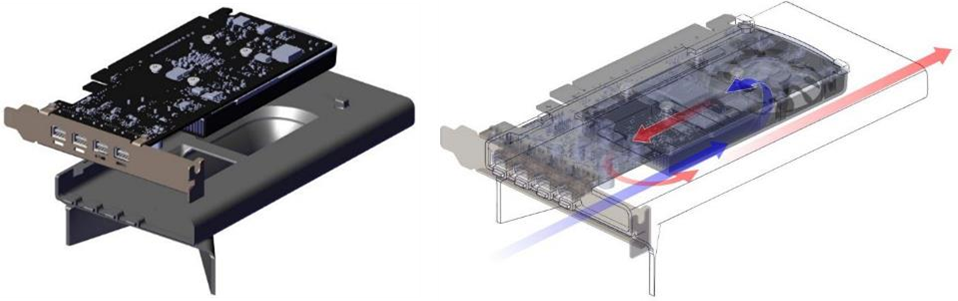
Example: NCS Technologies develops custom and ruggedized servers for military use, with uncompromising requirements. By developing tailored cooling channels using HP’s Multi Jet Fusion Technology , NCS was able to improve the SWaP-C (Size, Weight, Power, and Cost), while maintaining thermal performance and noise limitations on these Mil-Spec systems.
3. Reduction of Inventory and Storage Costs
Additive manufacturing enables just-in-time (JIT) production, eliminating the need for large inventories that are often subjected to tariffs when shipped internationally.
- Holding excess inventory ties up capital and exposes businesses to tariff risks when importing goods. 3D printing addresses these challenges by enabling parts to be produced on-demand.
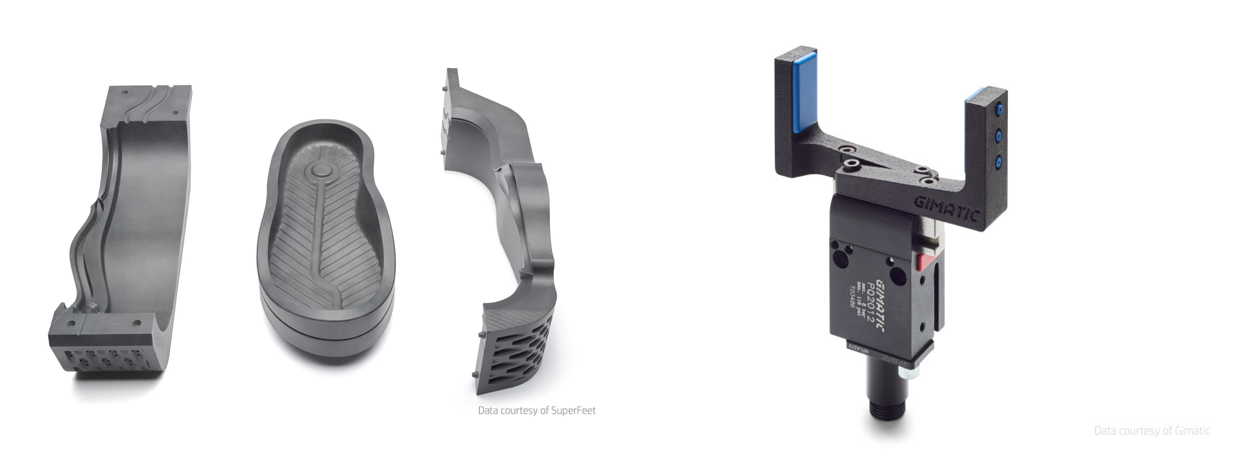
Specific Use of 3D-Printed Parts: Spare and replacement parts for machinery can be printed as needed rather than stockpiled. Companies can also replace traditional injection-molded components with 3D-printed versions for low-volume or custom applications.
Example: Siemens Mobility adopted 3D printing to produce replacement parts for trains. Previously, spare parts were imported and stored in warehouses for years. By 3D printing on demand, Siemens reduced inventory costs by 85% and avoided import tariffs, leading to significant savings.
4. Enhanced Supply Chain Resilience
Global disruptions, such as tariffs or geopolitical tensions, can severely impact traditional supply chains. 3D printing enables decentralized production, making supply chains more resilient. While the global marketplace offers cost advantages, it also increases risks. Having additive manufacturing equipment in place can mitigate these risks by enabling on-demand production of finished parts.
- Diversifying production capabilities reduces dependence on foreign suppliers, mitigating risks related to tariffs, shipping delays, or raw material shortages.
Benefits of 3D-Printed Parts: Critical components, such as turbine blades, heat exchangers, and medical devices, can be produced closer to end-use locations. 3D printing also allows companies to create tooling, such as molds and dies, without waiting for international shipments.
Example: A study by Deloitte found that companies using 3D printing during the COVID-19 pandemic reduced lead times by 70% compared to those relying on traditional supply chains. This resilience is increasingly vital as tariffs exacerbate supply chain vulnerabilities.
5. Environmental and Sustainability Benefits
3D printing can support sustainability goals by reducing transportation needs and material waste, which also has financial benefits. Additive manufacturing systems can produce parts in plastic or metal with minimal waste. While traditional manufacturing methods require large blocks of material to be machined, 3D printing can significantly reduce scrap and environmental impact.
- Low-waste production not only saves on material costs but also on disposal fees. Domestic production can reduce carbon emissions from shipping and take advantage of incentives for environmentally sustainable manufacturing practices.
Benefits of 3D-Printed Parts: Lightweight components, such as aerospace brackets and vehicle parts, can be printed to reduce material usage and fuel consumption. Additionally, 3D printing generates minimal waste compared to subtractive manufacturing methods like CNC machining.
Example: Adidas used 3D printing for its “Futurecraft” line of shoes, producing them domestically. This approach reduced shipping costs and emissions while appealing to eco-conscious consumers. Adidas reported a 50% increase in customer satisfaction for these sustainably produced products.
Conclusion
In a world where tariffs on imported goods are constantly evolving, 3D printing presents a strategic advantage by lowering costs, enhancing flexibility, and fortifying supply chains. Companies that adopt additive manufacturing not only reduce financial risks but also establish themselves as leaders in innovation and sustainability.
By embracing localized production, rapid prototyping, and just-in-time manufacturing, industries can thrive in a tariff-driven economy. The experiences of companies like NCS, Technologies, GE, Siemens, and Adidas showcase the tangible benefits of 3D printing, proving that it’s not just a tool for cost-saving but a critical investment for businesses navigating the complexities of global trade. As tariffs reshape global commerce, 3D printing stands as a beacon of adaptability and efficiency for the future of industry.
Having worked extensively in both manufacturing and 3D printing, I’ve seen firsthand how 3D printers can pay dividends well beyond the initial investment. Today’s 3D printers—empowered by cutting-edge materials and technology from world class OEMs like HP Additive Manufacturing Solutions and others—are true multipliers of value, offering a range of applications that extend well beyond traditional manufacturing.
If you’re concerned about supply chain disruptions, or the rising costs of import tariffs, now is the time to act. Reach out to NCST (3DSales@ncst.com), HP Additive Manufacturing Solutions, or other professionals in the 3D printing industry to explore how additive manufacturing can help you mitigate risks and capitalize on new opportunities arising from these changing tariffs. The time to expand your use of 3D printing is now—waiting will only cost you more.
About the Author:
Jeffery Freeman is the Director of 3D for NCS Technologies.
Subscribe to Our Email Newsletter
Stay up-to-date on all the latest news from the 3D printing industry and receive information and offers from third party vendors.
Print Services
Upload your 3D Models and get them printed quickly and efficiently.













You May Also Like
Russia’s 3D Printed Missiles & Can NATO Get Its Act Together?
For most of US history, however much the two major parties differed on domestic policy (in some cases a lot, overall less than you’d think), there was always essentially a...
3D Printing News Briefs, October 21, 2026: Digital Twins, AI CAD Service, AR Smart Glasses, & More
In today’s 3D Printing News Briefs, America Makes announced the winners of its MIAMI Project Call, and AM Europe released a new report. Artec 3D launched its new Artec Twins...
3D Printing News Briefs, October 10, 2026: Drones, WAAM, Ceramics, & More
We have a packed 3D Printing News Briefs for you this weekend! First, America Makes celebrated the recent National Manufacturing Day with 3D printed drones, and then it’s on to...
The Manufacturing Race Behind the Drone Revolution
We are in the middle of a major manufacturing shift focused on the production speed and payload capacity of uncrewed aerial systems (UAS), or drones. A recent Manufacturing Dive article...