
“Return on Investment”: Rocket Lab Unveils Sea-Based Landing Platform for Its 3D Printed Rockets

Rocket Lab USA, the Long Beach-based company specializing in launching reusable rockets made with additive manufacturing (AM), has announced ‘Return on Investment’, a modified barge that will enable sea-based landings for Rocket Lab’s forthcoming Neutron rocket. Rocket Lab has acquired the 400-foot barge from the New Orleans marine transportation firm Canal Barge Inc., and plans to have the platform operational in 2026.
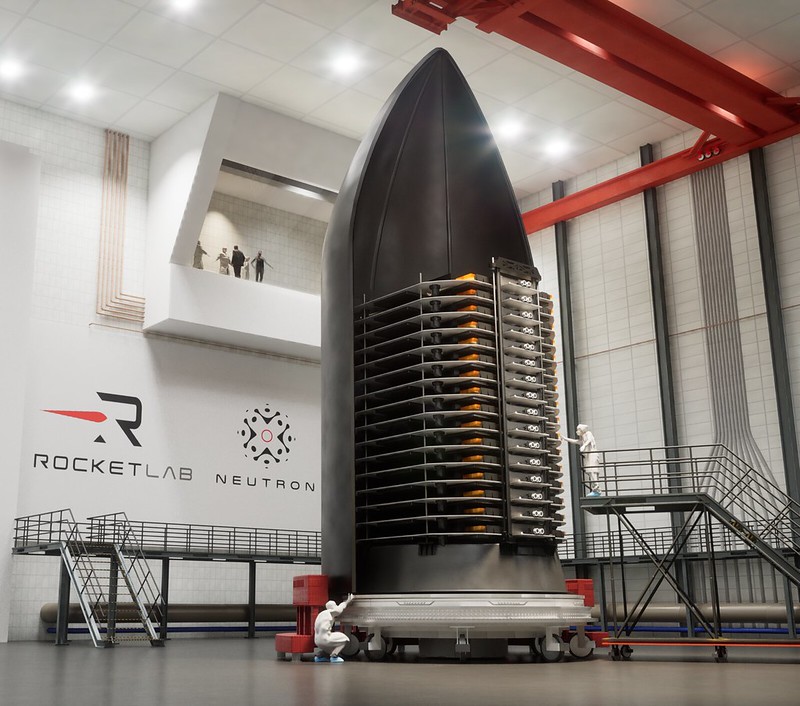
Rocket Lab expects the Neutron — a carbon composite rocket that can handle payloads of up to 33,000 pounds — to launch for the first time in the second half of 2025. That first launch will take place from the company’s Launch Complex 3 facility in Virginia, from which Rocket Lab executed its first US launch in January 2023.
The Virginia launches exemplify what Rocket Lab refers to as Return To Launch Site (RTLS) missions, one of two “mission profiles” the company will offer for its Neutron launch services. Return On Investment represents the second mission profile, Down Range Landing (DRL), a capability which Rocket Lab believes will increase access to launch services across the full range of the space industry’s customer base.
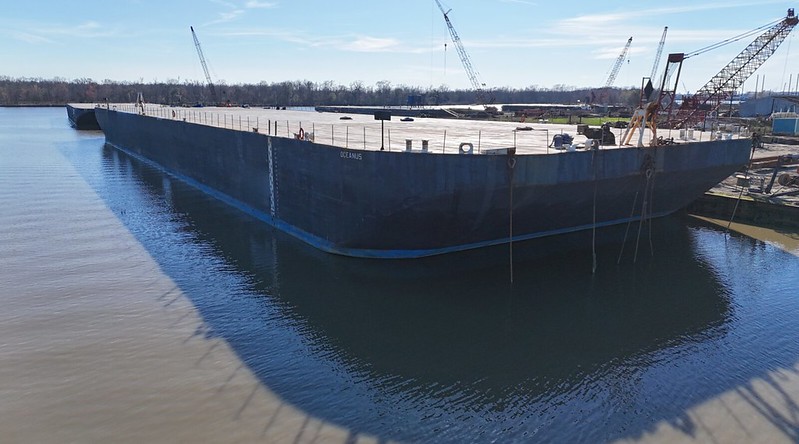
In a press release about Rocket Lab’s construction of its Return On Investment platform for sea-based landings, the company’s founder and CEO, Sir Peter Beck, said, “We’re working hard to bring Neutron online with one of the fastest development schedules in history for a new rocket, because we know medium-lift launch opportunities are limited and space access is being stifled. Neutron’s debut launch planned for later this year will help to ease that bottleneck, and our new landing platform will open space access even further by enabling even more mission opportunities that require maximum Neutron performance.”
Rocket Lab’s announcement of Return On Investment comes alongside the company’s posting of its 2024 earnings, revealing that the company brought in record annual revenues of $436.2 million, which included record quarterly revenues of $132.4 million in Q4. The announcement also comes about a month after the company’s stock price surged to all-time highs on news that Rocket Lab had successfully launched five low Earth Orbit (LEO) satellites for French IoT company Kinéis.
Rocket Lab’s share price has since pulled back quite a bit, but the stock is still up around 300 percent over the last year, emphasizing that we can take the name of its in-progress sea-based landing platform quite literally. Even more exciting than the company’s financial numbers, though, is the fact that Rocket Lab’s launches of its Electron rocket were up 60 percent over 2023.
This illustrates the pace at which the company is capable of moving forward once it achieves its first Neutron launch, and legitimizes the idea that Rocket Lab can deliver on its vision to truly broaden access to space services. Rocket Lab’s execution of that strategy wouldn’t benefit the company alone: it would have a direct impact on the ability of smaller companies to succeed at 3D printing components for satellite systems, with the company likely having to rely more and more on contract manufacturers in order to meet its growth targets.
Images courtesy of Rocket Lab USA
Subscribe to Our Email Newsletter
Stay up-to-date on all the latest news from the 3D printing industry and receive information and offers from third party vendors.
Print Services
Upload your 3D Models and get them printed quickly and efficiently.













You May Also Like
The Money Behind AM: What to Watch at AM Investment Strategies 2026
For years, simply being a 3D printing company could attract attention from investors. New machines, new materials, faster speeds, and the promise of mass production were often enough to get...
3D Printed Football Helmets Are Amazing Business. They’re Also So Much More
NFL football is by far the most popular sport in the US, followed by college football (a state-of-affairs oddly similar to the fact that the world’s largest air force is...
Continuous Composites Wins Navy SBIR for 3D Printed UAVs
In a diversification effort, Continuous Composites has decided to seek work outside of the courtroom. The company that has been successful in defending its patent portfolio in composite 3D printing...
When Data Becomes the Differentiator: Qualified Material Data is Changing the Future of Structural Additive Manufacturing
For years, additive manufacturing has promised engineers greater design freedom. The challenge wasn’t printing the part—it was proving the part belonged on an aircraft. Designing a lightweight bracket or consolidating...























































