
When Innovation Meets Reality in 3D Printing

Additive manufacturing has long promised to revolutionize industries, offering groundbreaking solutions across aerospace, automotive, medical devices, and more. However, the road from bold innovation to practical application has proven to be more complex than anticipated. While the headlines tout AM’s potential, the industry stands at a crossroads, and it’s time to bridge the gap between aspirations and impactful outcomes. This journey requires a more balanced approach—one that prioritizes partnerships, patience, and power to the people.
A Reality Check for 3D Printing
Our industry’s claims have been ambitious, and yet, the current reality paints a more modest picture. Low investment levels, fewer startups, and financial challenges persist. Despite the rhetoric, AM’s potential cannot materialize without acknowledging its supporting role in the broader manufacturing ecosystem.
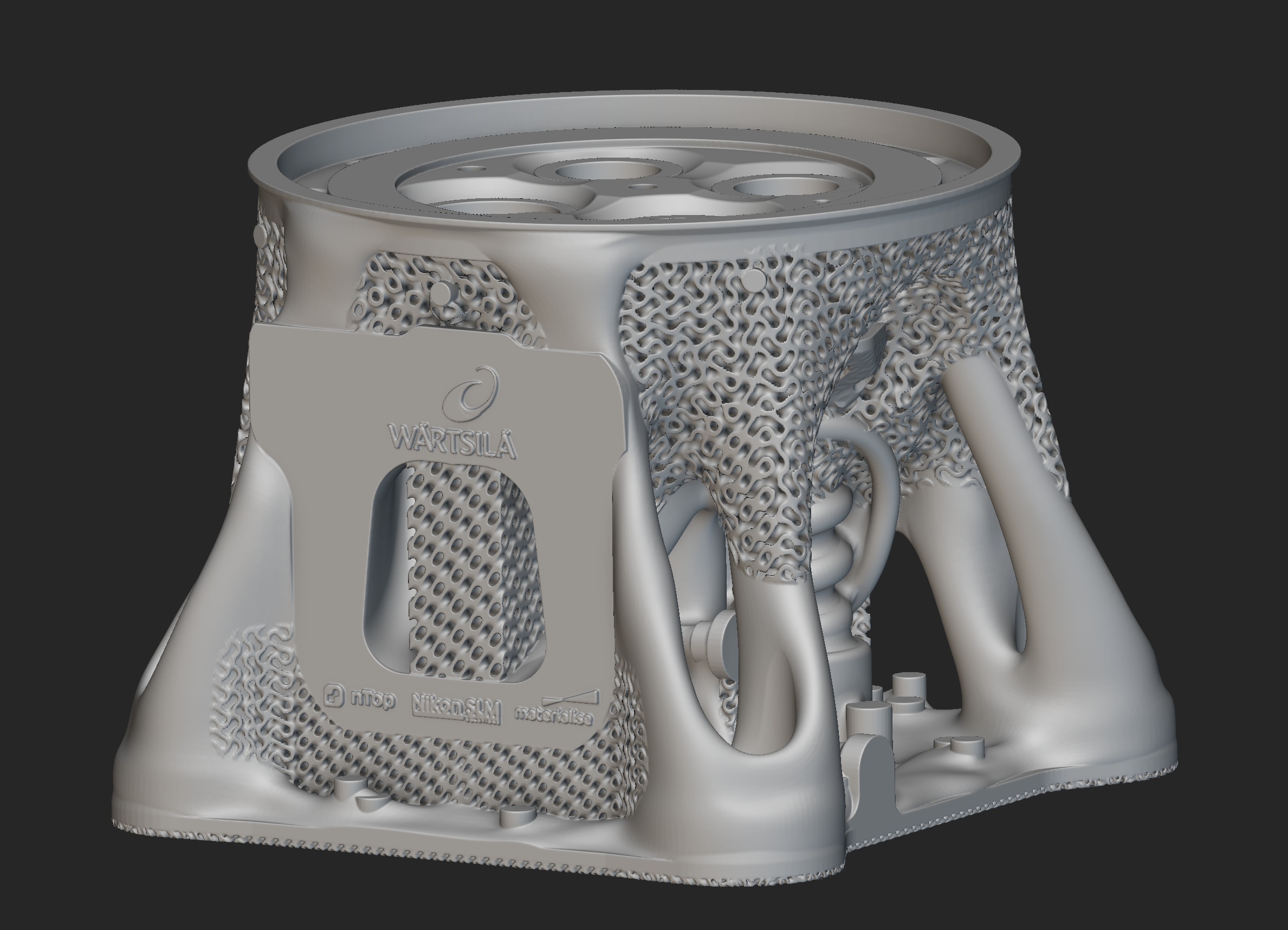
– Wärtsilä – Materialise collaborates with technology group Wärtsilä for the production of a high-performance, 3D-printed cylinder head, significantly enhancing cooling performance and reducing weight by 60%.
A case in point: 3D-printed metal hinges for foldable phones, printed by the millions in China, have demonstrated the interplay between AM’s design capabilities and traditional manufacturing’s scalability. This collaboration showcases the practical applications that emerge when innovation meets reality. It’s not about replacing traditional methods entirely but about complementing them to create exciting new solutions.
The Slow Revolution: Patience in Scaling Applications
Realizing AM’s full potential takes time. Scaling innovative applications into cost-effective, high-volume production is a long-term endeavor—a concept Materialise founder Fried Vancraen calls “The Slow Revolution.”
Consider GE’s landmark 3D-printed fuel nozzle. The project began in 2003, with additive process parameters refined by 2012, and production launched in 2015. This 12-year journey highlights the dedication required to transform a concept into a scalable solution. Similarly, Materialise introduced the first titanium 3D-printed personalized Cranio-Maxillo-Facial implants in 2006, but only now is this application reaching large-volume production.
There are exceptions, such as the hearing aid industry in the U.S., which transitioned to 3D printing within 500 days. However, for most applications, the path from dream to deliverable is lengthy yet rewarding. The steady expansion of machine fleets by existing manufacturers signals a readiness to scale.
Lowering Barriers with Automation and AI
To accelerate the transition from innovation to application, our industry must address the challenges companies face when integrating and scaling AM. Automation offers a powerful solution, reducing manual intervention and increasing production efficiency. Automated workflows enable companies to manage larger volumes without compromising quality, making AM more accessible and scalable.

– Sartorius – Since 2018, Materialise and Sartorius have worked together to produce over 26,000 single-use end-use components that are trusted by some of the most well-known names in the industry.
AI also holds significant promise in unraveling the complexities of AM by providing new insights and streamlining processes. At Materialise, we’ve integrated AI into our solutions, enhancing our ability to support innovative applications. However, caution is warranted; questions about AI’s reliability and usability remain.
Power to the People
Ultimately, the future of AM lies in empowering customers. While the industry excels in 3D printing, customers are experts in their respective fields, from aerospace to medical devices. Addressing their unique workflows and challenges requires tools that align with their expertise and needs.
An example of this philosophy is Materialise’s decision to share the algorithms behind Magics, our flagship software for data and build preparation. By enabling our customers to create tailored solutions, we empower them to achieve greater efficiency. This approach shifts the focus from telling customers what to do to empowering them to do what they do best.
Additive manufacturing’s future is not about the technology itself or the companies behind it. It’s about the customers who bring these innovations to life. As the industry transitions from dreams to deliverables, our role is clear: empower our customers to excel in their fields. By focusing on their success, we ensure the collective success of our industry, ensuring its growth and profitability.

Brigitte de Vet-Veithen, CEO Materialise
Brigitte de Vet-Veithen will participate at Additive Manufacturing Strategies, Feb 4-6 2025 in New York City
Subscribe to Our Email Newsletter
Stay up-to-date on all the latest news from the 3D printing industry and receive information and offers from third party vendors.
Print Services
Upload your 3D Models and get them printed quickly and efficiently.













You May Also Like
Prusa Core One L+: A Worthy Upgrade?
Disclosure: The Core One L+ was provided to me by Prusa3d free of charge for the purpose of this review. I have not received any other compensation. All opinions expressed...
Building Profiles in the Additive Print Services Market – Market Research Beyond AI Scraping
AM Research New market research: AM Research is building its new Additive Manufacturing Services Market 2.0 model. View the report and preorder here → In case you haven’t heard, at...
3D Printing Services Near $2.5B as AM Market Shifts Beyond Hardware
The additive manufacturing market may be growing again, but one of the more interesting numbers behind that recovery has little to do with selling 3D printers. AM services generated nearly...
Bambu Lab and SUSAN FANG 3D Print for London Fashion Week
At London Fashion Week, some of the more unusual pieces on the runway came from 3D printers. Chinese fashion designer SUSAN FANG presented her Spring/Summer 2027 Air-Illusion collection at the...
























































