OXMAN’s 3D Printed Zero-Waste Biodegradable O° Shoes Produce No Microplastics


Design lab OXMAN is on a mission to make products “by, for, and with Nature while advancing humanity,” moving from human-centric to nature-centric design. It recently unveiled a new technology platform called O° (pronounced “O-Zero”), which uses 3D printing, biomaterial, and robotic technologies to produce bio-based textiles and wearables made entirely out of one organic material. They produce no microplastics, use no glues or petrochemicals, and the process is supposedly nearly zero-waste. The lab’s O° shoe, made with OXMAN’s patent-pending technology, is said to be 100% biodegradable in ambient conditions, and is made out of a class of organic material called polyhydroxyalkanoates (PHAs).
The fashion industry is notoriously wasteful, causing a very negative impact on the environment; in 2022, Kornit’s CEO Ronen Samuel said that 28 trillion liters of water are used to produce shirts. According to OXMAN, 92 million tons of garments are discarded annually, while 40 different materials are used to make traditional shoes, and anywhere from 33 to 4,200 “forever chemicals” are in those shoes. Plus, many of the industrial dyes and pigments that are used to color our clothes and shoes come from petrochemicals, which are bad for the environment because they release damaging chemicals during production and use. They also depend on the global supply chain to be synthesized, processed, and shipped, which is also not the most environmentally friendly.
However, PHAs are biologically recyclable, created by bacteria that consume atmospheric carbon dioxide, methane, and even food waste, and as they grow, they reduce carbon in the environment. If O° shoes and textiles are really made completely out of PHAs, they won’t leave microplastics behind when they decompose, and will simply return back to the bacteria that was used to make them. OXMAN also uses bacteria to encode other functional properties, like pigment production, into O°, which centralizes the manufacturing process.
“PHAs have long been recognized as a promising alternative to petroleum-based plastics. We have successfully elevated the potential of PHA through the development of O°, a new technology for the design and fabrication of products that seeks to minimize harm in its conception and nourish the environment in its afterlife,” said architect and designer Neri Oxman, CEO and Founder of OXMAN. “We are thrilled to unveil our first product using this new technology: the O° shoe, which is made using 100% PHA, is 100% biodegradable, and has no petrochemicals or microplastics.”
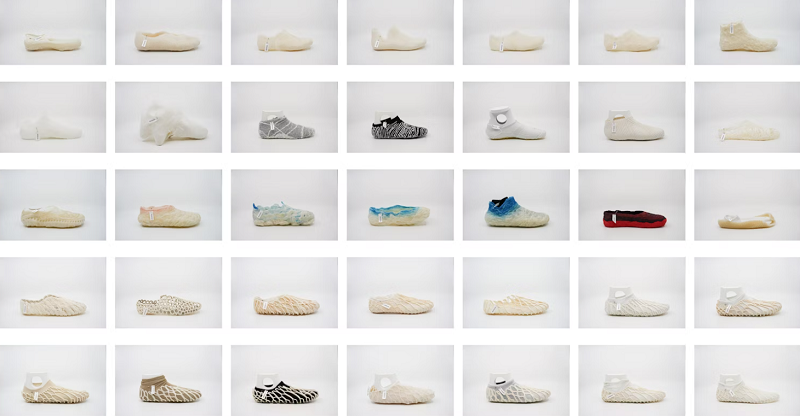
While Oxman herself has been part of the AM industry for several years, OXMAN the design lab was only officially launched last month, started for the purpose of creating “fully integrated systems that unify design, materials, production, and decomposition, to create positive impacts across the lifecycle of products and buildings.” Its mono-material O° platform is a more holistic design and production option, taking into account a product’s full lifecycle. It reminds me a little of Balena’s circular model for 3D printed compostable slides.
The new O° shoes incorporate designs inspired by human motion, which you can see in their unique, organic look. Each one features a base layer consisting of a knitted upper, and outer layers are printed robotically onto the textile to offer various forms of functionality, including strength, cushioning, pliability, and reinforcement. The shoes are biodegradable, but just like more traditional biodegradable materials like silk and wool, PHA doesn’t biodegrade while being worn, stored, or washed.
“We present a revolutionary class of biologically programmed, computationally grown, and robotically manufactured shoes and textiles that give biodegradable bioplastics the design that their biology deserves,” the website states.
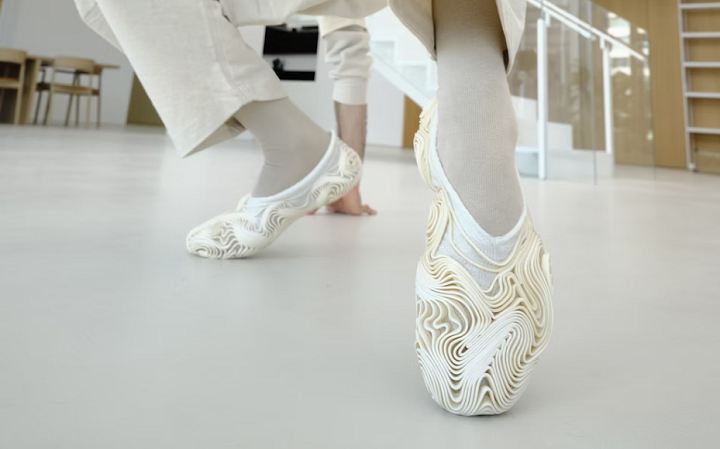
The lab’s compact robotic system prints custom PHA blends onto a textile, which is 3D knitted on an industrial flatbed machine out of 100% PHA yarn that’s made through extrusion and melt spinning. Traditional shoe assembly is all about cutting, sewing, and adhesion, but 3D printing can eliminate most of that. OXMAN has built automation into its O° platform, which allows for rapid design iterations and a faster product development process. Minimal human involvement is needed during the production process, which means that local, low-cost production is possible—reducing the environmental impact of supply chains. It sounds about as zero-waste as you can get.

OXMAN is actively seeking investors, partners, and brand collaborators to bring its O° shoes and textiles to scale. Reach out here if you’re interested in working with the design lab to get these biocompatible shoes to the market.
Subscribe to Our Email Newsletter
Stay up-to-date on all the latest news from the 3D printing industry and receive information and offers from third party vendors.
Print Services
Upload your 3D Models and get them printed quickly and efficiently.













You May Also Like
50,000 Orders and Counting: EPlus3D & Chinese AM Services Provider Are Scaling Liquid Cooling Solutions for AI Servers
An under-appreciated story driving the additive manufacturing (AM) industry this year has been the divergence between what’s driving the market in China and what’s driving it everywhere else. Let’s start...
Seven Trends Reveal What’s Next for 3D Printing at TCT Shenzhen 2026
TCT Shenzhen 2026 opened on October 14 in Hall 15 of the Shenzhen World Exhibition & Convention Center in Bao’an, and ran through October 16. The event brought together equipment...
With Increased Aerospace & Defense Focus, CORE Industrial Partners Buys More Manufacturing Firms
Private equity’s march into manufacturing continues with CORE Industrial Partners’ latest acquisitions. CORE purchased Fathom a few years ago, and later bought 3DXTECH LLC, Triton 3D LLC, and Gearbox3D. It...
Can India’s AM Push Help Make it a Viable Supplement to China?
Diversifying manufacturing supply chains to locales outside of China has nothing to do with actually cultivating “substitutes” to the Chinese economy. The real stakes are these: China is an irreplaceable...