Student Produces Winning Design for 3D Printed Formula 1 Trophies

Formula 1 cars are the thoroughbreds of the automotive world, capable of reaching speeds of nearly 230 mph on the faster tracks on the race circuit.
The cars crank out 800 bhp, but weigh just 1400 pounds, and that includes the weight of the driver. It’s thought that at speeds over 150mph, a Formula 1 car could create enough aerodynamic downforce to run upside down on the ceiling of a tunnel. Formula 1 drivers are crushed under the weight of some 5 Gs in high-speed corners, and their tires reach temperatures of 120 degrees Celsius after a race.
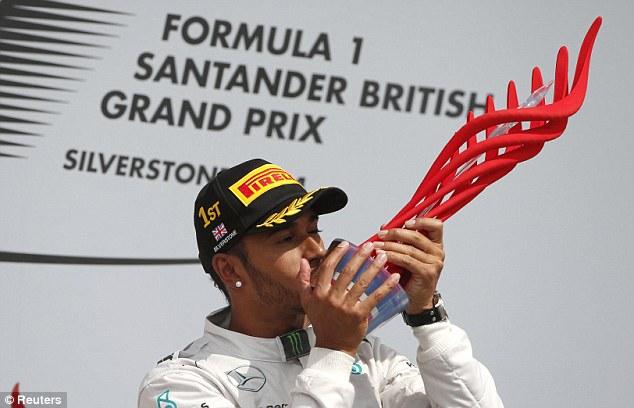 A Spanish company has produced 3D printed trophies for F1 winners that rival the technology of the cars and drivers they’re meant to celebrate. RePro3D manufactured the trophies using SLS and SLA technology to create them from polyamide and resin materials. The trophies were then polished, sanded, and treated to arrive at the finished result. The company says even the plates and screws were tailored to the piece and 3D printed.
The trophies, awarded to the winners at the races at Hockenheim in Germany and at Silverstone in England, were the result of a worldwide competition held by Spanish banking giant Banco Santander. The competition drew more than 500,000 student votes for 371 designs from 104 universities in 15 countries.
The winning design entry was created by Saúl Latorre Sebastián, a student at Universidad Católica de Murcia (UCAM) in Spain. Sebastián was awarded a trip for two to the race at Silverstone in the UK.
The student designer said winning the contest was a thrill and that knowing “my design will be theirs – and it will be at their home – is an honor.”
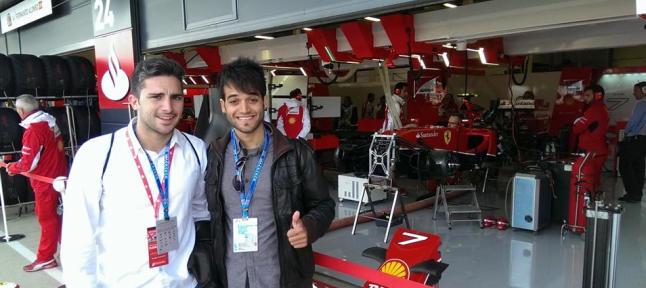
Design contest winner Saúl Latorre Sebastián (right) at the Ferrari paddock during the Silverstone race.
Formula 1 race teams make extensive use of the 3D printing process in the prototyping of their cars, and some teams print as many as 900 pieces a month to create new designs and maintain their competitive edge.
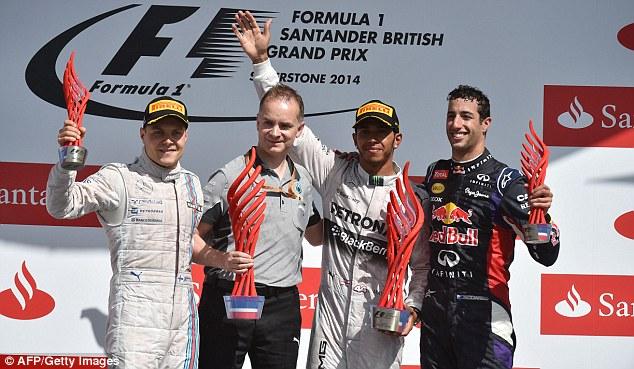
Nico Rosberg hoisted one of the trophies after standing on the podium in his home country as a result of his win at the Hockenheim race. It was his fourth win of the season and increased his lead over Mercedes teammate, Lewis Hamilton, in the F1 world champion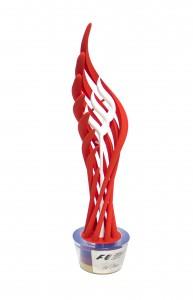 ship standings. It also made Rosberg the first German driver to win in Germany and for a German car and engine manufacturer.
For his part, Hamilton had raised a version of the 3D printed trophy awarded for a win at Silverstone, and the Briton eventually went on to win the Formula 1 title after defeating Rosberg in the final event of the season in Abu Dhabi.
Do you think the trophies for most major sporting events will ultimately be designed and created with 3D printing technology? Discuss the idea in the Formula One 3D Printed Trophy forum thread on 3DPB.com.
Subscribe to Our Email Newsletter
Stay up-to-date on all the latest news from the 3D printing industry and receive information and offers from third party vendors.
Print Services
Upload your 3D Models and get them printed quickly and efficiently.











You May Also Like
Amnovis Expands to the US
Belgian firm Amnovis is a scalable partner for orthopedic innovations. From design to production and regulatory, you can rely on them to take your innovation to market. Coupled with deep...
Scaling 3D Printing Takes More Than You Think; HP’s Webinar Looks at Making It Work Long Term
3D printing is no longer new. In fact, most manufacturers already know what it is, where it fits, and what it can do. But knowing the technology and actually scaling...
Astrobotic Tests Rocket Engine Made with Elementum 3D Materials
Astrobotic has completed a series of hot-fire tests for its Chakram rotating detonation rocket engine, with additive manufacturing (AM) playing an important role in how the engine was built. The...
The Additive Chicken Coop, Part I: Million Dollar Petri Dishes
After decades of tinkering with our individual technologies, billions were poured into speculative claims and optimism. Now the attention is gone, and sometimes it can seem like we’re surrounded by...