Aerojet Rocketdyne’s Titanium 3D Printed Satellite Propulsion System Almost Ready For Space

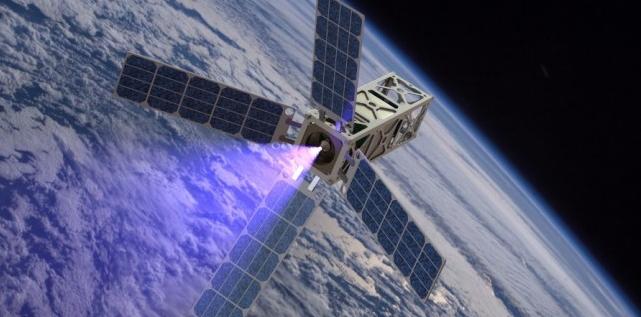
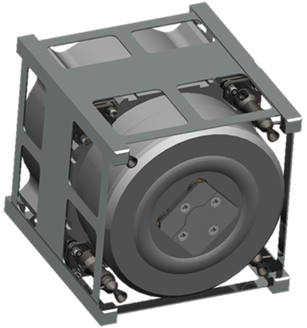
It’s a satellite propulsion system that includes four miniature rocket engines and feed system components, a 3D printed titanium piston, a propellant tank and a pressurant tank. The MPS-120 is designed to be compatible with hydrazine propellant and green propellants. Perhaps the most interesting part of the system? The entire chassis is not much bigger than a coffee mug.
Aerojet Rocketdyne, completed a hot-fire test of the MPS-120 CubeSat High-Impulse Adaptable Modular Propulsion System this week, and it’s the first 3D printed, hydrazine integrated propulsion system. It’s designed to provide propulsion for tiny CubeSats.
“The MPS-120 hot-fire test is a significant milestone in demonstrating our game-changing propulsion solution, which will make many new CubeSat missions possible. We look forward to identifying customers to demonstrate the technology on an inaugural space flight,” says the Program Manger for the MPS-120 project, Christian Carpenter.
According to Ethan Lorimor, a project engineer at Aerojet Rocketdyne, the 3D printing work on the system took a single week and the final assembly of the system took just two days.
 Lorimor says the MPS-120 demonstrated more than five times the required throughput on the engine and went through several full expulsions on the propellant tank as part of the testing process. He said those tests brought the system to Technology Readiness Level 6 as well as a Manufacturing Readiness Level 6. All that remains is that the system needs to be qualified as Level 9 for it to be ready to fly in space.
The MPS-120 is Aerojet Rocketdyne’s first 3D printed, integrated propulsion system, but the company has previously conducted a number of hot-fire tests on 3D printed components and engines for other rocket projects. The tests on a Thrust Chamber Assembly which uses copper alloy AM technology, a series of tests of a Bantam demonstration engine and a series of tests on a liquid-oxygen and gaseous hydrogen rocket injector assembly were all designed specifically for production via additive manufacturing.
This latest project was funded by the NASA Office of Chief Technologist’s Game Changing Opportunities in Technology Development and awarded by the Armstrong Flight Research Center.
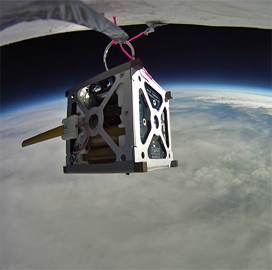 Testing was done in Redmond, Washington.
Julie Van Kleeck, vice president of Space Advanced Programs at Aerojet Rocketdyne, says the program of successful tests “opens a new paradigm of possibilities that is not constrained by the limits of traditional manufacturing techniques.”
Aerojet Rocketdyne is an aerospace and defense contractor which provides propulsion and energetics to the domestic and international markets in space, missile defense and strategic systems, tactical systems and armaments.
Yet another bleeding edge use of additive manufacturing within the aerospace industry, this amazing technology will drive tiny satellites through the harsh environment of space. Let us know what you think about this development in the Titanium 3D Printed Satellite Propulsion System forum thread on 3DPB.com.
Subscribe to Our Email Newsletter
Stay up-to-date on all the latest news from the 3D printing industry and receive information and offers from third party vendors.
Print Services
Upload your 3D Models and get them printed quickly and efficiently.













You May Also Like
3D Printing News Briefs, August 22, 2026: Polymers for CubeSats, Animal Mobility Devices, & More
We’re starting with defense news in this weekend’s 3D Printing News Briefs, before moving on to polymers for CubeSats and 3D printed prosthetics. We’ll end with a story about engineering...
Pusan National University & ORNL Develop Elastomeric Liquid Crystal Actuators
Researchers from Korea’s Pusan National University and Oak Ridge National Laboratory (ORNL) have developed 3D printed elastomeric actuators. In a paper published in Nature, the team used elastomeric liquid crystal...
Scientists Use BMF to 3D Print Seal Whiskers That Track Prey Long After It’s Gone
Seals use their whiskers to hunt. Not Navy Seals, although they may in some way also, but this article is about lowercase seals. Not Seal the musician either; as far...
Harvard’s Jennifer Lewis Lab Is 3D Printing Artificial Muscles That Twist and Bend on Demand
Researchers at Harvard John A. Paulson School of Engineering and Applied Sciences (SEAS) have developed a new way to 3D print materials that can move on their own, bending, twisting,...