3DXTech Offers New Carbon Fiber-Reinforced PLA and ABS Filaments, 3DXMax CFR


Traditional 3D printing materials such as PLA and ABS are incredibly useful, but they do have limited technical capabilities as a result of the structures of the polymers themselves.
But a Michigan firm, 3DXTech, is working to develop innovative solutions to some of those technical challenges when it comes to PLA and ABS materials.
They say their latest solution, 3DXMax CFR, offers a significant improvement over current carbon fiber reinforced filaments on the market. The company says 3DXMax CFR-PLA grade offers “improved mechanical properties over competitive materials in the same space,” and they add that the PLA- and ABS-based materials are available now in limited quantities.
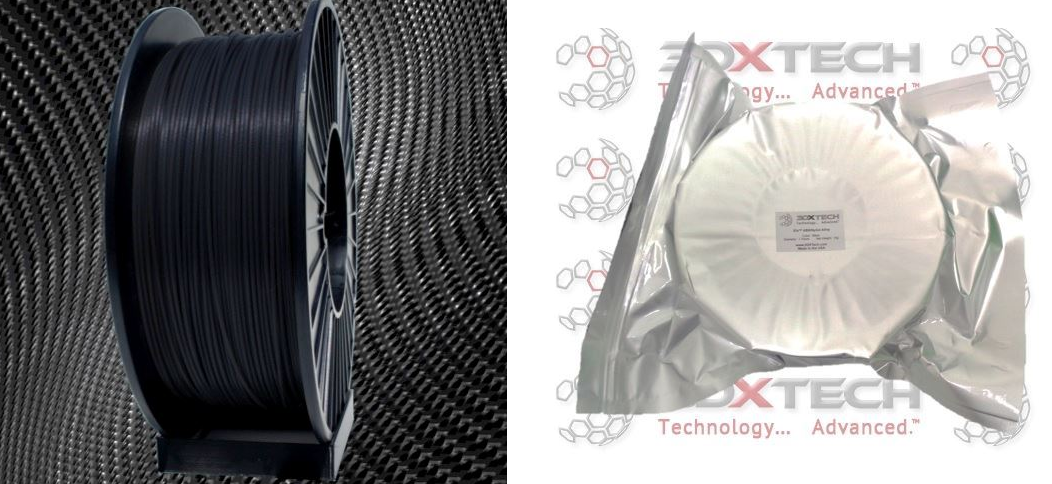
The company says both materials will be available in production quantities in January 2015.
“We’re currently testing our carbon fiber reinforced nylon (and) this new nylon is a carbon fiber reinforced, semi-aromatic polyamide – often referred to as a high performance polyamide (HPPA),” says Mark Haskins, Materials Manager at 3DXTech.com. “We also understand that the products we develop must not only provide additional performance, but must be
suitable for use in a wide array of commercially available 3D printers. Striking this balance between improved functionality and ease of printing is a key part of every new product we launch.”
The company says 3DXMax CFR-PLA offers a 128% improvement over unfilled PLA – and a 31% improvement over competing CF-PLA products.
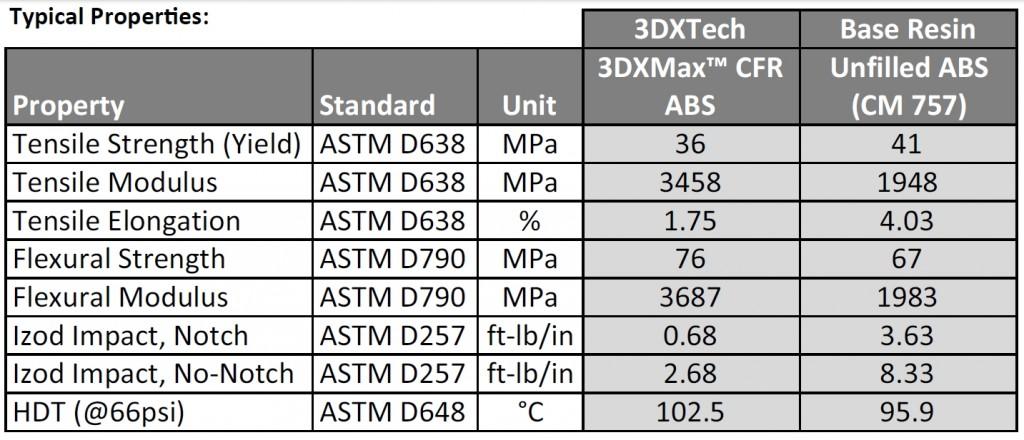
They say the 3DXMax CFR-ABS product is improved 86% when compared to unfilled ABS materials, and each of the graded materials has been custom formulated to offer “an ideal combination of improved mechanical properties, dimensional stability and print-ability.”
The say both the carbon fiber ABS and PLA filaments are ideal for printing from device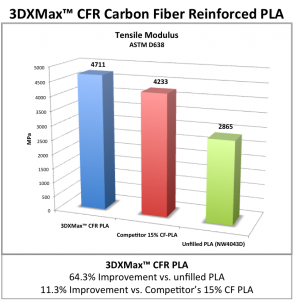 s with a heated-platform which features an extruder capable of 220-235°C and a bed temp in the 100-110°C range. They add that the bed should be prepped with Kapton Tape or an ABS and acetone slurry.
Haskins says all the company’s new products are put through test runs in their 3D printers at their lab to complete a “rigid internal qualification process.” He adds that all products in their line are test marketed before being put into production and offered to the general market.
3DXTech also offers a filament made specifically electronics and semiconductor applications.
If you need more information about these latest 3DXTech.com products, you can contact them here to take part in the evaluation process or receive samples.
3DXTech creates new filaments, and their carbon fiber reinforced ABS and PLA materials have tested out to be stronger than competing products. What do you think about the 3DXMax line of filaments? Let us know if you’ve used these filaments, or plan to use them, over at the 3DXTech Carbon Fiber Reinforced PLA and ABS Filaments thread at 3DPB.com.
Subscribe to Our Email Newsletter
Stay up-to-date on all the latest news from the 3D printing industry and receive information and offers from third party vendors.
Print Services
Upload your 3D Models and get them printed quickly and efficiently.











You May Also Like
3D Printed Bone Grafts From Georgetown Researchers Could Replace Traditional Implants
Researchers at Georgetown University are developing a new type of 3D printed bone graft designed to work more like real human bone. Instead of relying on metal implants or donor...
TV’s Scarpetta Suggests We Can 3D Print Full Human Organs. Reality Is… Not Yet
Having spent a good part of my journalistic career covering crime stories, it’s hard for me to stay away from any crime or medical forensic drama. So when Scarpetta premiered...
At RAPID + TCT 2026, Executive Keynotes Break Down What’s Next for AM
While AI is expected to be a major focus at RAPID + TCT 2026, the event is also putting the spotlight on something just as important: leadership. This year’s Executive...
3D Printing Moves Deeper Into Production as Parts Near $110B by 2034
A new report takes a closer look at how much 3D printing is actually being used in real production. The numbers point to a market that is already growing at...