Northrop Grumman Taps SWISSto12 to 3D Print RF Antennas


Previously, radio frequency (RF) antenna 3D printing expert SWISSto12 has collaborated with Lockheed, CAES, and the European Space Agency (ESA), and has secured a 25 million Swiss Franc loan. Now, SWISSto12 has been selected by Northrop Grumman to produce 3D printed RF antenna feed chains for GEOStar-3 satellites.
The company specializes in manufacturing 3D printed RF components, which are often more efficient, can be designed to be conformal, and typically have reduced mass compared to traditional components. This is particularly advantageous for antenna feed chains, which are complex assemblies consisting of multiple waveguides that direct the RF feed for transmission and reception. An added benefit of using 3D printing in this context is the reduction in manufacturing costs, which can be significant when compared to the complex and potentially error-prone manual processes of conventional manufacturing.
The win for SWISSto12 is significant because it positions the company in a growing segment of the satellite market—geosynchronous satellites that are relatively small yet high-performance and can be launched efficiently from platforms such as the Falcon and Ariane. These satellites are capable of handling communications, intelligence, and sensing tasks, all with more bang for the buck. Northrop’s GEOStar-3 satellite has customers including the Norwegian Space Agency, satellite broadband firm Avanti Communications, and the soon-to-be-merged satellite service companies Intelsat and SES. GEOStar satellites can carry payloads of up to 1000 kilograms and have operational lifespans ranging from 15 to 20 years.
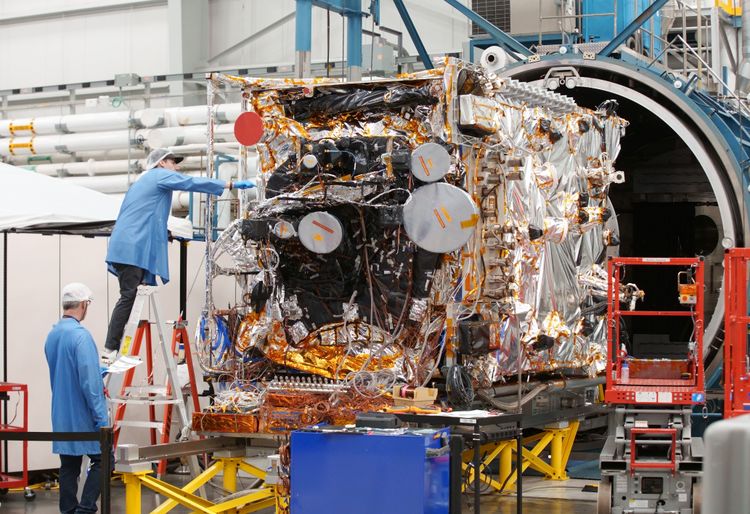
A peek inside the ASBM-1 GEOSat by Northrop. Image Courtesy Northrup
SWISSto12 states that its 3D printing technology enables it to deliver advanced RF performance, as well as significant size and weight savings. The firm has already shipped three of the chains and successfully passed Northrop’s qualification program. The first of these chains, which are “fully-integrated monolithic assemblies” that include diplexers, filters, polarizers, horn apertures, and mechanical interfaces, are 3D printed as a single-piece assembly and are expected to be launched this year. The company has set up a U.S. subsidiary, St12 RF Solutions, to aid in the sale.
“SWISSto12 is delighted to announce this first delivery to Northrop Grumman of cutting-edge Radio Frequency Antenna Feed Chains for its commercial GEOStar-3 program. Our novel Radio Frequency Additive Manufacturing coupled with advanced monolithic designs enabled by 3D printing has created a new benchmark in Antenna Feed Chain size, weight and performance. Our Radio Frequency and HummingSat geostationary SmallSat business has delivered over $200 million in customer orders to date, validating our mission to push the limits of existing payload capabilities to better protect and connect every corner of the world,” said Scott Wolf, Managing Director of St12 RF Solutions.
The GEOStar program plays a crucial role, especially as it is set to provide essential C Band Spectrum for 5G and wireless communications for explorers and warfighters in the Arctic. This includes the Arctic Satellite Broadband Mission (ASBM) led by the U.S. Air Force and the Norwegian Space Agency, among others. This mission is particularly sensitive and critical for maintaining communications in the Arctic, a region where connectivity is notoriously unreliable. With these satellites scheduled for launch in 2023, the antenna feed chains developed by SWISSto12 might be onboard, potentially for this mission or a 5G satellite from Intelsat/SES.
The application of 3D printing in manufacturing waveguides, antennas, diplexers, horns, and antenna chains for space is exceptionally fitting. In such applications, weight reduction, the ability to fit components into tight spaces, and enhanced performance are crucial factors that drive the adoption of new technologies like 3D printing. Furthermore, 3D printing has proven to provide superior performance for many types of antenna components, advancing the field RF technology piece by piece and installation by installation.
Moreover, meeting launch schedules is crucial, and the faster delivery of 3D printed parts can significantly support this effort. In complex assemblies like these chains, conventionally assembled alternatives can often fail, sometimes late in the process, which can be costly. Given the high “buy to fly” ratios and the astronomical costs associated with failures—where the cost per kilo in orbit can be overshadowed by the $10,000 per kilo launch costs—complex RF assemblies represent one of the most compelling business cases for 3D printing.
It’s fascinating to observe how companies like SWISSto12 and Optisys are advancing this space, and it’s somewhat surprising that they remain among the few companies actively pursuing 3D printed RF components for satellites.
Subscribe to Our Email Newsletter
Stay up-to-date on all the latest news from the 3D printing industry and receive information and offers from third party vendors.
Print Services
Upload your 3D Models and get them printed quickly and efficiently.













You May Also Like
Metal 3D Printers for the Desktop Are Finally Starting to Feel Like Desktop Products
FDM 3D printing is becoming increasingly accessible, yet metal 3D printers designed for everyday desktop use remain rare on an ordinary workbench. The real challenge is not making a metal...
What 3D2GO Says About 3D Printing’s Growth in Southeast Asia
The Philippines offers an interesting case study in how 3D printing can develop in Southeast Asia, and Manila-based 3D2GO helps illustrate it. 3D printing in Southeast Asia doesn’t have to...
The Frankenservice Part 2: Have Your Cake and Eat it Too
This series of articles delves into a thought experiment. What if we let go of using a few machines very optimally, but instead use lots of different machines to meet...
Silencer Market Set to Test Metal Additive’s Readiness for Production Prime Time With Enormous Market Expansion
Throughout the history of additive manufacturing (AM) technologies, there are only a couple of really interesting case studies in which we see a market significantly disrupted and revolutionized by AM....