Relativity Space Lands $8.7M Air Force Contract for Real-time Flaw Detection in 3D Printing

Relativity Space has landed an $8.7 million contract from the U.S. Air Force Research Laboratory (AFRL) to carry out real-time flaw detection during the 3D printing of large parts. The work, according to contract details, will be performed at Relativity Space’s Long Beach, California, facility and is expected to be completed by July 3, 2026.
Under the new contract, Relativity Space is tasked with developing advanced technologies to enhance the integrity and quality of aerospace components through real-time flaw detection in large-format 3D printing. As revealed by SpaceNews, Adam Hicks, a physicist at the AFRL’s Materials and Manufacturing Directorate, explained that “this effort with Relativity Space is in response to a congressional demand signal.”
As indicated by Hicks, Relativity Space’s $8.7 million contract to improve flaw detection in 3D printing directly supports U.S. government goals. The 2024 National Defense Authorization Act emphasizes the importance of technologies like 3D printing for national defense. This law specifically asks the Department of Defense (DoD) to use 3D printing more, especially for creating parts that keep military equipment running and are often hard to replace. Furthermore, the law requires the development of a network of local facilities that can produce these essential parts. So Relativity Space’s work to create a more reliable way to detect errors in 3D printing is a critical step towards meeting these goals, making sure that parts needed for defense are both high-quality and readily available.
Hicks also explained that the initiative will see the AFRL working closely with Relativity Space to “implement in-situ process monitoring and post-build non-destructive evaluation techniques.” These techniques are crucial because they allow them to check the quality of the printed parts without harming them. During the printing process, they’ll monitor everything in real-time to make sure the process is going smoothly. After printing, they’ll use advanced methods to inspect the parts further, ensuring they are perfect for use without actually breaking or damaging them. This careful inspection is essential because it helps prevent future failures and ensures the parts can be used safely in critical applications like aerospace.
As discussed by SpaceNews, Hicks further outlined the project’s objectives: “Relativity Space will develop and prove a real-time flaw detection system which will detect, localize and classify defects during the print process. This data will then be aggregated, enabling a true digital thread.”
This approach aims to ensure the structural integrity of aerospace components and enhance manufacturing processes with advanced robotics, automation, and digital enterprise tools. This contract could improve the company’s capabilities in producing reliable, high-quality components crucial for space missions.
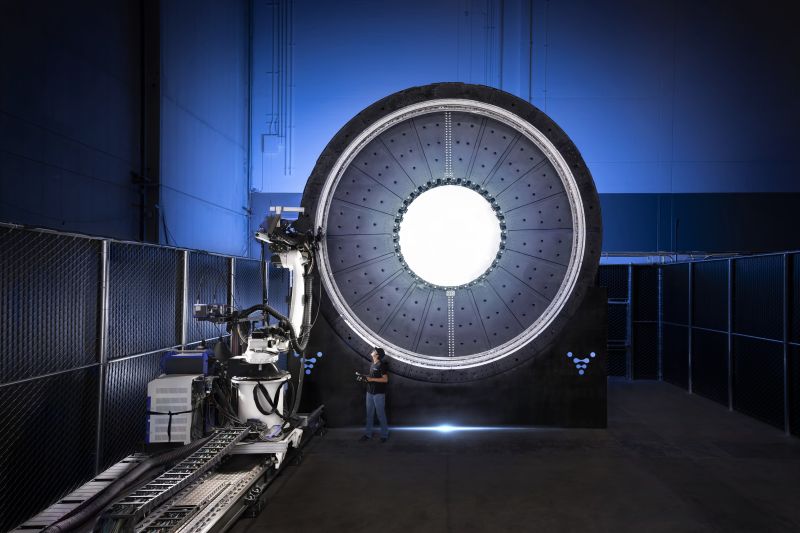
Relativity Space’s Stargate 4th Generation metal 3D printer moves horizontally instead of vertically, feeding multiple wires into a single print head. Image courtesy of Relativity Space.
The same Relativity Space facility in Long Beach, tasked with this new Air Force project, is also where Stargate—the world’s largest metal 3D printer—resides. Stargate is at the heart of the company’s revolutionary approach, blending AI, autonomous robotics, and large-scale additive manufacturing (AM) to transform spacecraft component production. This facility has driven the advancements behind the Terran 1 and the Terran R rockets. The facility’s ability to iterate quickly and integrate machine learning for real-time adjustments is crucial for meeting the demands of aerospace engineering and could be the reason it contributed to the objectives of its new million-dollar government contract.
Exploring innovative approaches to flaw detection and manufacturing shows Relativity Space’s dedication to advancing its technology, even as the company recently faced challenges in spaceflight. Despite last year’s setback, where the flagship 3D printed Terran 1 rocket did not reach its target orbit in its debut launch, Relativity Space continues to demonstrate resilience and forward-thinking. The company is making moves to prepare for future successes, which recently led to the appointment of Umer Khan as Chief Information Officer and Senior Vice President of Software. With over 25 years in the software and tech industry, Khan’s previous roles include significant stints at communications semiconductor firm MaxLinear and space giant SpaceX, where he oversaw mission-critical operations and full-scale manufacturing. At Relativity, Khan will lead efforts across various domains, including rocket design, simulation, and mission control, as well as overseeing the enhancement of technology infrastructure like AI and cybersecurity.
This combination of a fresh Air Force contract and the incorporation of a seasoned executive like Khan highlights the company’s strategic initiatives to give their brand a technological edge and operational efficiency, gearing up to play a pivotal role in the next generation of space exploration.
Subscribe to Our Email Newsletter
Stay up-to-date on all the latest news from the 3D printing industry and receive information and offers from third party vendors.
Print Services
Upload your 3D Models and get them printed quickly and efficiently.











You May Also Like
Cobra’s 3D Printed Golf Clubs Reveal What the Technology Can Do for Sports
When 3DPrint.com attended the PGA Show in Orlando this January, one booth stood out for a reason that had nothing to do with marketing hype or big-name tour pros —...
TCT Asia 2026: Empowering Asia · Connecting the World
TCT Asia, now in its 12th year, is more than just a 3D printing exhibition — it embodies its original concept: Time Compression Technology, a vision of making the entire...
3D Printing News Briefs, February 28, 2026: Sales Partner, Holographic 3D Printing, & More
We’re kicking off today’s 3D Printing News Briefs with some business news, as Meltio has announced a sales partner in the U.S. and Immensa has joined Shell’s Energy Transition Campus....
From “Magic” to Metal: How Intrepid Automation Wants to Make 3D Printing Matter at Scale
Ben Wynne still talks about 3D printing the way people do when they’ve felt that “wow” moment up close. Back in the early 2000s, he was working at HP’s advanced...