OneClickMetal Turns Up the Heat With 500W LPBF Machine for €120,000

OneClickMetal has been making affordable metal LPBF systems in Germany for several years. Started by Trumpf, the company is now owned by innovative machine tool manufacturer Index. OneClickMetal’s machines are easy to use, with simple UI’s and workflows. Powder comes in canisters to make it easier to manage and contain. These are affordable machines meant to be run by smaller businesses with less infrastructure in play. But, since they lower the barrier to entry, many firms are now looking to OneClick to enter into the LPBF market or manufacture with less risk and up-front cost. OneClick is expanding the market and offering an alternative to Chinese firms such as Farsoon and BLT, which also offer a lower entry point. Meanwhile, EOS and SLM focus on much larger, expensive systems for aerospace. If you are not familiar with the 1997 bestselling business book The Innovator’s Dilemma, what comes next, and indeed the next few years of the powder bed fusion market, will be a surprise to you.
Now, OneClick has developed a PROLine system to complement its MPRINT and MPURE systems. The MPRINTpro is a Nitrogen or Argon 150 x 150 x 150 mm, 500 W fiber laser LPBF system. The MPRINT is around 89,000 Euros ($149,000 in the US), and the MPRINTpro is now 120,000 Euros in Europe ($149,000 in the US). That’s a remarkable price, especially in Europe. The system works with aluminum, cobalt-chrome, titanium, tool steels, and stainless steel. If you buy from them, AlSi10Mg, the powder costs around €70 per kilo. But, good news, the new Pro is open so that you can add your own powder.
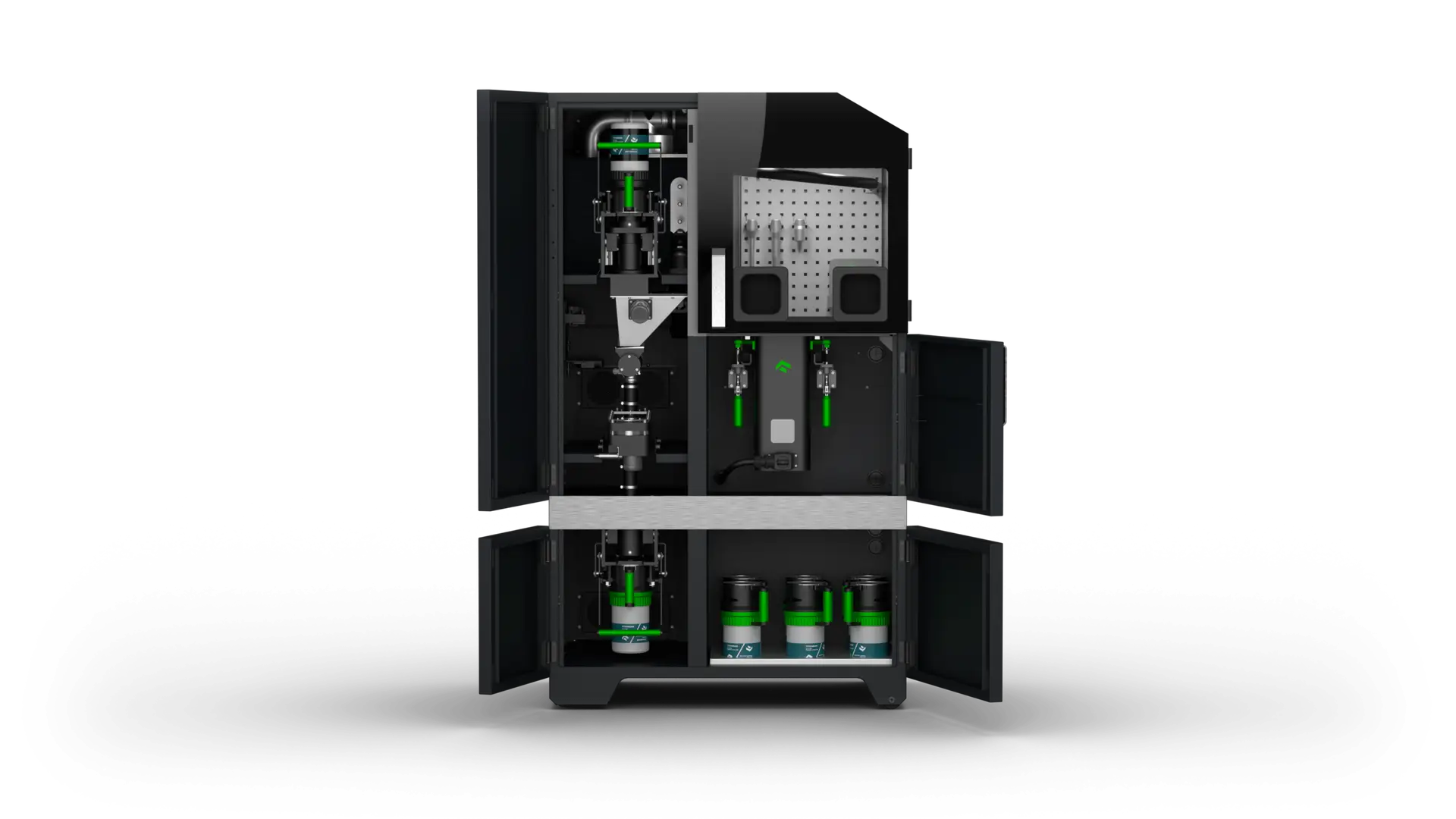
MPUREpro. Image courtesy of OneClickMetal.
The system can be bought with a sieving and unpacking module, the MPUREpro ($39,000 in the US). That sieves and conveys unused powder using vacuum conveying and ultrasonic sieving. There are also heating and productivity modules, as well as an app that allows you to start builds and monitor print jobs. Starter kits provide extra build plates, while all consumables and most spares are listed on the site, along with their corresponding pricing. The Pro has a self-cleaning filter from Herding Filtertechnik, which lasts up to 500 hours of printing. You can hold up to six powder cartridges, each weighing 2.5 kilograms, in the machine.
We do not yet know how the MPRINTpro stacks up to existing systems. And we’re sure to get the usual hee-hawing about it not being a quad laser M290. But this is precisely the point. The Japanese auto industry grew because its low-cost, well-made cars met customer needs, which were often unmet by the expensive and inefficient US cars. Now, Japanese cars are available at every price point and dominate quality rankings. Time and time again, companies eschew the need to innovate with low-cost systems. We’ve seen this before in material extrusion and again in SLA; an unwillingness to examine the technology deeply leads to arrogance and blindness. Companies refuse to “race to the bottom” and, indeed, refuse to even consider the competitive threat. Then they get wiped out. I’ve said it before, but Please Race to the Bottom.
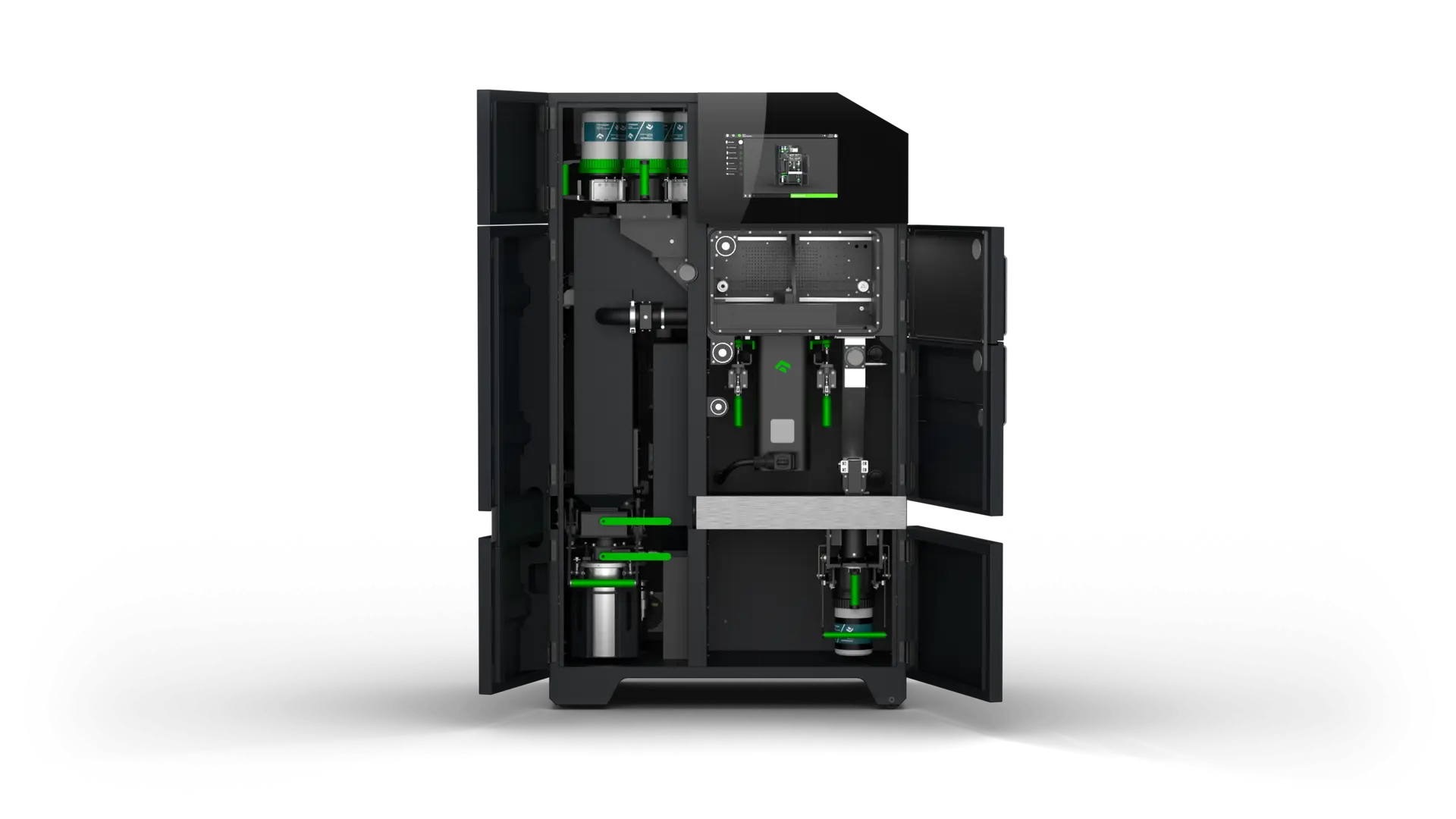
MPRINTpro. Image courtesy of OneClickMetal.
The Japanese efficiency push in the 1973 oil crisis was actually preceded in 1972 by a building shift towards smaller cars with better finishing, luxury, and value. From a 1972 Popular Science article,
“I know the intermediates have got bigger and heavier in recent years. The 1973 Chevelle is as big as the 1957 Impala. So naturally the picture changes a bit if you move the barrier below the intermediates. But would you have believed three years ago that 39.3 of all cars now sold in the U.S. would be compacts or smaller? Traditionally, Detroit has equated value with size. Now this is changing, too. Oldsmobile’s Omega is the same size as Chevy’s Nova, but priced like an Olds. Ford will introduce expensive new luxury options for the Maverick, and Dodge is looking very hard at special high-grade interiors or the Dart. The idea is finally beginning to gain recognition in Detroit that people really want smaller cars, without giving up any comfort or luxury, and pay for what they want.”
I’m going to tell you something completely shocking: customers will pay for value. People will pay for what they need. People will pay for what they want. I may be able to dazzle you into buying an unnecessary perfume at a ridiculous price with marketing pizazz, but we are in the machine tool market. Draping actresses over cars didn’t work, so why would similar sophistry work for machine tools? Yes, of course, some people want $5 million machines, and they need the biggest and best. But if you do not have a low-cost solution, you will be wiped out eventually. There are hundreds of thousands of machine shops and factories; how many people can afford a $5 or $1 million machine?
Between very expensive traditional firms and Chinese firms, OneClick (together with Xact Metal) offers a NATO-made alternative that is one-tenth to one-twentieth the cost of installation. For defense companies, these systems will be very tempting. Indeed, we’re seeing a lot of defense customers adopt these systems. Startups use OneClick and Xact systems to produce thousands of suppressors. Not for brackets or prototypes, no, they’re using these systems in the production of high-value items. Profitable production. And it’s quicker for them to get started, installed, and up and running. This is not (only) a toy for your university; this is the fastest and cheapest way to get started manufacturing metal LPBF parts. More accessible products, which make money faster for clients, will win out in the end.
So this is truly a seminal moment for the democratization and true growth of LPBF. Xact and OneClickMetal are offering increasingly capable, affordable LPBF systems. That, combined with the value engineering by Eplus, Farsoon, and BLT, will make the LPBF market much larger than it is today. I hope that we see much more low-cost LPBF innovation, something that has been quietly building for many years now.
Subscribe to Our Email Newsletter
Stay up-to-date on all the latest news from the 3D printing industry and receive information and offers from third party vendors.
Print Services
Upload your 3D Models and get them printed quickly and efficiently.













You May Also Like
The Manufacturing Race Behind the Drone Revolution
We are in the middle of a major manufacturing shift focused on the production speed and payload capacity of uncrewed aerial systems (UAS), or drones. A recent Manufacturing Dive article...
ADDMAN to Buy Up to $10.8M in Nickel 718 Powder from 6K Additive Over 30 Months
After years of buildup, we’re finally starting to see what the US metal additive manufacturing (AM) market could look like at scale. To be sure, it’s still not quite there,...
Metal AM in a Multipolar World, Part 2: How PBF and DED Could Change by 2035
The first decades of PBF development were heavily shaped by machine capability: more power, more lasers, larger build volumes, better recoating, and improved process monitoring. These developments will continue, but...
Advanced Manufacturing at IMTS 2026: 3D Printing and AI and Drones, Oh My!
Last week’s International Manufacturing Technology Snow (IMTS) in Chicago welcomed over 90,000 attendees to the jungle that is McCormick Place. With over 1.17 million square feet of exhibit space, and...