Wilson Shoots for the Hoop with First-Ever, 3D Printed Basketball… at $2,500

In an unprecedented move, Wilson Sporting Goods Co. has announced the release of the Wilson Airless Gen1, the first-ever 3D printed basketball. This bold product, which has the potential to shift the sports equipment industry in the longer term, comes on the heels of the enthusiastic reception of the Airless Prototype last year. Available exclusively at Wilson from Feb. 16, the Wilson Airless Gen1 represents a leap forward in sports equipment technology. The price tag? A gut-punching $2,500.
The Wilson Airless Gen1 basketball emerges from the success of its prototype, which debuted at the NBA Slam Dunk Contest last year. The commercial version includes similar functionality but with significant improvements that elevate its performance to nearly match that of a regulation basketball in terms of weight, size, and rebound.
“We were overwhelmed by the excitement from our Airless Prototype, and we knew it was time to bring this rare, first-of-its kind innovation to the world,” said Kevin Murphy, General Manager, Team Sports at Wilson. “Wilson has gone where no brand has gone before with the release of the Airless Gen1 basketball, further inspiring the next generation of sports innovation.”
The development of the Airless Gen1 was spearheaded by Wilson Labs, the innovation arm of Wilson, which focused on refining the basketball’s performance and manufacturing efficiency over the past year. The functionality has seen significant improvements, with an upgraded lattice design ensuring more consistent performance and bounce, while maintaining its unique see-through lattice structure adorned with eight panel-like “lobes.” In an effort to streamline the manufacturing process, holes have been integrated within the ball’s channels, expediting the production of each basketball without compromising its airless nature, thus eliminating the need for inflation. Customization options have been broadened; each ball comes with a built-in label that not only allows for personal customization but also displays the specific, limited production number of each unit. Moreover, the Airless Gen1 broadens its aesthetic appeal by introducing color variations that go beyond the original jet-black colorway, including options in brown and natural white.
To create the original prototype and limited series production model, Wilson Labs worked with several key partners. This included collaborating with General Lattice for computational design services, DyeMansion for color and finishing solutions, EOS for technical oversight, and SNL Creative as the primary manufacturing partner.
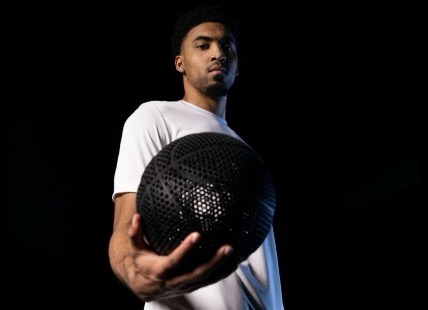
Priced at $2,500, the Wilson Airless Gen1 is a premium, limited-edition product available exclusively on Wilson.com. Its launch coincides with an on-site activation at NBA Crossover in Indianapolis, offering fans a firsthand experience of this unique basketball.
The project and price raise several key issues. Though Wilson has been exploring the additive manufacturing (AM) space for some time, notably using Azul3D’s high-speed technology to produce pickleball paddles, this is its first commercial product, albeit a limited run. Who would pay $2,500 for a basketball? Not your average consumer. As one 3DPrint.com reader pointed out, maybe those who’d buy it as a status symbol from the Kardashians.
The high price is indicative of the cost of production for such an item. As a limited market test run, Wilson can gauge interest, potentially build out its niche, and Wilson and/or SNL can scale based on demand—something only 3D printing can allow as a flexible, tool-less manufacturing method. Because EOS machines, along with DyeMansion systems, are already used daily in production for service bureaus and the like, they are stable and reliable. Throughout can be increased with more lasers and the workflow can be automated, ultimately bringing down costs. Ultimately, they could do for sporting goods what Adidas has done for 3D printed midsoles. In turn, the price could eventually be brought down below $1,000, but making it cost competitive with consumer balls would be a leap. Serious enthusiasts might make the investment, again performing some conspicuous consumption, for a $500 ball that outperforms and outlasts traditional models.
And that’s probably the ballpark Wilson is shooting for—not to mix metaphors. The closest comparison is the range of golf clubs from Cobra, made with HP’s MetalJet technology to achieve a product that retails for about $350. That’s a premium above high-end consumer clubs, but fits well within the niche of consumer that would buy them.
It would not be surprising at all for this project to take off and truly jumpstart the sports segment for AM, which has already gained significant traction over the past several years in terms of helmets, gloves, bikes, and other elements. I also wouldn’t be surprised to see competitors, possibly using less expensive 3D printers, attempt to recreate similar balls at a lower cost.
Perhaps what makes this product most appealing is how it demonstrates the potential to get away from rubber and leather for basketballs. Both materials are fraught with ethical and ecological concerns, but resource scarcity is dictating market trends around rubber and its alternatives. If Wilson can make a ball that lasts nearly forever without this material, it can overcome key supply chain hurdles in the future.
Subscribe to Our Email Newsletter
Stay up-to-date on all the latest news from the 3D printing industry and receive information and offers from third party vendors.
Print Services
Upload your 3D Models and get them printed quickly and efficiently.











You May Also Like
3D Printing News Briefs, March 28, 2026: TCT Asia, Distribution Agreement, FDA Clearance
We’re starting 3D Printing News Briefs this weekend with some news out of TCT Asia, and then moving on to a metal AM distribution agreement between MULTISTATION and WAAM3D. We’ll...
The Magic of AMUG as Reported by a First-Time Attendee
There’s a special kind of magic about AMUG. I’ve heard about it for years, but never experienced it myself until last week. It’s different than what you see at some...
3D Printing News Briefs, March 26, 2026: AMUK, IP Dispute, Asbestos, & More
We’re kicking off today’s 3D Printing News Briefs with an America Makes Project Call, and then moving on to additive manufacturing in the UK. Then we’ve got some legal news...
At TCT Asia 2026, China’s AM Industry Looked Ready for Scale: Part 1
Walk into TCT Asia 2026, and the first impression is density. More than 55,000 square meters across Halls 7.1 and 8.1 at Shanghai’s National Exhibition and Convention Center, over 550...