Scalable Metal 3D Printing via Electrochemical Additive Manufacturing


Additive manufacturing (AM) brings the promise of design flexibility, performance optimization, reduced lead times, and sustainability. However, perhaps one of the greatest challenges remaining for this enabling technology is scaling to meet the demands of high-volume applications. While some successes in high volume manufacturing have been achieved in plastic AM, metal AM has seen limited success. Key constraints limiting the mass scalability of metal AM include the use of expensive and difficult to handle powder-based feedstocks, complex and labor-intensive post-processing, insufficient repeatability, energy intensive thermal processes, and high-cost equipment that requires skilled operators. A variety of solutions have been developed to address these constraints, but few have been able to successfully address them all.
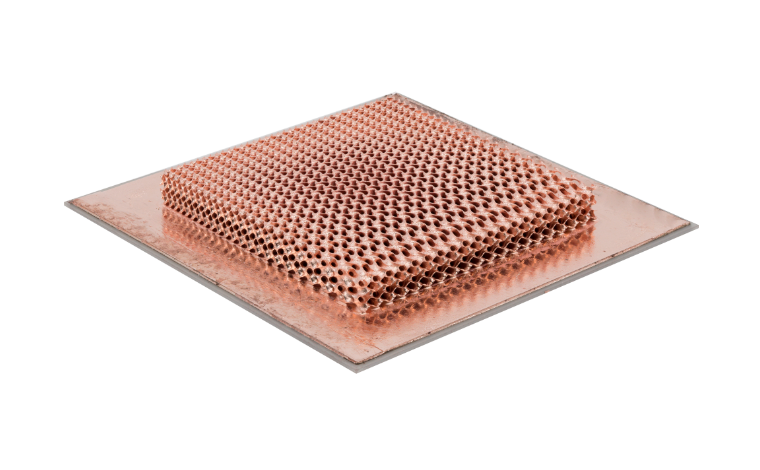
Fabric8Labs’ Electrochemical Additive Manufacturing (ECAM) has recently emerged as a differentiated technique for high resolution metal AM. In contrast to other AM techniques, ECAM does not use powder-based feedstocks nor thermal processes. Instead, ECAM builds at the atomic level from a room-temperature, water-based feedstock containing dissolved metal ions. The metal is sourced from widely available, low-cost metal salts from a long-standing and robust supply chain.
The ECAM printing process is more akin to stereolithography (SLA), or digital light processing (DLA) printing processes used for polymers, rather than existing metal AM processes such as laser powder bed fusion or binder jetting. The water-based ECAM feedstock has low viscosity and is maintained at room-temperature, allowing for hundreds of printers to be served by a common feedstock reservoir via standard plumbing components – drastically simplifying management of raw material inputs. Furthermore, powder-free feedstock has significant advantages when making complex, high-resolution liquid cooling products that are difficult, if not impossible, to de-powder.
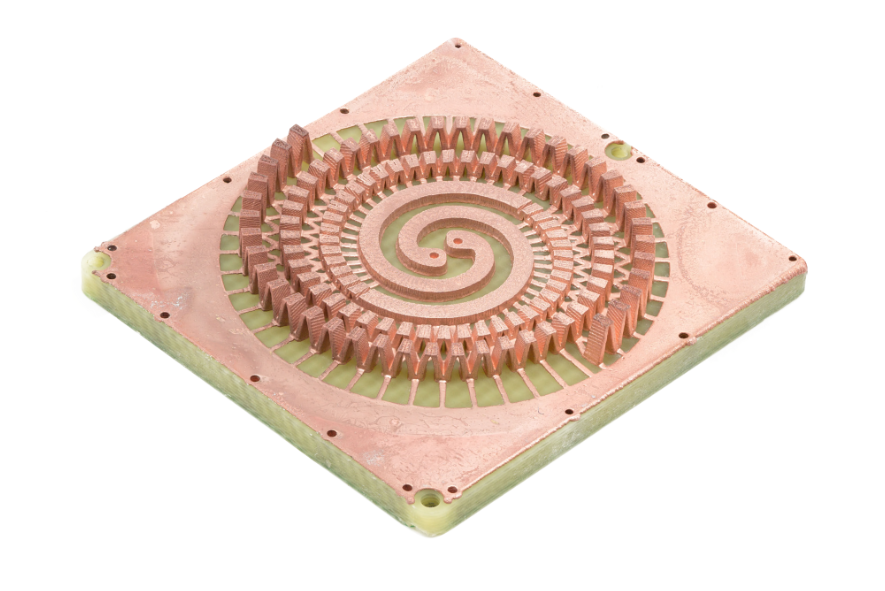
ECAM’s room-temperature process also allows for printing directly onto a wide range of substrates including copper sheets or foils, printed circuit boards (PCBs), ceramics, and silicon. In one common example, ECAM is utilized to add high-resolution cooling features onto a pre-machined copper base plate to produce an advanced liquid cold plate for data center cooling. Other examples include power modules and high-frequency RF devices which utilize ceramic and PCB substrates, respectively. This hybrid manufacturing approach of coupling AM with traditional manufacturing drastically improves the scalability of the technology, as only the high-value and complex features need to be 3D printed.
The high-volume scalability of ECAM has attracted significant funding from the private sector, with more than $73M of total capital investments into Fabric8Labs. The company has used the recently closed Series B funding to establish a pilot production facility based in San Diego, CA. ECAM is uniquely suited to serve applications in the electronics value chain. Early products delivered from this facility include high-performance thermal management devices, such as liquid cold plates, and high-frequency RF components including antennas and filters. With the capability to scale to millions and even billions of parts per year, ECAM has potential to become a widespread manufacturing technology.
Subscribe to Our Email Newsletter
Stay up-to-date on all the latest news from the 3D printing industry and receive information and offers from third party vendors.
Print Services
Upload your 3D Models and get them printed quickly and efficiently.











You May Also Like
AM Demand Signals: Global Grid Resilience
We’re one year and a few days removed from the DeepSeek meltdown that rocked U.S. equity markets, not to mention the de facto U.S. AI brain trust, with fears that...
Critical Alloy Powder Manufacturing: CAPP Prioritizes AM Feedstocks and Advances U.S. Materials Leadership
Scaling additive manufacturing (AM) supply chains, particularly for metal powder-based processes, depends on the economic viability of products. The development of critical high-temperature metal alloys in powder form requires customer...
3DPOD 290: 3D Printing Since 1993 with Rajeev Kulkarni, Axtra3D
Rajeev Kulkarni was an early 3D Systems employee. He would spend 29 years at 3D Systems and was their VP of Corporate Strategy, CPO Printer Products, Manager of their Desktop...
The AM Adoption Problem No One Models
Through its short history, Additive Manufacturing has been presented to the investment community as a classic high growth technology story. Manufacturing is a multi-trillion-dollar market. Even a small percentage looks...