The Winds of Change in Metal 3D Printing

The famous rock ballad by the Scorpions, Winds of Change is my inspiration. I would change it to the “Gas Path of Change” but then that is really hard to lyricize to. We can rock out (and whistle) the intro together in person as I will be at the upcoming Additive Manufacturing Strategies in NYC where The Barnes Global Advisors is a sponsor this year. I will be moderating the panel on “Metals in AM” on behalf of Metal Powder Works. The panelists are Chris Eonta from Molyworks, Jamie Perozzi from 6K Additive, and Samantha Welch from Joby Aviation. We will explore where we are in powder production but also the requirements for powders where Sam will keep us all honest by representing the user and the originator of the requirements.
Our understanding of powders in AM is in its infancy. Today, we have one standard for characterizing powder, the Hall Flow, and most manufacturers treat it as a data point, not a pass or fail. We describe roundness as a binary – spherical or non-spherical when in reality, it is a continuum. AM powder bed system moves powder fine if you only need to cover a 250 mm2 surface, but it is not scalable. Imagine trying to plow a mound of powder big enough to cover a 1 m2 bed?!
Going from the macro sense down into the granular (pun intended) our understanding of powder particles, populations, and processing effects is still being studied at universities. As my oldest daughter started college this year, I made an analogy that made sense to me (figure 1).
When you meet a new person, they have a characteristic, just like a powder particle. The particle may be big or small, have satellites, or be 0.87 sphericity. A boy she meets may wear a ball cap, have cool clothes, and tell funny jokes.
When the same person is with a group of colleagues, their behavior likely changes to accommodate the population just as their presence alters the behavior of the population. With powder particles, small particles or fines can dominate the movement of the population.
Finally, those of us in AM often forget to look at the last piece – the process. We spend inordinate amounts of time getting powder into the bed, but the process imparts a force on the population. Truly ‘high flowing’ powder will then migrate away as the binder or laser (i.e. the process) in what we have seen as denudation or ballistic impact to the surface. Imagine the influence of the introduction of alcohol on our population of college students, changing their collective behavior together.
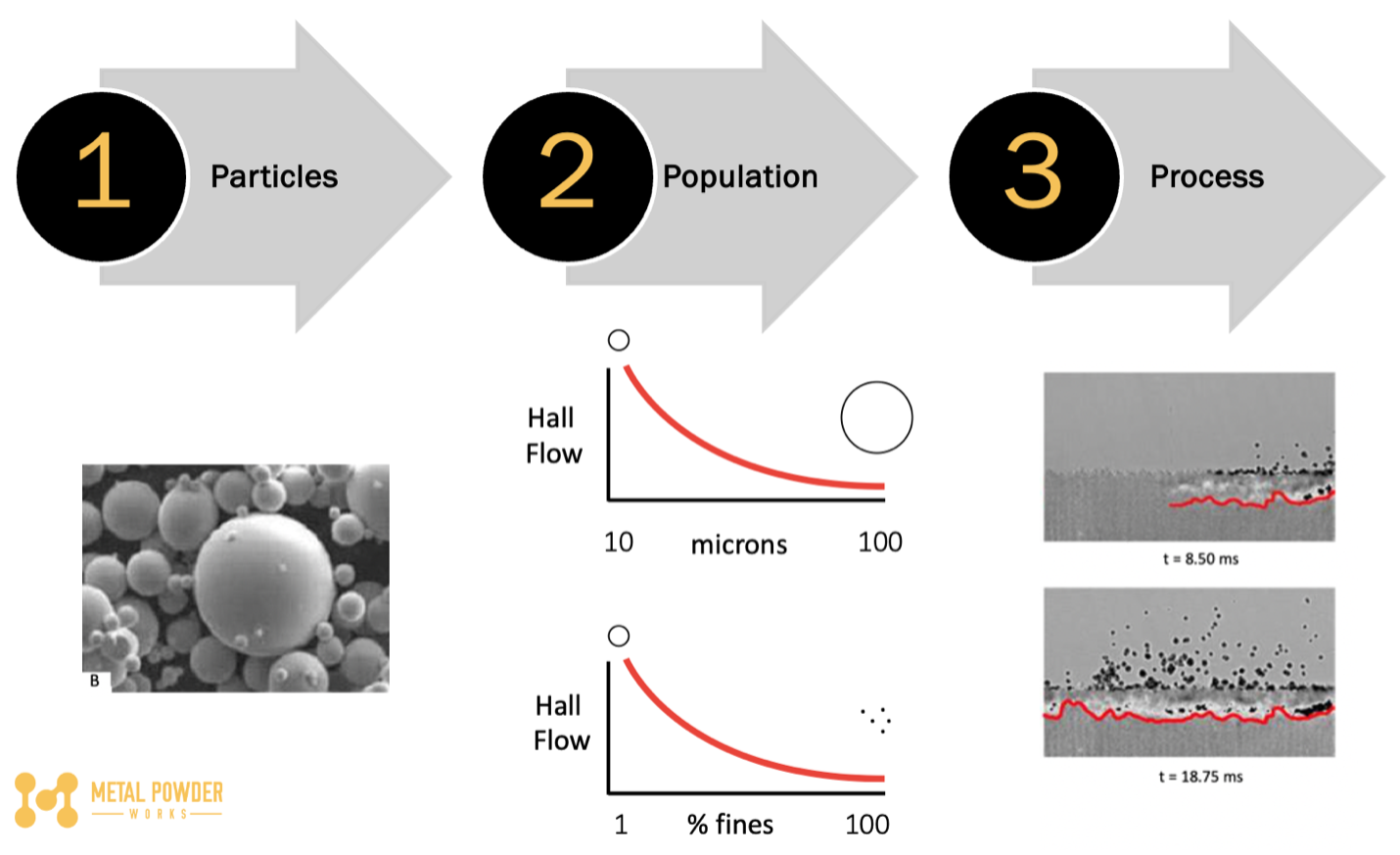
Figure 1.
We’re still in the early days of thinking about powders and the various AM processes. Our graphic (figure 2) shows the different requirements for powders by the various AM processes.
One steady comment that has come from my peers and colleagues in the manufacturing space is the need for consistency. 6K did a survey over the last year, and the need for consistency (and quality, which are essentially the same) is the biggest.
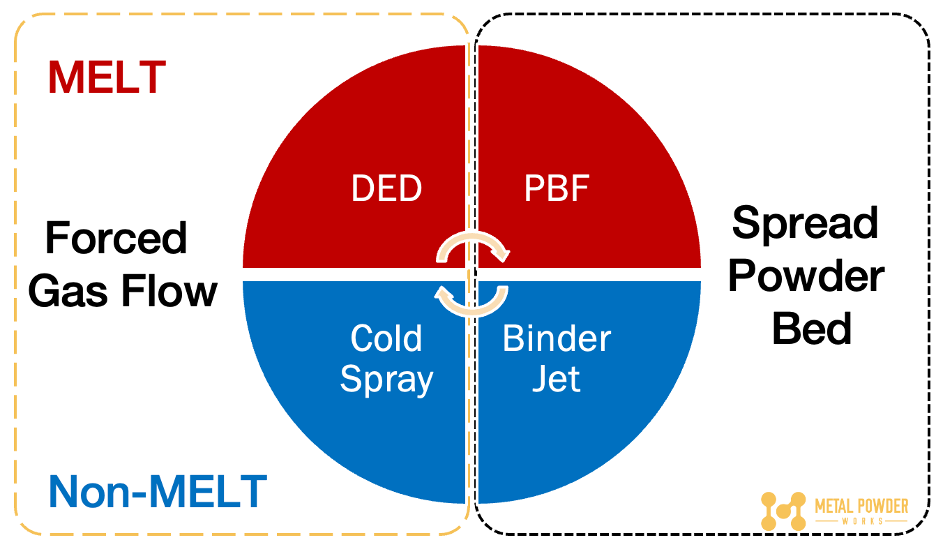
Figure 2.
Lastly, let’s be conscious of how we got here and the macroeconomics. Virtually all AM powders are gas or plasma atomized which yields a ‘rounder’ particle than water atomization but neither is very consistent. Water atomization makes up almost 95% of global powder production – it is more useful for making powders for the manufacturing processes that use it. Atomization does not have to be the only method for making AM powders, especially when you consider the range of requirements from being melted, to sintered, and/or deformed. The next time you get together with a population of your friends consider this: How will AM grow when it uses only 5% of global production capacity?
John Barnes, Founder of The Barnes Global Advisors and CEO of Metal Powder Works, will be participating at the upcoming Additive Manufacturing Strategies business summit in New York, February 6 to 8, 2024. Barnes will be moderating a panel on “Metals in AM” on behalf of Metal Powder Works. The Barnes Global Advisors will be hosting a workshop titled “Finding the Value in AM” on the third day of the event, as well.
Subscribe to Our Email Newsletter
Stay up-to-date on all the latest news from the 3D printing industry and receive information and offers from third party vendors.
Print Services
Upload your 3D Models and get them printed quickly and efficiently.













You May Also Like
Solid Rocket Motors: the First Big Scaling Test for AM in the US Defense Sector
The additive manufacturing (AM) industry has become obsessed with the opportunity for drones, and there’s certainly good reason for that. But before drones, the big focal point in AM for...
UK Sight Loss Charity 3D Printing Ultrasounds for Visually Impaired Parents-to-Be
The Guide Dogs for the Blind Association, more commonly known as Guide Dogs, is the UK’s top sight loss charity, working to help people with vision loss “live the life...
Savannah River National Laboratory & 3D Systems Sign Nuclear CRADA
Cooperative Research and Development Agreements (CRADAs) are deals between US federal organizations and other entities. The latter group most often includes private companies, as the primary purpose of CRADAs is...
3D Printing News Briefs, August 29, 2026: Prosthetics, Pelvic Implants, Capillaries, & More
In this weekend’s 3D Printing News Briefs, America Makes announced the winner of its GOTHAAM Project Call. Then it’s all about healthcare 3D printing news, with Stratasys and Limbitless Solutions...