Dubai Commences Construction of First Private 3D Printed Residential Villa

Work has recently begun to build a private, residential villa in Dubai using 3D printing technology, a significant milestone in the emirate’s ambition additive construction (AC) plans. The Dubai Municipality has issued the first construction license for a privately-owned villa that will be entirely built via AC. This project aligns with Dubai’s long-term vision outlined in the Dubai 3D Printing Strategy 2030, aiming to incorporate a minimum of 25 percent of 3D printed buildings within the emirate by 2030.
The villa, located in the Al Awir 1 area, will reach a height of 4m (13.2 ft) and will be printed in a single session. Construction work on the villa began recently and is expected to be completed by October 2023, utilizing locally sourced concrete for the entire structure.
“Dubai Municipality has issued the emirate’s first construction license for a private residence built with 3D printing technology. This project aims to encourage contractors, engineers, investors, and real estate developers to adopt and use technology in their building operations,” said Eng. Mariam Al Muhairi, Acting CEO of the Buildings Regulation and Permits Agency at Dubai Municipality. “The municipality further offers support and facilities to monitor and control the usage of this innovative technology in building and construction, in line with the Dubai 3D Printing Strategy and Decree No. (24) of 2021 Regulating the Use of Three-dimensional Printing in Construction Works in the Emirate of Dubai, which aims at increasing the percentage of buildings implemented and printed using the 3D technology by no less than 25 percent by 2030.”
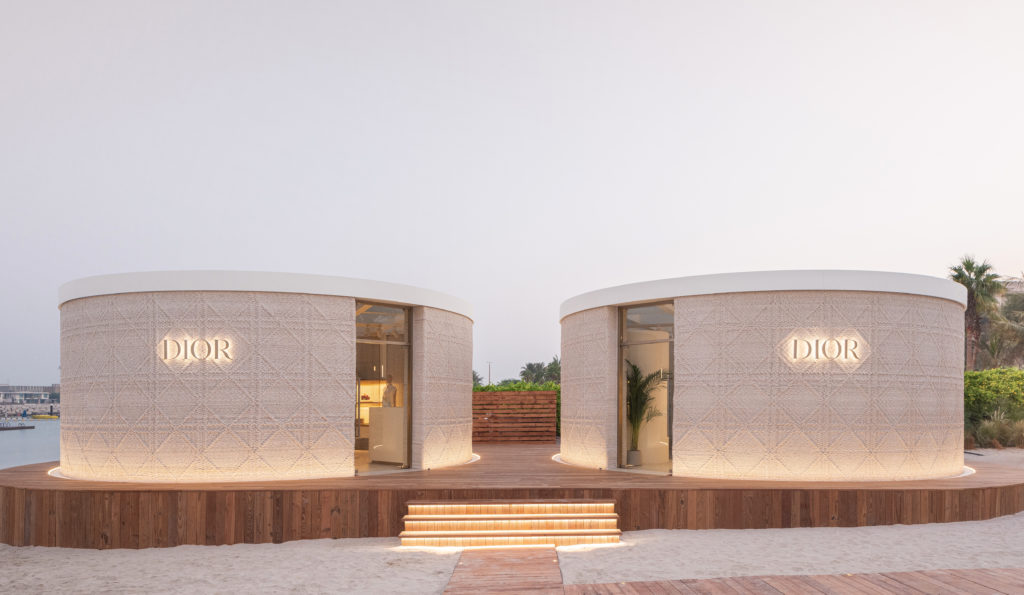
3D printed Dior concept store in Dubai. Image courtesy of Mohamed Somji/Dior/WASP.
Introducing 3D printing technology in construction introduces several advantages, including the potential to address labor issues prevalent in Dubai’s construction industry, which relies heavily on a typically poorly treated migrant workforce that have, in the past, protested against their treatment. By reducing the need for extensive on-site labor, 3D printing offers an alternative approach that mitigates potential labor-related conflicts.
This is alongside the economic and environmental benefits typically touted by AC companies and users. It simplifies the supply chain, reduces construction costs, and shortens timelines. The use of sustainable and recycled materials contributes to environmental preservation by minimizing construction waste. Additionally, the efficiency of 3D printing technology reduces the need for extensive on-site personnel, resulting in faster and more precise construction compared to traditional methods.
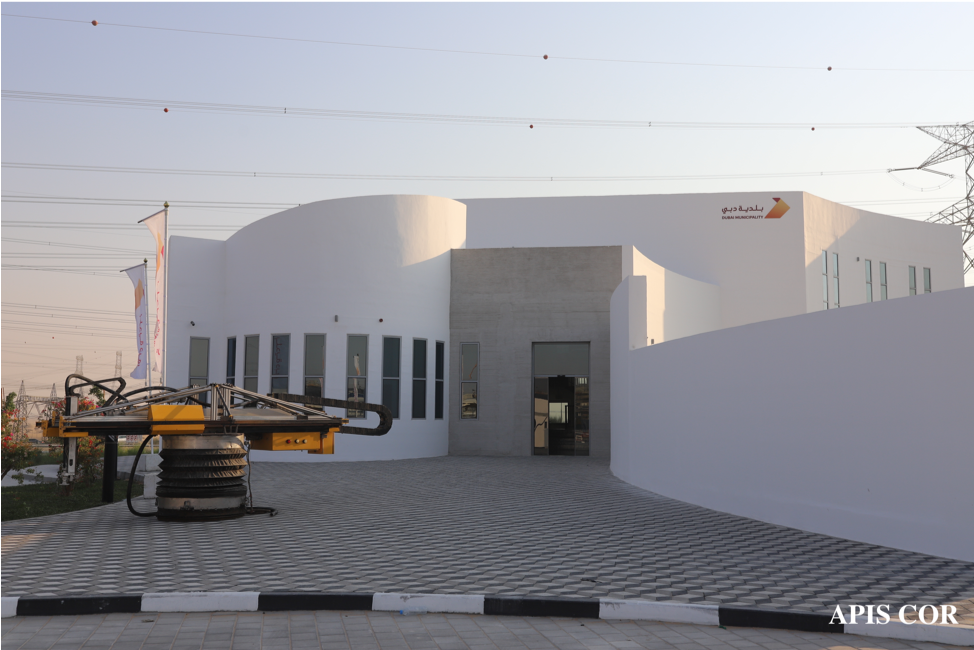
A 3D printed office building in Dubai. Image courtesy of Apis Cor.
Dubai has been an early adopter of additive manufacturing and AC, in particular. In 2016, the city unveiled the Office of the Future, the world’s first fully functional 3D printed office. Building on this success, Dubai Municipality subsequently constructed the emirate’s largest 3D printed building—a two-story Innovation Centre located in Al Warsan. Other projects have included a Dior store, made with WASP’s AC technology, and a drone research laboratory.
The technological roadmap the city has established is necessary as easily accessible supplies of fossil fuels peak, forcing formerly oil-rich municipalities to turn to new industries to sustain their economies. For Dubai, this means an attempt at creating a tech paradise.
Subscribe to Our Email Newsletter
Stay up-to-date on all the latest news from the 3D printing industry and receive information and offers from third party vendors.
Print Services
Upload your 3D Models and get them printed quickly and efficiently.











You May Also Like
China Becomes Latest Space Power to Demonstrate Metal 3D Printing in Orbit
China has demonstrated metal 3D printing in space as part of its plan to develop manufacturing technologies for future space missions, including Moon construction. The experiment took place aboard the Qingzhou...
AMPulse Asia: APAC 3D Printing Market Roundup
Key Takeaways Coverage window: April 27 to May 10, 2026. Roughly 30 additive manufacturing (AM)-relevant announcements were tracked across eight Asia-Pacific countries. Largest disclosures: Farsoon Technologies (688433.SH) filing a RMB...
3D Printing Financials: Stratasys Bets on Defense and Drones as Printer Sales Slow
Stratasys (Nasdaq: SSYS) started 2026 with lower revenue and a larger loss as customers continued to slow down spending on new 3D printers. Still, the company pointed to stable recurring...
3D Printing Financials: Xometry Surges After Record Quarter and Siemens Deal
Shares of Xometry (Nasdaq: XMTR) surged on Thursday, May 7, after the company reported record first-quarter 2026 results and announced a major partnership with Siemens. The stock climbed as much...