3D Printed Sneakers Made from Foaming Pellets Unveiled by ELASTIUM


3D printing shoes has taken off in a big way over the past year. One company joining the fray is ELASTIUM. Based in Sharjah in the United Arab Emirates (UAE), the company wants to make shoes using an elastomer foaming pellet 3D printer. Similar to digital foam efforts from EOS, OPT Industries, Rapid Liquid Print and PrintFoam, the startup wants to produce functional, architected materials that can work in ways that traditional materials cannot. For example, a programable foam can be designed to feel different at different locations of the sole.
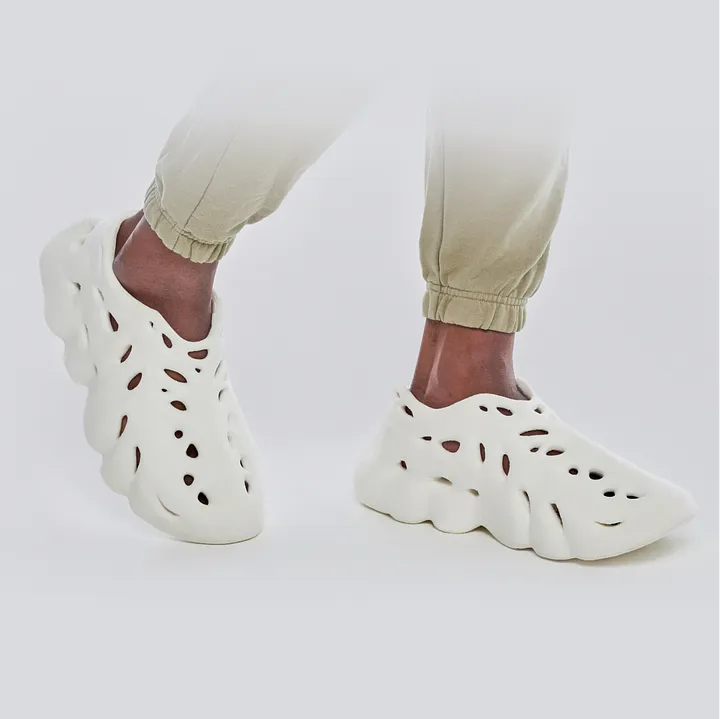
ELASTIUM says that it has developed its own process with elastomer foams that can be turned into unique 3D printed shoes. The first pair of sneakers from the company is dubbed ELASTIUM-1, available in a limited production run of a 1,000 pairs with an “adjustable fit.” Customers can also own their own shoe designs as an NFT. The company says that its shoes have the “same level of comfort and performance as traditional footwear,” in part as a result of lattice structures incorporated into the design.
“[I]f you want something Crocs-level soft for wearing barefoot or something just nice to the touch, there is no alternative to foam. Still lattice structures are very useful. They are resilient. They reduce printing time. They make the structure tunable. So here is what we actually are going to use: foam lattice structures (FLS),” ELASTIUM founder Robert Karklinsh said.
If that claim pans out, this would be a huge advance over other efforts in the space. The company also has 12 color options and the shoes are machine washable. The material is based on TPU, so it could be similar to Colofrabb Varioshore TPU, a filament whose foaming properties can be changed. Lubrizol also has a foaming TPU technology, as do others.
In 2021, Karklinsh was developing the Unitruder, a pellet-based extruder, when he decided to add a foaming agent to his pellets. The firm’s technology should have a potential cost advantage over filament-based approaches to printing shoes, with ELASTIUM stating that it can buy pellets for “$7/kg. TPU filament would cost around $12/kg to produce. PU resin would cost at least $35/kg.¨ The company also says that pellet extrusion with TPE is faster than with filament.
The company also says that the company makes the shoes “on-demand without human labor: We created the world’s first 3D printer capable of producing footwear from super soft and low-density materials.” In the future, the company wants to offer custom footwear based on scans of customer feet.
“[We hope for] 3D printing factories [that] are continuously scalable and can be deployed almost anywhere. They can be deployed near consumers and scaled up or down depending on the demand or population density. This can drastically reduce the cost of transportation and recycling. They can also be deployed in areas with access to renewable energy. For example, for our company residing in the UAE there is a surplus of solar energy, and one of our goals is to create a 5k/month factory in daylight running on the solar power alone,” Karklinsh wrote in a substack post about his company.
“Fully 3D printed footwear (from thermoplastic materials) is also relatively easy to recycle. There is no glue involved. There is no need to separate different materials that make up a traditional pair. A fully 3D printed sneaker can be shredded into pieces and mixed up with virgin material in extruder to produce a new pair.
“To make fully 3D printed footwear mass adopted we need to produce at the same cost as Nike ($25 per pair). And our footwear needs to be as comfortable, light and durable as Crocs.”
The founder also hopes that the firm’s printhead can process foams with characteristics that can not be replicated by filaments. In a quick cost calculation, Karklinsh estimates that the production costs of a pair is $19.80, which can be printed in under 20 hours. To reduce overall costs, the company aims for faster 3D printing and more automation.
ELASTIUM is certainly ambitious. I’m a little worried because of the NFT angle, but generally love the idea of 3D printed shoes made from foaming TPE pellets. Someday someone is going to get the 3D printed shoe right and I can’t wait to find out who it is.
Subscribe to Our Email Newsletter
Stay up-to-date on all the latest news from the 3D printing industry and receive information and offers from third party vendors.
Print Services
Upload your 3D Models and get them printed quickly and efficiently.











You May Also Like
AM Demand Signals: Global Grid Resilience
We’re one year and a few days removed from the DeepSeek meltdown that rocked U.S. equity markets, not to mention the de facto U.S. AI brain trust, with fears that...
Critical Alloy Powder Manufacturing: CAPP Prioritizes AM Feedstocks and Advances U.S. Materials Leadership
Scaling additive manufacturing (AM) supply chains, particularly for metal powder-based processes, depends on the economic viability of products. The development of critical high-temperature metal alloys in powder form requires customer...
3DPOD 290: 3D Printing Since 1993 with Rajeev Kulkarni, Axtra3D
Rajeev Kulkarni was an early 3D Systems employee. He would spend 29 years at 3D Systems and was their VP of Corporate Strategy, CPO Printer Products, Manager of their Desktop...
The AM Adoption Problem No One Models
Through its short history, Additive Manufacturing has been presented to the investment community as a classic high growth technology story. Manufacturing is a multi-trillion-dollar market. Even a small percentage looks...