
New DMG PBF Metal 3D Printer to Be Made in USA

At the 2023 RAPD + TCT show in Chicago, machine-builder DMG Mori announced the development of a new metal powder bed fusion (PBF) 3D printer, LASERTEC 30 SLM US. Not only does the new machine improve upon the company’s existing PBF line, but it will also be manufactured in the U.S.
To begin shipping in December 2023, the LASERTEC 30 SLM US was designed with a focus on lowering cost-per-part. While most manufacturers have simply increased the number of lasers on a machine to accomplish this, DMG Mori introduced improved features that accomplish similar results.
Specifically, Adaptive Beam Control allows for dynamic changes to the power, speed, and beam profile of the 1.2 kW laser, making it possible to improve quality and overall throughput. The spot size can be changed on the fly from 80-240 μm. Additionally, the machine, which features a 11.8 x 11.8 x 11.8 in. build envelope, also includes non-contact recoating, which further improves quality and speed, as well as optimized gas flow and a long filter light of up to 1500 hours. Altogether, this results in what the company described as “best cost/productivity,” a metric invented by DMG Mori to measure the value and throughput that can be achieved by modifying the beam throughout the build.
One of the largest machine-builders worldwide, DMG Mori is a unique company in many ways in that it has a strong heritage emanating both from Germany and Japan. Its machine tools are similarly hybrid, in that the company has focused not only on subtractive but also additive manufacturing (AM). Typically, this has included a number of directed energy deposition (DED) printers, but, with the acquisition of Realizer in 2017, also metal PBF. This is now augmented with the addition of the LASERTEC 30 SLM US.
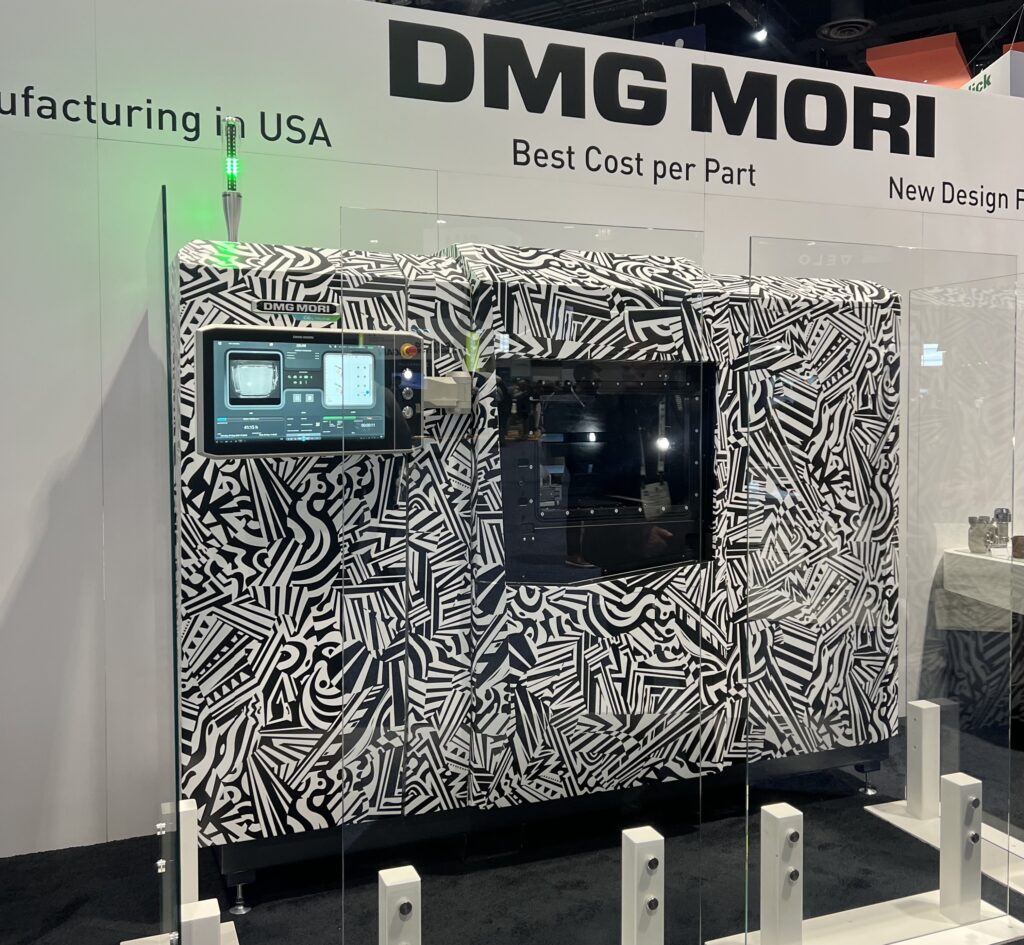
The LASERTEC 30 SLM US on display at RPAID + TCT 2023.
In addition to its AM Excellence Centers in the U.S., Germany, and Japan, DMG Mori has 12 technologies centers in the U.S., as well as a U.S. headquarters, Academy Training Center, and spare parts center. In the U.S. alone, it has over 16,000 customers and has installed over 63,000 machines. At the AM Excellence Centers offer support for applications, services, design for AM, metallurgy, and other developments.
All of this is to say that, while the company’s rollout into LPBF hasn’t been as quick as one might have expected since its purchase of Realizer in 2017, it is innovating without the need to rely on many lasers. We’ll have to see how the machine compares to multi-laser 3D printers, however. What is more interesting is that the company is following a trend that increases supply chain resilience for DMG Mori and that is to have multiple manufacturing sites globally. It has its bases covered in Asia, Europe, and the U.S. so that, given future global instability, it will not only be able to serve its clients better, but it will be able to serve itself better as well.
Subscribe to Our Email Newsletter
Stay up-to-date on all the latest news from the 3D printing industry and receive information and offers from third party vendors.
Print Services
Upload your 3D Models and get them printed quickly and efficiently.













You May Also Like
3D Printing News Briefs, August 22, 2026: Polymers for CubeSats, Animal Mobility Devices, & More
We’re starting with defense news in this weekend’s 3D Printing News Briefs, before moving on to polymers for CubeSats and 3D printed prosthetics. We’ll end with a story about engineering...
Pusan National University & ORNL Develop Elastomeric Liquid Crystal Actuators
Researchers from Korea’s Pusan National University and Oak Ridge National Laboratory (ORNL) have developed 3D printed elastomeric actuators. In a paper published in Nature, the team used elastomeric liquid crystal...
Scientists Use BMF to 3D Print Seal Whiskers That Track Prey Long After It’s Gone
Seals use their whiskers to hunt. Not Navy Seals, although they may in some way also, but this article is about lowercase seals. Not Seal the musician either; as far...
Harvard’s Jennifer Lewis Lab Is 3D Printing Artificial Muscles That Twist and Bend on Demand
Researchers at Harvard John A. Paulson School of Engineering and Applied Sciences (SEAS) have developed a new way to 3D print materials that can move on their own, bending, twisting,...























































