Riddell’s 3D Printed Helmet Liners Are the MVPs of the NFL Playoffs

When Josh Allen took the field for the NFL’s Wildcard round vs the Miami Dolphins, most people saw a typical helmet. However, if you looked closer, you will notice a lattice structure surrounding his head. This is Riddell’s Diamond Precision Technology, made with 3D printing to make a customized helmet liner that better protects a player against collisions during a game. The technology has matured over the years and is now being seen protecting not only the stars of the game, but the journeymen as well.

Josh Allen helmet with Diamond Precision Technology by Riddell. (Source: Wikipedia)
Head injuries have been a crucial topic for the NFL over the years, and developing safer helmets has become paramount. Riddell, one of the largest helmet manufacturers, touts itself as a leader in head protection across all levels of football, and says, “[We are] committed to advancing on-field protection for football players.” Naturally, when the company saw they could advance on-field protection by incorporating 3D printing, they jumped at the opportunity.
“Riddell is known for head protection leadership. Our partnership with Carbon, Silicon Valley’s leading digital manufacturer, reinforces our commitment to advancing on-field protection for football players,” said Riddell Senior Vice President of Research and Product Development, Thad Ide. “As the first to use digital manufacturing in football helmets, Riddell continues our industry leadership by embracing promising new technologies and advancing our innovation roadmap today and into the future.”
Riddell partnered with Carbon in 2018 to make this idea a reality, resulting in this new “Diamond precision” technology. The process relies on Riddell’s Precision-fit head scanning technology and Carbon Lattice Engine to design a liner that is customized to a player’s head and position. The liner is then printed using Carbon’s high-dampening elastomer on Carbon’s L1 printer. Each liner has over 140,000 struts, optimized to absorb rotational and linear impact forces based on the position.
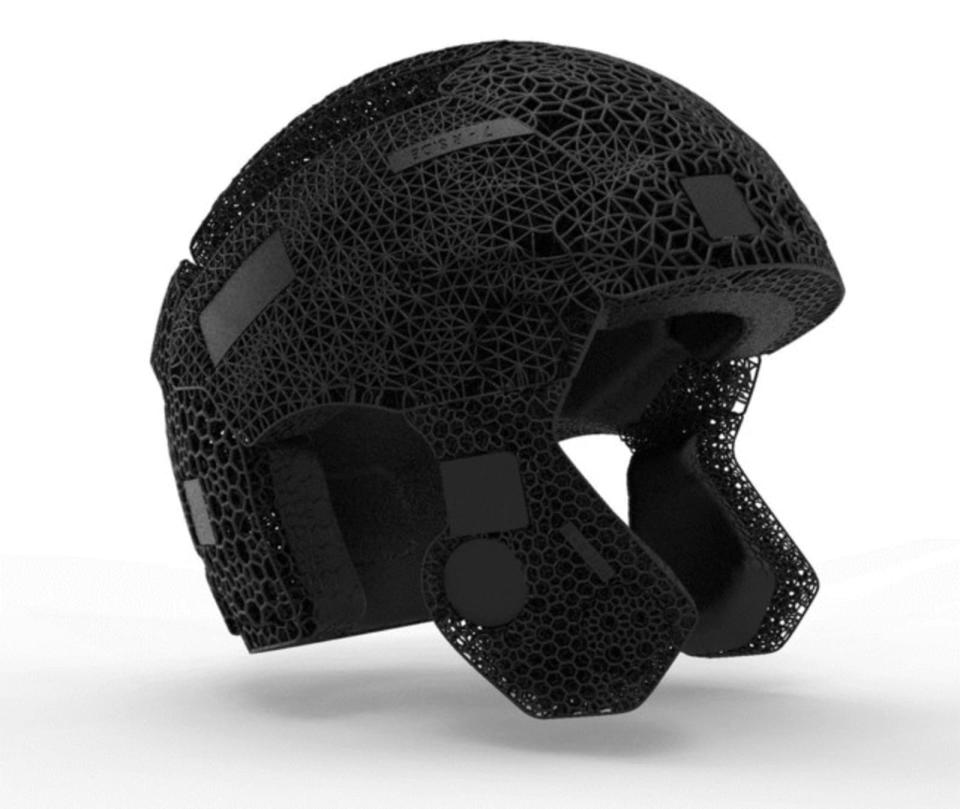
3D printed helmet liner using Carbon’s technology. (Source: Carbon 3D)
“At Carbon, we believe in using the power of technology to advance innovation. Our platform enables companies like Riddell to make products that were never thought possible,” said CEO and Co-founder Dr. Joseph DeSimone. “With this partnership, Riddell becomes one of the largest users of 3D printers in the world. We are proud to be at the forefront of digital manufacturing of protective equipment.”
The liners were initially trialed by a few top players of the league, and have grown in popularity since their release. As it stands, five out of eight starting quarterbacks in the divisional round of the playoffs will be wearing them. They have become one of the safest helmets in the NFL and can only improve as Riddell’s proprietary head impact database captured by their smart helmets continues to grow.
It’s awesome to see 3D printing play a big role on Sundays and in helping better protect player’s craniums too. I am curious to see if this technology could apply to the racing world or other contact sports as they could also benefit greatly from this technology. These lattices are showing they can provide some of the best protection in contact sports and with further improvements they could be unrivaled by any traditional manufacturing method. We are excited to see how this partnership progresses and hopefully see these lattices trickle down to other sports and our local Junior Football leagues soon.
Subscribe to Our Email Newsletter
Stay up-to-date on all the latest news from the 3D printing industry and receive information and offers from third party vendors.
Print Services
Upload your 3D Models and get them printed quickly and efficiently.













You May Also Like
Prusa Core One L+: A Worthy Upgrade?
Disclosure: The Core One L+ was provided to me by Prusa3d free of charge for the purpose of this review. I have not received any other compensation. All opinions expressed...
Building Profiles in the Additive Print Services Market – Market Research Beyond AI Scraping
AM Research New market research: AM Research is building its new Additive Manufacturing Services Market 2.0 model. View the report and preorder here → In case you haven’t heard, at...
3D Printing Services Near $2.5B as AM Market Shifts Beyond Hardware
The additive manufacturing market may be growing again, but one of the more interesting numbers behind that recovery has little to do with selling 3D printers. AM services generated nearly...
Bambu Lab and SUSAN FANG 3D Print for London Fashion Week
At London Fashion Week, some of the more unusual pieces on the runway came from 3D printers. Chinese fashion designer SUSAN FANG presented her Spring/Summer 2027 Air-Illusion collection at the...