Realize Medical Gets 510(k) Clearance for VR Surgical Planning Software


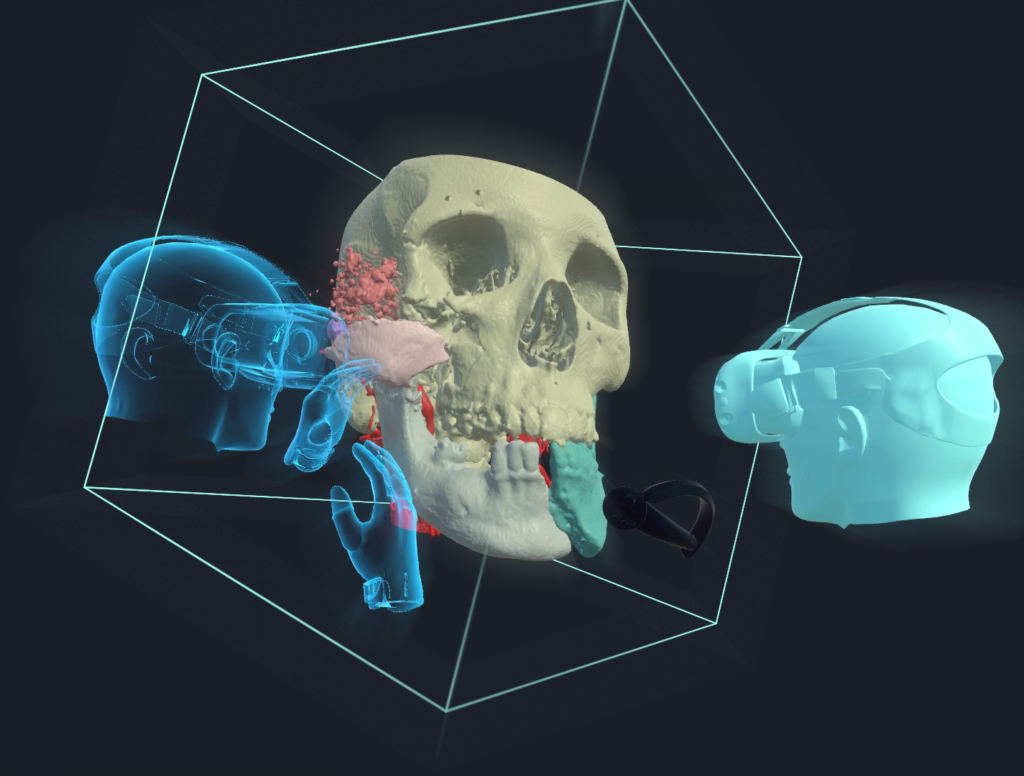
The company hopes that surgeons and other physicians will use the platform to share and experience medical files. One could see how an immersive environment could really aid in surgical planning. Rather than doctors simply imagining a procedure based on the slices of an MRI or CT, more realistic VR models could elicit better understanding. It would also be possible for physicians to collaborate across borders, with a remote technician in India aiding a U.S. surgery to reduce costs. A remote site could aid in understanding a specific pathology with specific knowledge.
The ability to see relevant scans for a complex procedure in VR could allow a patient to really understand their issue and the operation. In a competitive medical field, hospitals and surgeries could win clients by giving them better choices. A more informed choice made by a patient who has a better grasp of the options could aid medical efficacy and overall contentment.

Many CTs and MRIs are shared on compact disks or through cumbersome file exchange programs. As a patient, I don’t have access to the sum total of my medical information. Different doctors maintain portions of my medical info in a piecemeal fashion, as well. The whole balkanized file landscape is flawed and terribly expensive. We sorely need a new level of infrastructure and display technologies. With more scans and laws requiring that records are kept for many years, the storage capacity for these things is also exploding while access and control are fragmentary. We are at the cusp of spending way too much money on a terribly leaky and inefficient way to store, control and access files. So any investment such as that from Realize and Medical IP should be applauded.
However, there is something else here, as well. 3D printing medical models is quite the business for additive manufacturing (AM). With reimbursement now possible, the 3D printing of surgical planning models is growing. Stratasys and others are making specific medical 3D printers and materials to aid in medical training and surgical planning. This whole segment will stop in its tracks if VR is widely adopted. That is crucial to the AM sector because these 3D printed anatomical models are gateway drugs for the adoption of 3D printing by hospitals. Many in-hospital 3D print labs are being set up worldwide. One way to get buy-in, visibility, and relevance in hospitals quickly is to print medical models for everyone. The AM sector should, therefore, pay close attention to AR and VR in medicine because it may seriously inhibit our own growth in that segment.
Subscribe to Our Email Newsletter
Stay up-to-date on all the latest news from the 3D printing industry and receive information and offers from third party vendors.
Print Services
Upload your 3D Models and get them printed quickly and efficiently.












You May Also Like
3DPOD 318: 3D Printing at ORNL, Part II – Thomas Feldhausen
Thomas Feldhausen works at Oak Ridge National Laboratory (ORNL) on hybrid manufacturing, DED, digital twins, and new manufacturing solutions. For years, he’s tried to marry traditional subtractive manufacturing with additive...
Push Button Metal: SnowX
In addition to MetalBase and ScrapLabs, we now have a new competitor in the low-cost LPBF space. Chinese firm SnowX aims to release its SnowPod through Kickstarter. The 80 ×...
Solukon Goes Big with New SFM-AT850 Depowdering System
Solukon has released the SFM-AT850 depowdering system. The German depowdering specialist has updated its product line, and this machine replaces the SFM-AT800-S and SFM-AT1000-S. Rather than many small parts, this...
The Hidden Economics of Powder Bed 3D Printing: Closing the Loop in Powder Management
Automation is a very topical thing in additive manufacturing at the moment. With renewed scale, some clients are fervently looking to automate production. Other business cases only make sense with...