3D Systems Enters into Low-Cost SLS 3D Printing with Wematter Partnership


Additive manufacturing (AM) sector stalwart 3D Systems (NYSE: DDD) announced that the company has entered into a strategic partnership agreement with Swedish original equipment manufacturer (OEM) Wematter, to become the exclusive worldwide distributor of the company’s Gravity selective laser sintering (SLS) platform. Wematter is one of the few companies on the market specializing in making relatively low-cost SLS machines.
Wematter President Robert Kniola, commented, “Through our partnership with 3D Systems, this platform will be available and serviced globally through a well-known, established brand in this market. This will transform Wematter into a relevant global market player in the niche of affordable and accessible SLS solutions.”
With a price tag of €90,000, the Wematter Gravity 3D printer is within the reach of labs, hospitals, universities, print farms and more. It maintains a small footprint of 0.7 m x 0.7 m x 1.5 m while featuring a robust build volume of 300mm x 300mm x 300mm, which the partners claim to be three times larger with three times less space than “comparable solutions.”
This is a smart decision for both companies, since it allows 3D Systems to make entry into the lower end of the price spectrum for SLS platforms without having to commit to manufacturing a new system or acquiring another company. And, as Wematter’s president notes, the Swedish OEM benefits from 3D Systems’ well-established presence and global customer base.
New Metal 3D Printing Materials
Additionally, 3D Systems announced it will now be supplying two new metal powders: Certified HX, a nickel alloy that 3D Systems says is ideal for producing tall, large parts with integrated cooling and flow channels, and Certified CuCr2.4, a copper alloy optimal for heat management and cooling systems. The new materials are both compatible with 3D Systems’ DMP Flex 350 and DMP Factory 350 platforms, and Certified HX is compatible with the DMP Factory 500, as well.
The Certified HX is nickel alloy with a higher percentage of molybdenum (up to 9.5%) compared to other nickel alloys, improving its strength and resistance to corrosion, creep deformation, cracking, and oxidation in hot zone environments. This makes it suitable for environments where it may face 1200°C temperatures, such as industrial gas turbine, petro-chemical, and military applications. 3D Systems names a few examples, including “hot zone stator blades and integrated stators, impellers, turbine vanes, drilling tools, and combustion components.” The CuCr2.4 is a high-strength, corrosion-resistant copper alloy that is stronger and easier to process than pure copper. Its 99.9% density and high conductivity make it ideal for high-tech, consumer goods, automotive, and aerospace & defense applications where strength and conductivity are necessary.
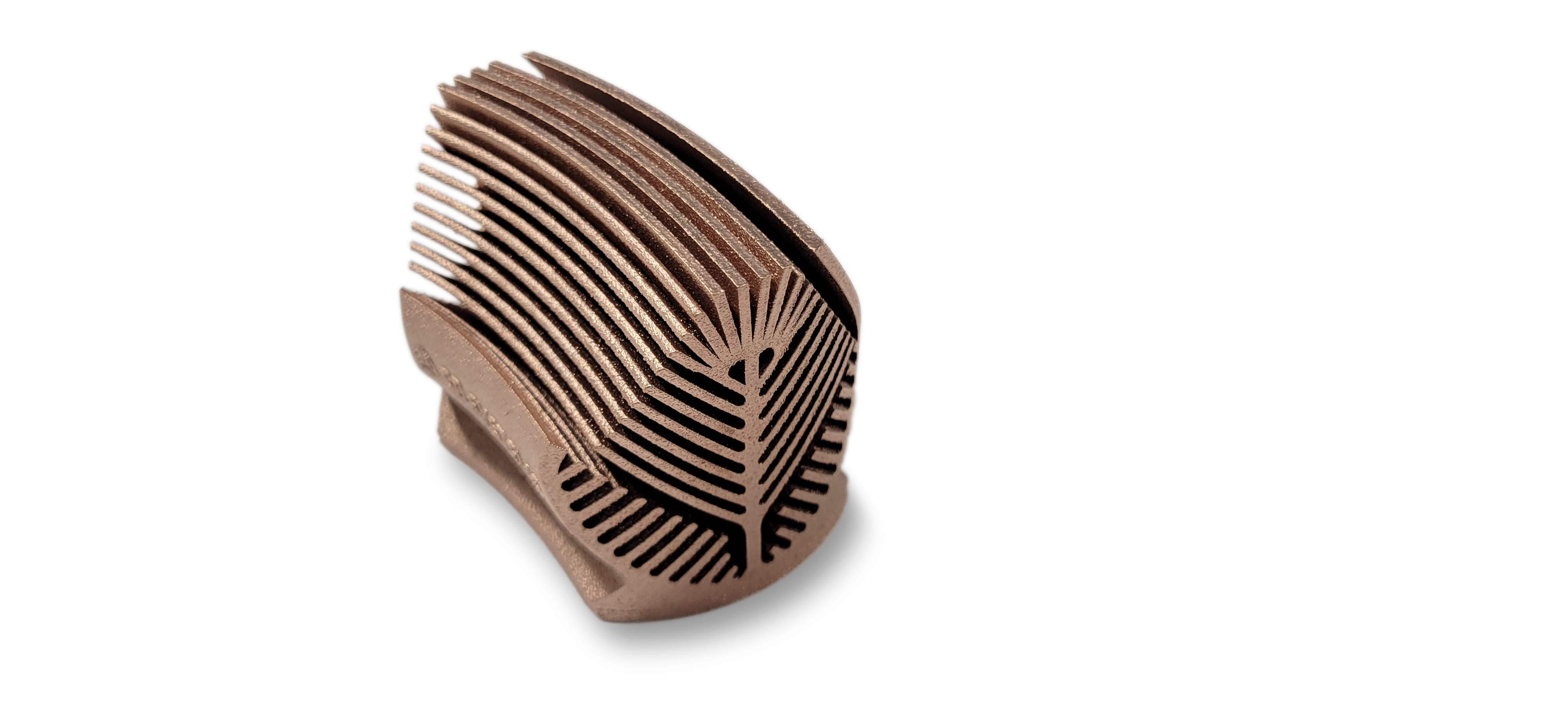
Custom Heat Sink manufactured with Certified CuCr2.4 on 3D Systems’ DMP Flex 350
David Leigh, Executive VP and CTO for AM at 3D Systems, said of the new materials, “Defining the right solution starts with our team collaborating with customers to select the best material to meet the part’s required performance and mechanical properties. Continued investment in our materials portfolio will help increase the number of applications available to help our customers’ demands — enabling them to accelerate their innovation and maintain their competitive advantage.”
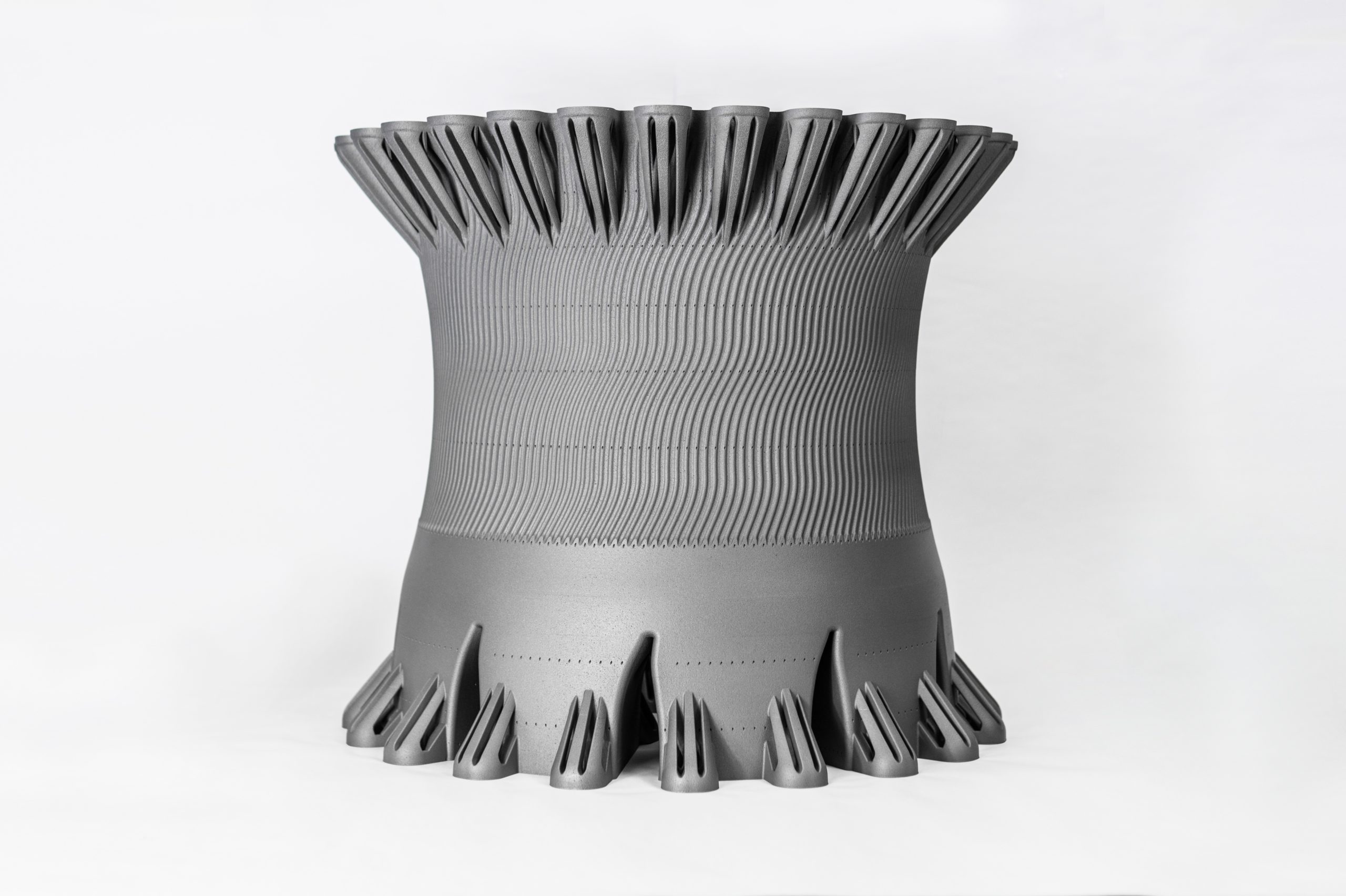
Industrial Gas Turbine component built with Certified HX parameters, manufactured on the DMP Factory 500 (Image courtesy of GF Casting Solutions).
The Possibilities for Low-Cost SLS 3D Printing
It is possible that the strategic partnership with Wematter is not completely unrelated to 3D Systems’ launch of two new materials, despite the fact that the Gravity is a polymers platform. In the past few months, the ColdMetalFusion (CMF) Alliance, a trade association made up largely of SLS OEMs dedicated to CMF 3D printing, has been rapidly gaining members. CMF allows for SLS platforms to be utilized for output of metal end-parts.

The Wematter Gravity SLS 3D printer and ecosystem. Image courtesy of Wematter.
In that context, it is perhaps noteworthy that Wematter has not joined the CMF Alliance — although one of its competitors, Swiss OEM Sintratec, has. Also worth noting is that the alliance’s founder, Headmade Materials, is an AM Ventures portfolio company, as is Sintratec. This is not to say that 3D Systems has plans of turning the Gravity into a low-cost SLS metal platform, to create an American competitor to CMF Alliance, simply that, with the company having a foot in both the metal and polymer camps, it would be in an advantageous position to do so. And, copper and nickel alloys are two materials that appear to be compatible with CMF printing.
Whether or not the company enters the CMF arena, the new materials are timely insofar as they add to 3D Systems’ potential to get involved in any potentially emergent EV battery markets in the US. This is especially advantageous given that 3D Systems is based in South Carolina, which, according to the state’s senator, Lindsey Graham, is about to “become the Detroit of batteries”. In any case, 3D Systems’ latest announcements are a reminder that as the AM market continues to scale-up, despite all the newcomers, there are already companies on the field that have decades of experience: and those companies seem just as capable of learning new things as are the startups.
Subscribe to Our Email Newsletter
Stay up-to-date on all the latest news from the 3D printing industry and receive information and offers from third party vendors.
Print Services
Upload your 3D Models and get them printed quickly and efficiently.













You May Also Like
The Two Paths to AM Print Services Market Growth
AM Research New market research: AM Research is building its new Additive Manufacturing Services Market 2.0 model. Learn more about the report and preorder here → Things continue to heat...
Additive Manufacturing Has a Major Growth Opportunity; Trust Will Decide Who Captures It
After years of overpromising, the next phase of AM growth will be won by companies that consistently deliver what they say. When I entered additive manufacturing in 2014, after 15...
10 Years of Multi Jet Fusion: Onsite at HP’s Vancouver, Washington Facility
At this year’s RAPID event in Boston, HP Additive Manufacturing Solutions celebrated ten years in the additive manufacturing (AM) market. The company ushered in the milestone with several innovations, including...
ADDMAN to Buy Up to $10.8M in Nickel 718 Powder from 6K Additive Over 30 Months
After years of buildup, we’re finally starting to see what the US metal additive manufacturing (AM) market could look like at scale. To be sure, it’s still not quite there,...