American Petroleum Institute Announces New 3D Printing Standard for Suppliers of Oil & Gas Parts

Standardization is perhaps the most significant element involved in the transition of the additive manufacturing (AM) market from startup to scale-up. For a variety of reasons, this state-of-affairs is best exemplified by the oil & gas industry.
All year, oil & gas companies have, less and less quietly, been increasing adoption and implementation of AM applications into their routine production operations. This has followed the publication of the first technical standard for 3D printed parts to be formulated by the American Petroleum Institute (API), in Q4 of 2021. That standard, 20S, is titled Additively Manufactured Metallic Components for Use in the Petroleum and Natural Gas Industries, and its creation took about two years of work from start to finish.
Last month, the API published API 20T, Additively Manufactured Polymer-Based Components for Use in the Petroleum and Natural Gas Industries. If anything, this standard could be an even greater catalyst than API 20S in driving oil & gas companies to embrace 3D printing: for starters, in contrast to metal, the oil & gas sector has a direct stranglehold over polymer supply chains.
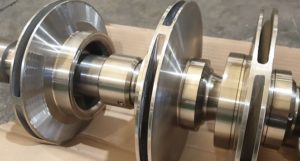
In an API press release announcing the publication of API 20T, Carlo De Bernardini, a ConocoPhillips engineer who led API’s 20S standard group on 3D printing, explained, “3D printing opens up myriad possibilities for the creative design of parts and components that couldn’t be made using traditional manufacturing, which requires welding, casting and grinding material. By allowing engineers to make digital designs without costly [R+D] lead times, the industry can become more efficient and innovative.” Anchal Liddar, senior VP of API’s Global Industry Services, commented, “3D printing is poised to bring significant benefits to all segments of our industry.”

Also according to the press release, a World Economic Forum report suggested that use of AM could reduce inventory levels by 2 percent, and reduce repairs, maintenance and transportation costs by 3 percent. In its report, “The Market for Additive Manufacturing in the Oil and Gas Sector 2018-2029”, SmarTech Analysis projects that by the end of this decade, applications for oil & gas could be worth $2 billion to the AM sector.
In general, this standard should be a boon to any company specializing in platforms compatible with PEEK, and in particular, I think Italian-based Roboze, with a North American headquarters in Houston, will benefit from it. Roboze, in partnership with Belgian chemical giant Solvay, published a white paper on AM applications for oil & gas in 2020, and the sector is one of the company’s biggest strong suits.
Despite the Biden administration’s anti-oil rhetoric, no American president is ever that against the oil & gas sector, and the industry’s profits this year have been higher than ever. Relatedly, in the long run, the AM market for oil & gas could benefit as much as any other subdivision within the sector from President Biden’s AM Forward Initiative.
If the mostly aerospace/defense companies participating in the initiative are successful at driving small and medium sized enterprises (SMEs) towards their target thresholds for AM-produced parts, this will lead to a scale-up of supply for many of the same materials used for printing components for the oil & gas sector. Moreover, most of the largest companies in aerospace and defense, including those involved in AM Forward, also do significant business in the oil & gas sector. Finally, one of the companies involved in AM Forward that’s not explicitly a defense contractor is Siemens Energy, which — again, if the initiative is successful — also suggests generally increasing demand for 3D printed oil & gas hardware.
Subscribe to Our Email Newsletter
Stay up-to-date on all the latest news from the 3D printing industry and receive information and offers from third party vendors.
Print Services
Upload your 3D Models and get them printed quickly and efficiently.











You May Also Like
Low-Cost LPBF Leader Xact Metal Reports Order Growth is Up 30% Year to Year
Xact Metal is the pioneer in low-cost LPBF. The US-based firm was the first to sell sub $100,000 LPBF machines. Through value engineering, gumption, and a focus on cost, the...
Subaru’s Adoption of T25 High Speed Head Reinforces Stratasys’ Dominance in 3D Printed Automotive Tooling
Last September, AM Research published a white paper sponsored by Stratasys on the role of additive manufacturing (AM) in enabling point-of-need tooling production across various industries. The white paper, “3D...
Why Superior, Affordable Chinese AM Machines Are a Great Chance for the Industry
Additive Manufacturing is entering a decisive phase. Consolidation is no longer a future scenario; it is happening now. Across polymers and metals, companies are under intense pressure to become profitable,...
Formlabs Fuse 1+ 30W: Small SLS Printer, Massive Impact
Disclosure: With Formlabs permission I was able to sell my 4L and use that to help with the purchase of the Fuse 1+ and Fuse Sift. Aside from allowing me...