
Canadian Teacher and ‘Printrbot Learn’ Propose a 3D Printing Curriculum

3D printer manufacturer Printrbot’s educational initiative, dubbed Printrbot Learn, has an assignment for you: Help them construct via a living document a 3D printing curriculum. The company created Printrbot Learn to encourage schools to incorporate 3D printing in their curricula.
 At the helm of Printrbot Learn’s blog is Clarence Fischer of the tiny town of Snow Lake, Manitoba in the north of Canada. Fischer, who was a teacher at Snow Lake’s small school for 20 years, keeps his remote town at the edge of technological development. He was interviewed by the New York Times and CNET when the kids in his classroom became some of the world’s first bloggers.

Clarence Fischer is keeping his students in Snow Lake, Manitoba, Canada in the center of 3D printing technology.
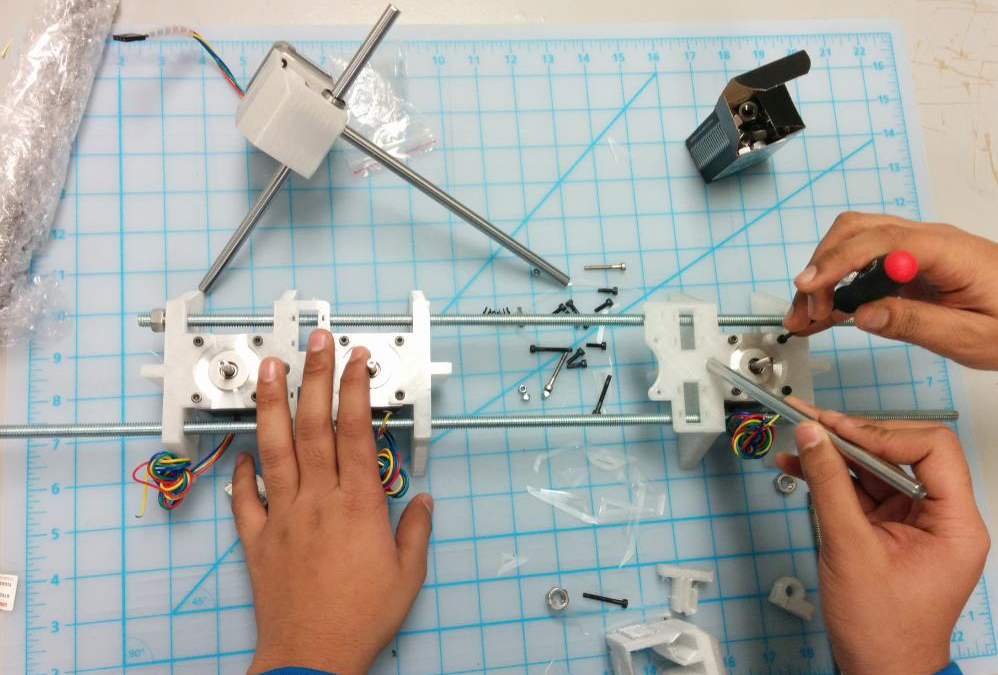
Fischer’s passion for technology led him to 3D printing and to Printrbot, the modest but successful company based in Lincoln, California. Printrbot sells affordable 3D printers and offers what they call “maker kits,” which are printers plus accessories to encourage the project-minded. The Canadian teacher’s zeal is apparent in the blog he writes for Printrbot Learn, where he issued his appeal for help creating a 3D printing curriculum for school kids.
“Something that has come up repeatedly over the past six months that Printrbot Learn has been active,” writes Fischer, “is the lack of quality, organized curriculum to do with 3D printing and manufacturing.”
Although he points out that the 3D printing community is beginning to address this issue, the curricula proposed by some companies — he uses Stratasys as an example — are specific to certain 3D printers rather than being broader if not more general.
Fischer also believes there is a sort of conflict of interests for companies that reach out to schools but do so while promoting their products. He suggests that the people on the ground — those doing the work in schools, from kindergarten through college, should be collaborating to produce a cohesive 3D printing curriculum, which would be adjusted to an extent based on the age of the students.
“In the end,” explains Fischer, “this document should have outcomes for students of different ages in each section. It can also link to outside resources, projects and information to support the outcomes and the learning that we want to see.”
The resulting 3D printing curriculum, an ongoing group effort and open document — or, really, series of documents — would ideally be licensed and released via Creative Commons. Fischer encourages those people who would like to contribute to this project to “highlight the possibilities that 3D printing brings to entrepreneurship and manufacturing.” His Google document, which he invites others to edit, to add their own ideas, has a basic structure that includes simple “how tos,” the sort of “A-B-Cs” of 3D printing.
The enthusiastic educator believes in opening his classroom in a remote corner of Canada to the outside world, where students will surely be headed once they leave his school, fully prepared to engage with the high-tech future. Let’s hear your thoughts on this initiative in the PrintrBot Learn Curriculum forum thread on 3DPB.com.
Subscribe to Our Email Newsletter
Stay up-to-date on all the latest news from the 3D printing industry and receive information and offers from third party vendors.
Print Services
Upload your 3D Models and get them printed quickly and efficiently.













You May Also Like
3D Printing News Briefs, August 22, 2026: Polymers for CubeSats, Animal Mobility Devices, & More
We’re starting with defense news in this weekend’s 3D Printing News Briefs, before moving on to polymers for CubeSats and 3D printed prosthetics. We’ll end with a story about engineering...
Pusan National University & ORNL Develop Elastomeric Liquid Crystal Actuators
Researchers from Korea’s Pusan National University and Oak Ridge National Laboratory (ORNL) have developed 3D printed elastomeric actuators. In a paper published in Nature, the team used elastomeric liquid crystal...
Scientists Use BMF to 3D Print Seal Whiskers That Track Prey Long After It’s Gone
Seals use their whiskers to hunt. Not Navy Seals, although they may in some way also, but this article is about lowercase seals. Not Seal the musician either; as far...
Harvard’s Jennifer Lewis Lab Is 3D Printing Artificial Muscles That Twist and Bend on Demand
Researchers at Harvard John A. Paulson School of Engineering and Applied Sciences (SEAS) have developed a new way to 3D print materials that can move on their own, bending, twisting,...























































