Large-Format Goliath 3D Printer Finalized, Sets Sights on Underwater 3D Printing


German startup Teu2tec GmbH was launched in 2018 to help clients develop and implement new ideas, processes, and products. One of the first projects the service provider started on back in 2019 was a 3D paste extrusion modeling (PEM) system, which uses elastomer-based (EPDM) granules and polyurethane binder. The startup recently completed development on the Goliath 3D printer, which, as evidenced by its name, is used to 3D print large-format objects, like furniture, out of granulate, using the PUR poly-component process.
“The goal of this project was to develop a system that allows precise mixing and dosing between both components and produce fine printed layers that meet the high-quality requirements,” the startup wrote on its website.
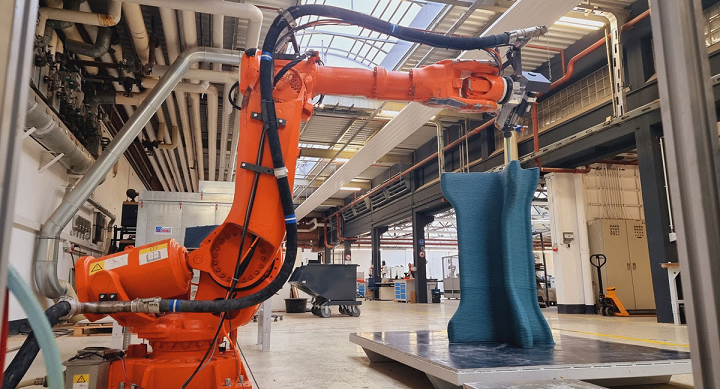
Teu2tec designed the robotic arm 3D printer to help a manufacturer of EPDM granules manufacturer increase its business, and the Goliath uses two-component polyurethane binders and granules that have grain sizes up to 2 mm. The startup says its PEM technology offers fast material curing and printing, which keeps costs lower, and the robotic arm ensures more design freedom as well. In addition, the print head features a special design that makes it possible to print highly viscous paste materials.
“Due to the very short pot life of less than 10 seconds, we can currently work here with printing speeds of up to 300 mm/s, with a mass flow of up to 100 g/s,” explained Jens Mikus, a development engineer at Teu2tec. “That, already, is very impressive!”


Users can change up the properties of the large products they print on the Goliath by adapting the granules and binders. The layer height is adjustable between 3 to 12 mm, which allows for a faster printing process. Additionally, optically complex components can be printed on the system because of the low layer height. The modular machine is easily scalable, and features a 2200 x 2200 x 2000 mm build volume for printing applications like playground equipment and furniture. It can also be expanded for 5-axis 3D printing, as well. In addition to EPDM and other rubber granules, the Goliath can also process sand, wood flour, and cork.
According to the website, Teu2tec determined the “requirements, limitations, and errors” of the PEM manufacturing process, and then got to work on the initial concept of a dosing and mixing system for the materials. Then, the startup continued development on the printer to take care of some necessary requirements, like flow optimization, in order to open up some additional applications. During the first testing period for the Goliath to validate the concept, the team successfully set down and repositioned the print head during active 3D printing without leaking any paste from the nozzle in a process they called “discontinuous printing.”
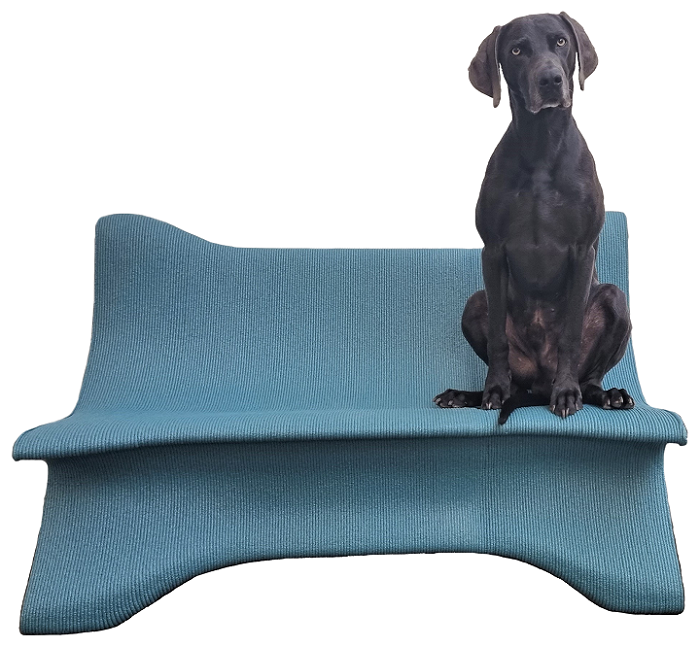
Someone is enjoying Teu2tec’s 3D printed furniture!
The next step for Teu2tec is 3D printing underwater, and in fact the startup has already completed some initial testing of the process this year. The startup explained that with the proper binder systems, its flexible PEM process will definitely be able to 3D print components underwater, which would open up even more applications in the marine industry.
Subscribe to Our Email Newsletter
Stay up-to-date on all the latest news from the 3D printing industry and receive information and offers from third party vendors.
Print Services
Upload your 3D Models and get them printed quickly and efficiently.













You May Also Like
3D Printing News Briefs, August 13, 2026: 510(k) Clearance, Dental Resin, Project Call, & More
We’re starting off today’s 3D Printing News Briefs with a little FDA news, and then a new dental material for the Axtra3D Lumia X1. We’ll end with the winners of...
3D Printing Financials: Velo3D Revenue Climbs 52%, 2026 Forecast Raised
Velo3D (Nasdaq: VELO) reported a sharp increase in second-quarter revenue and raised its full-year outlook as the metal additive manufacturing (AM) company expands production to meet demand from aerospace and...
Ricoh USA Sells 3D for Healthcare Spinout to Former VP and GM, Rebrands as Myrava
Japanese companies are really good at internal diversification and spin-outs, and this seems to be true even in cases involving foreign subsidiaries of Japanese multinationals. Ricoh USA recently demonstrated this...
Walter Reed Gets Premarket Clearance to Make 3D Printed Point-of-Care Medical Devices
The Walter Reed National Military Medical Center’s 3-D Medical Application Center (3-D MAC) has received premarket clearance to make 3D printed medical devices. This is the first time that a...