Desktop Injection Molding Now Available from Robot Factory

I’m a longtime fan of Italian firm Robot Factory. The Venice-based company makes long-lasting, high-performance machines, including a line of nifty 3D printers. This includes conveyer belt FDM systems, a desktop thermoforming machine, a DLP 3D printer, and an upgrade kit to turn your existing 3D printer into one with an infinite build volume. Everything is high quality and, when we interviewed owner Andrea Martini in 2019m he told us that they “make machines with extreme care.”
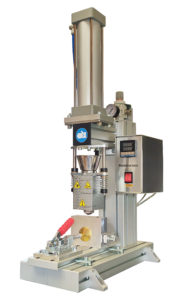 Now, the company has released a benchtop injection molding machine. This system can be used for experimentation and production runs using aluminum molds or molds made with resin 3D printers. The machine works with 6 to 8 bar of pressure and weighs 14 kilos. The company has successfully dialed in and used polypropylene, polyethylene, polystyrene, ABS, TPE, PMMA, TPU and EVA as materials. The injection chamber has 32 cubic cm of capacity and can heat up to 350°C.
By allowing users to make DLP molds for Robot Factory’s benchtop injection molding machine, this becomes an eminently quick solution for someone wanting to make molds quickly. No outside vendor. No long wait for a 3D printing service. Your DLP machine can produce the tool in-house in a matter of hours. Then, hook it up to a two shell mold and insert it into the IM machine and you can start with a limited production run. The system is so tiny and and the workflow so easy that this really lowers the barrier to entry for inexpensive, fast series manufacturing.
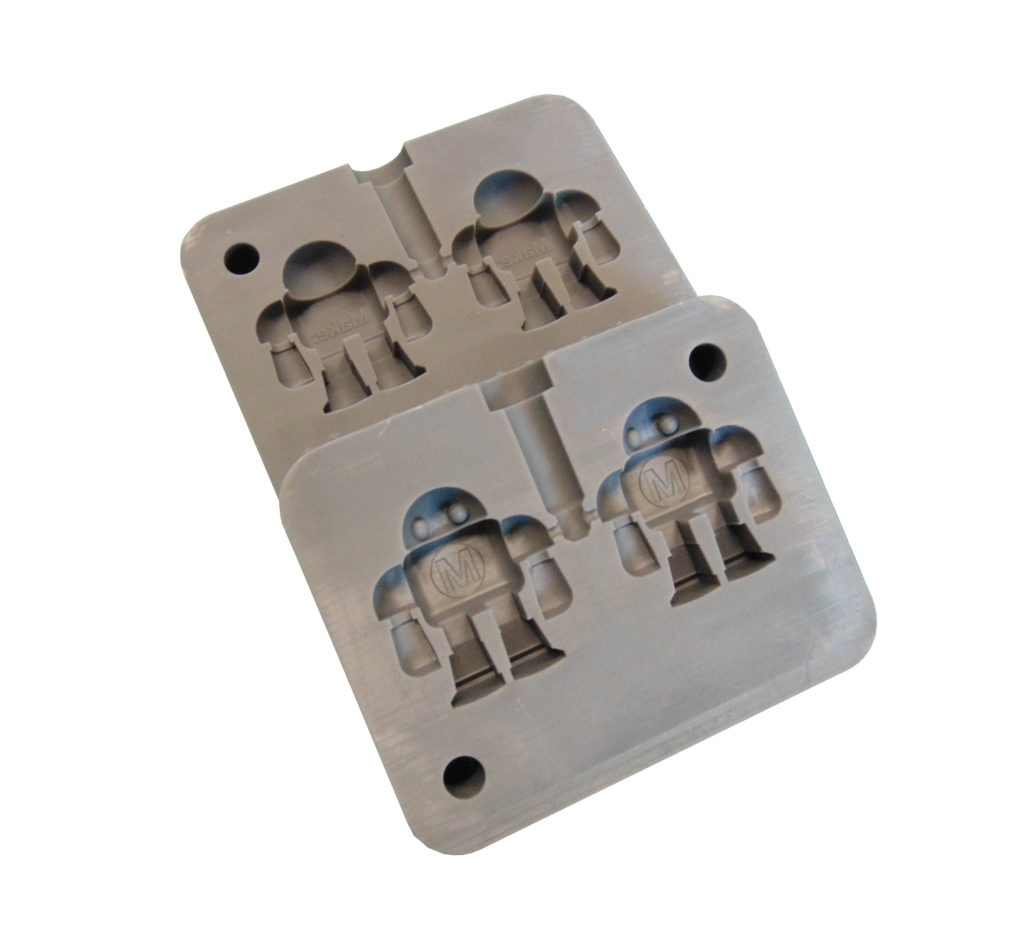
I could really see this finding a lot of users in the materials space. Large polymer companies, compounders, and filament manufacturers could use this to very quickly test coupons, as well as a whole bunch of other trial parts. You could rely on a series of molds for a whole test program and quickly build new parts in-house. But, I can also see wider commercial applications here.

If you’re in toys or make some kind of give-away, then small series like this could allow you to produce very timely little gadgets. You could have new items every week. Maybe you could create a local Happy Meal toy for a hardware store or at work. Or you could make inexpensive quick solutions to problems.
I really believe that 3D printing’s biggest advantages are in being a duck tape for industry. An improvisational tool that can quickly yield a solution for an unforeseen problem. One issue with the technology, however, is that series are expensive and time-consuming when made on a printer. A device like Robot Factory’s benchtop injection molding machine could really change that.
I also really like this for the food industry. You could print and then mold up-to-date templates and food molds with this. You could make a different desert mold every week or change the cacao pattern on the coffee every few days. Similarly, one could make molds for mashed potatoes or much else besides.
As a solution, the Benchtop Injection Molding machine could be a reliable, repeatable addition to our arsenal. For small series in the hundreds of parts, such a system could make economic sense very quickly. For an initial scale up, you could first print a solution, then iterate and improve it. Once it seems like it’s working, you could deploy hundreds of parts with injection molding. Later on, you can either quickly redesign your mold and part again or continue to larger series on larger IM machines. I really think that this is something that could augment our solution set. Long live the desktop injection molding revolution!
Subscribe to Our Email Newsletter
Stay up-to-date on all the latest news from the 3D printing industry and receive information and offers from third party vendors.
Print Services
Upload your 3D Models and get them printed quickly and efficiently.











You May Also Like
When Castings Take 18 Months: How 3D Printing Helped Fix the Soo Locks
This article is Part II of a two-part series on Lincoln Electric’s large-format metal additive manufacturing operations. In Part I, we looked at how Lincoln Electric built one of the...
DEEP Manufacturing to Open 50,000 Sq. Ft. WAAM Facility in Houston
I’m a big fan of wire arc additive manufacturing (WAAM), in large part because it’s not that much of a departure from how arc welding already works. It’s a technology...
At TCT Asia 2026, China’s AM Industry Looked Ready for Scale: Part 2
At TCT Asia 2026, the shift did not stop at metal production. It extended into the consumer and prosumer side of the market, where the same logic of scale, integration,...
At TCT Asia 2026, China’s AM Industry Looked Ready for Scale: Part 1
Walk into TCT Asia 2026, and the first impression is density. More than 55,000 square meters across Halls 7.1 and 8.1 at Shanghai’s National Exhibition and Convention Center, over 550...