Largest 3D Printed Model of London Created by Hobs 3D and AccuCities


Hobs 3D and AccuCities, two London-based companies with a lengthy history of working together, have created their most impressive project yet: the largest 3D printed model of London. The 3D model, which is in fact still growing, is on display in its current form at LondonBuild 2021, taking place November 17-18, and will also be exhibited at Digital Construction Week at Excel London, November 24-25.
So far, the model represents 40-square-kilometers of the English metropolis: along the river Thames, from Hyde Park to Canary Wharf. As they’ve done on previous projects, which include models of Birmingham, Bristol, Cardiff, and Dublin, AccuCities created the design with CAD software before Hobs produced the physical model with SLA printers.
Eric Savant, Managing Director of Hobs 3D, said in a press release, “There have been other decent models of London made in the past, but nothing with this level of accuracy and scope. The combination of AccuCities’s high-precision 3D modelling with our state-of-the-art SLA 3D printing gives us the ability to produce something very few others could achieve.”
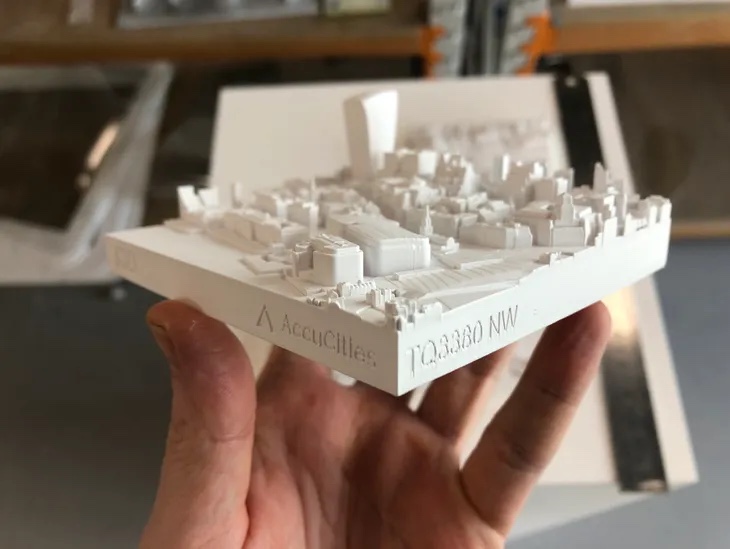
Meant for urban planners, architects, or just anyone interested in owning a miniature version of London, the creators tout the affordability and shortened production time as the main advantages to their project. This is made possible largely by the interchangeable, 10 x 10 cm tiles, each of which represents 500 x 500 meters of London proper. Hobs 3D and AccuCities claim that, over the course of four weeks of presentations, this can result in the cost of a city model being reduced by as much as 95%. An additional, related benefit to this design is that it can be added to or changed over time, piece-by-piece, instead of having to start over from scratch:
As Michael Konicek, AccuCities director, notes, “Creating a 3D printed London model in modular tiles means that we don’t have to 3D print the entire city model for each project, only the tiles affected by change.”
3D Printed Cities
AccuCities and Hobs are also making it possible to rent the city model for as brief a time as one week, including delivery, set-up, disassembly, and removal, which further adds to the cost-effectiveness for clients. This leads to a unique situation where customers don’t have to choose between quality and price. Moreover, customers also have the option to order custom tiles, allowing them to add or take away from the underlying design as they see fit.
It’s a bit like AccuCities and Hobs have taken the malleability of software design and transposed it into the physical realm, facilitating an experience for architects and urban planners that allows them to see the changes they want to make right in front of their eyes. I know this is a sophisticated tool for serious professionals, but I could also see this concept easily selling well at stores that offer educational toys and the like. AccuCities and Hobs may have figured out one way to create a future generation of engineering visionaries!
Subscribe to Our Email Newsletter
Stay up-to-date on all the latest news from the 3D printing industry and receive information and offers from third party vendors.
Print Services
Upload your 3D Models and get them printed quickly and efficiently.













You May Also Like
Divergent Declares that German 3D Printers are Superior, And Plans Massive LPBF Expansion
Divergent has announced a new version of its Laser Powder Bed Fusion (LPBF) printer and a new site. The company aims to do nothing short of “further accelerating its mission...
Zellerfeld Invests in Volumental
Correction: I was mistaken. Zellerfeld has invested in Volumental. Volumental is still independent. A previous version of this article stated that Zellerfeld had bought Volumental. My sincerest apologies for all...
SpaceX IPO Puts a Major 3D Printing Powerhouse on Wall Street
SpaceX officially began trading on the Nasdaq today under the ticker symbol SPCX, marking one of the most anticipated and largest public offerings in Wall Street history. The company priced...
TDK Makes Sound AI Infrastructure Bet with Fabric8Labs Acquisition Worth Up to $400M
As I described in a recent PRO article, the bulk of global investment is currently premised on a bet that an AI infrastructure buildout can eventually result in a workable...