UNICEF 3D Printed Busts on Display in Paris Raise Awareness of Mental Health


The scientific landscape of the field has gotten such significant advances so quickly; it’s easy to forget sometimes that the current era of commercialized 3D printing was initiated just as much by artists as by scientists. Artists have long been responsible for some of the most ingenious applications of 3D printing, and they’re getting more innovative all the time — not just to create buzz, but equally and even more importantly, to provoke thought and inspire social change.
At a global mental health conference entitled “Mind Our Rights, Now!”, hosted in Paris on October 5th and 6th, UNICEF collaborated on a project with one such 3D printing innovator in fine arts, the Barcelona-based studio Domestic Data Streamers. Domestic Data Streamers is a collective of graphic designers, engineers, data analysts, and researchers known for creating installation projects all over the world, all of which aim to give visual life to up-to-date sociological information to inspire socially-minded results in their audience. It’s hard to imagine a more timely, more urgent topic in this regard than what UNICEF and Domestic Data Streamers joined forces on for the “Mind Our Rights, Now!” summit: children’s mental health issues that the pandemic has exacerbated.
The particular difficulties faced by children with mental health issues are certainly not a new problem. Still, it has escalated in severity and gotten increased attention over the last two years because of the pandemic. Heightened feelings of isolation and mounting anxieties have, of course, hit people in every conceivable demographic since early 2020, and children are especially sensitive to these symptoms, among other reasons, because their brains are still in a fragile state of development.
Moreover, psychological and socialization problems that children are faced with early in their lives tend to persist for a lifetime, especially if they go unnoticed. Thus, it makes perfect sense that UNICEF and Domestic Data Streamers would be compelled to ensure these problems didn’t go unnoticed at “Mind Our Rights, Now!” in a visual installation called “On Our Minds.”
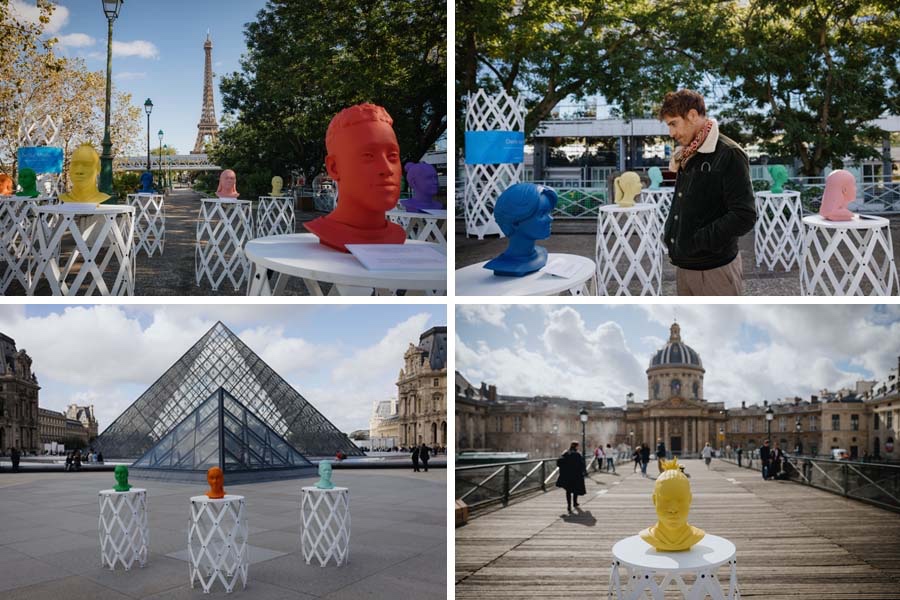
The art installation presented in Paris was augmented by volunteers sharing their own experiences of struggles with mental health. Image courtesy of BCN3D.
For the installation, Domestic Data Streamers made replicas of the faces of ten children struggling with various mental health issues, then printed them into busts on Epsilon W50s at the BCN3D print farm in Barcelona. The busts were then painted and presented on tables in Paris for three days, concurrently with the “Mind Our Rights, Now!” conference.
Martina Nadal, Head of Social Impact at Domestic Data Streamers, observed that “usually, we do homages to kings and queens and older people and conquerors. We thought it would be a beautiful idea to pay homage to all these young people who have been suffering in especially difficult conditions during the pandemic.”
The installations were placed in areas where classic French landmarks like the Eiffel Tower and the pyramid at the Louvre were seen in the backdrop, and volunteers waited nearby to explain their own battles with mental health issues to curious visitors.
The creative director of Domestic Data Streamers, Natalie Santolaria, explained, “We chose to use colors in the installation, firstly because although mental health is a really serious topic we wanted it to be cheerful because it speaks of childhood, and also because this way we could represent diversity.“

As someone who has struggled with mental health issues since I was a child, it’s uplifting, to say the least, to see not only an opportunity for children to feel less stigmatized and thereby more willing to open up about the difficulties they go through every day; but also, the increased awareness in adults of how important it is to create environments where this is possible.
Additionally, with 3D printing being at the forefront of this particular project, and given the astonishing technological skills children today possess (anyone who has seen a three-year-old use a tablet can verify this), who knows how many kids it may inspire to express themselves in artwork of their own? Projects such as this prove that the beauty of 3D printing is that you don’t have to categorize things like science, art, or technology; in fact, it’s all creativity, the foundation of which is human self-expression.
Subscribe to Our Email Newsletter
Stay up-to-date on all the latest news from the 3D printing industry and receive information and offers from third party vendors.
Print Services
Upload your 3D Models and get them printed quickly and efficiently.












You May Also Like
The AM Industry Is Growing. Arno Held Thinks It Still Needs to Get Smaller
Additive manufacturing is now a $24.2 billion industry, but Arno Held believes too many companies still compete for market share. That was one of the more pointed arguments during an...
3DPOD 322: Neil Hopkinson on Stratasys’ New H550 SAF 3D Printer
Coming to you from Formnext 2026, Joris Peels and Maxwell Bogue welcome Neil Hopkinson, Vice President of SAF Technology at Stratasys, for a conversation about what’s next in industrial 3D...
Formnext 2026: Large-Format 3D Printing Gets Bigger, Smarter, and More Production-Ready
The race to build bigger 3D printers is picking up speed at Formnext 2026, as manufacturers turn their attention to industrial-scale production. At the trade show in Frankfurt, Germany, companies...
Continuum Powders Releases the Argos Atomizer for Industrial Settings
Continuum Powders is releasing the new Argos Melt-to-Powder (M2P) atomizer. This takes the firm’s offering to a more industrial large-scale setting. The system is a hybrid plasma torch melting and...