Markforged Announces Larger, Faster FX20 Continuous Carbon Fiber 3D Printer

As the 3D printing industry heats up among SPACs, IPOs, acquisitions and just new product releases generally, Markforged has been no stranger to this activity. In addition to announcing an upcoming SPAC, the Massachusetts-based firm unveiled an upgrade to its Metal X 3D printer, a software update, and a new ruggedized 3D printer for composites. Now, Markforged has announced its newest system, the FX20, which it plans to fully unveil at Formnext this November.
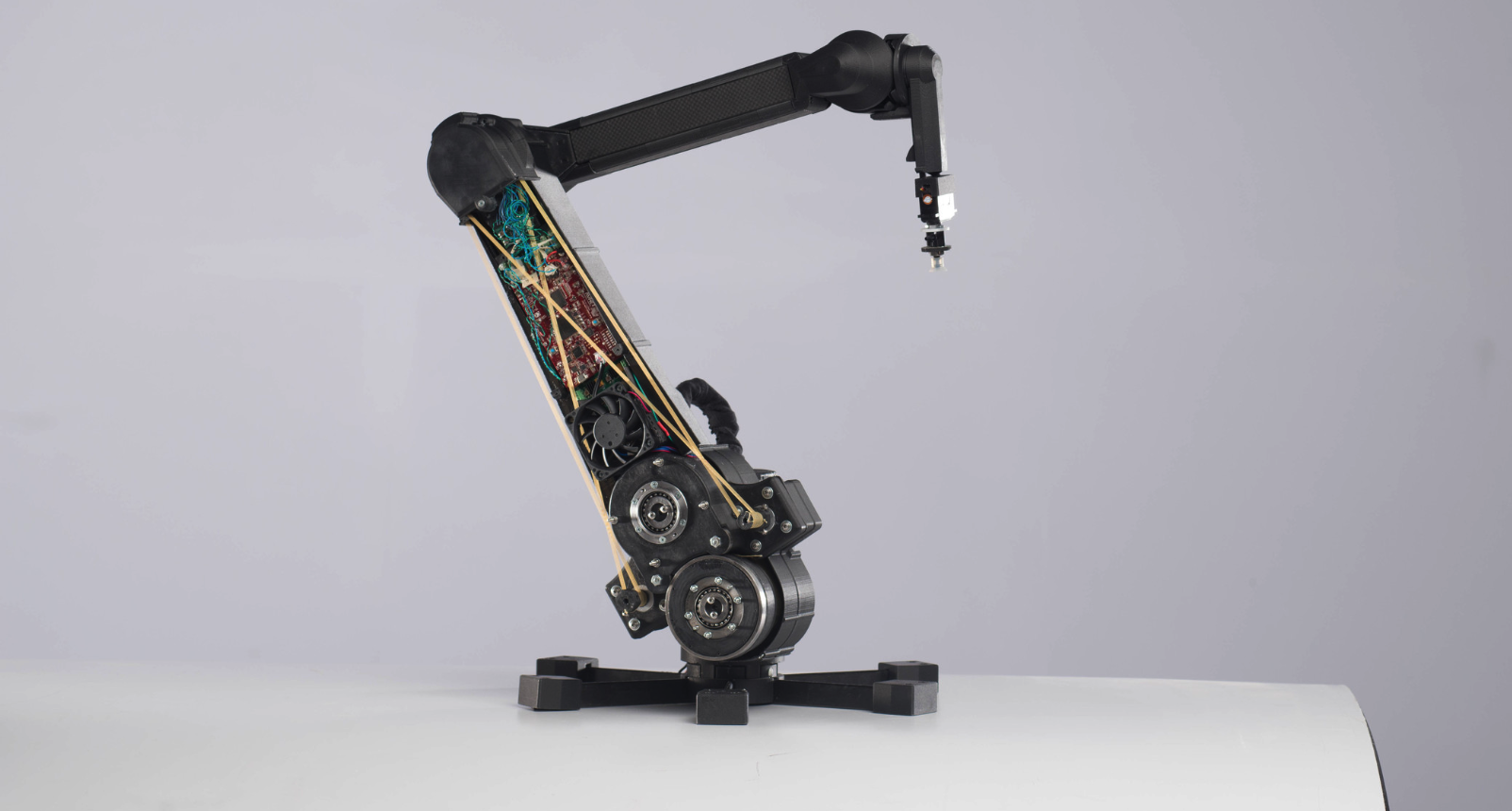
Robotic arm 3D printed with continuous carbon fiber. Image courtesy of Markforged.
Markforged can widely be considered the inventor of continuous carbon fiber 3D printing. Of course, referring to it as “continuous carbon fiber 3D printing” is shorthand for additive manufacturing with continuous fiber reinforcement. So, while carbon fiber may be among the most appealing materials the company offers, Markforged’s continuous fiber reinforcement (CFR) process is also capable of 3D printing with Kevlar and varieties of fiber glass.
The newest 3D printer, the FX20, will be the largest, quickest, and “most sophisticated” 3D printer the company has yet produced. It will be able to 3D print high-temperature thermoplastics reinforced with carbon fiber with greater strength, accuracy, and performance than previously possible with CFR. All of this will be powered by the Digital Forge, Markforged’s AI-driven network of customer 3D printers around the world.
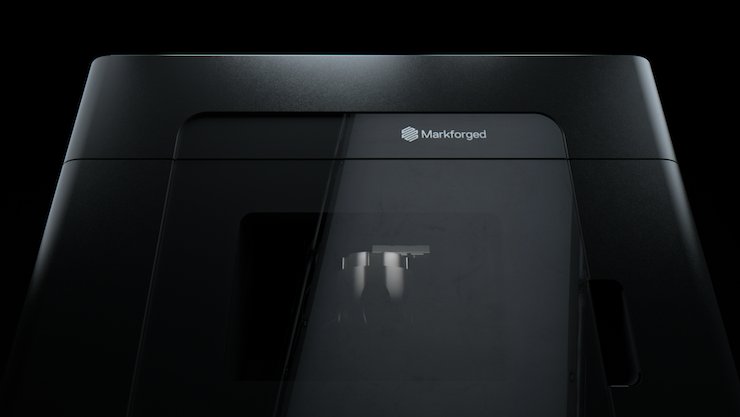
A teaser image for the FX20 3D printer. Image courtesy of Markforged.
“The FX20 is a beast of a machine and represents our commitment to providing innovative solutions to our customers to empower them to build anything they can imagine. The addition of the FX20 to the Digital Forge strengthens our leading position in the additive manufacturing market by enabling the robust production of lightweight, advanced composite parts. With this combination of hardware and software, our customers will be able to count on Markforged for production of the end-use, mission critical parts that are required to overcome the limitations of traditional manufacturing. This builds resilient and sustainable supply chains that extend directly to the point-of-need,” said Shai Terem, President and CEO of Markforged.
The news from Markforged is quite a tease, with little concrete information about the FX20’s actual capabilities. However, there are pieces we can put together to guess at what the FX20 will be capable of. High-temperature thermoplastics suggests that the new machine may be able to 3D print with PEEK, PEKK and PEI. It’s no coincidence that Markforged competitors like Desktop Metal and Anisoprint offer these materials.
When I spoke to former CEO and founder Greg Mark in 2016, he explained that the company was working on in-process quality control. At the time, the new X7 system had a built-in laser on the print head to scan parts as they were printed. This makes it possible to find deviations in the as-printed part from the CAD file. Mark noted that this would be the first step toward automatic, closed-loop control. It’s possible that the FX20 will have closed-loop control based on the machine learning behind its Blacksmith software in the Digital Forge.
Until we learn more, it’s difficult to guess what else the new machine has in store or if the company has some other tricks up its sleeve. We do know that competition is getting fierce in 3D printing and that Markforged will need to continue to innovate as it moves into the public space. We’ll have better insight by the time the FX20 is fully unveiled this November, before shipments begin in the first half of 2022.
Subscribe to Our Email Newsletter
Stay up-to-date on all the latest news from the 3D printing industry and receive information and offers from third party vendors.
Print Services
Upload your 3D Models and get them printed quickly and efficiently.











You May Also Like
From Material Maturity to Fleet Execution: What Comes Next for Additive Manufacturing in the U.S. Navy
Additive manufacturing is steadily moving from experimental use toward routine application in U.S. Navy shipbuilding, sustainment, and much more. In recent years, the Navy, working through its Maritime Industrial Base...
Industrial Additive Manufacturing Reaches Its Most Important Inflection Point
Additive manufacturing is entering the most consequential period in its evolution. After years of experimentation and uneven adoption, the industry is showing renewed momentum, shaped by supply-chain pressures, and a...
Scaling Beyond 10 Printers: When Support Becomes a Bottleneck
The leap to industrial-scale 3D printing is a support problem, not a hardware problem. A 3D print farm is a centralized facility that uses a large number of 3D printers...
Reshoring Requires Rules of Engagement
Reshoring manufacturing in the U.S. is a stated national priority. Policymakers, industry leaders, and defense planners agree that domestic production capacity is essential for economic resilience, national security, and long-term...