Fortify Adds Two New 3D Printers, Customization Software for Composite 3D Printing

Composite 3D printing startup Fortify has announced the launch of two new FLUX printers, and a new software platform to let users have more control over the print process. The new printers are expansions on Fortify’s Continuous Kinetic Mixing (CKM) and Fluxprint offerings, which the company promises will offer users more control over filler alignment in its composite 3D printing resins.
Fortify is known for its Fluxprint technology, a magnetic system within their printers used to align magnetically-coated composite fibers within Fortify’s photopolymer resins. The company is most focused on its ceramic reinforcement fibers for the production of high-strength tooling and other components. Their FLUX ONE printer, released in 2020, included a version of Fluxprint with a Z-axis magnetic field to overcome Z-axis anisotropy.
Fortify’s CKM technology, announced in March 2020, evens out the distribution of fillers in their composite photopolymer printers, preventing sedimentation and aggregation of filler fibers. Basically, this means that users can work with heavily-filled photopolymers without having the fillers clump up.
Now, the startup is adding two new printers to their lineup. The new FLUX CORE is billed as their “baseline” printer, including CKM, but not Fluxprint. The CORE works well for parts where magnetic alignment of filters isn’t necessary (the company cites RF devices and electronics). Their other offering, the FLUX 3D, includes a new take on Fluxprint. FLUX 3D has a three-axis magnetic field, giving users more control over how the fibers in their parts are aligned. End uses for FLUX 3D parts include heat sinks, heat exchangers, and high-performance industrial connectors.
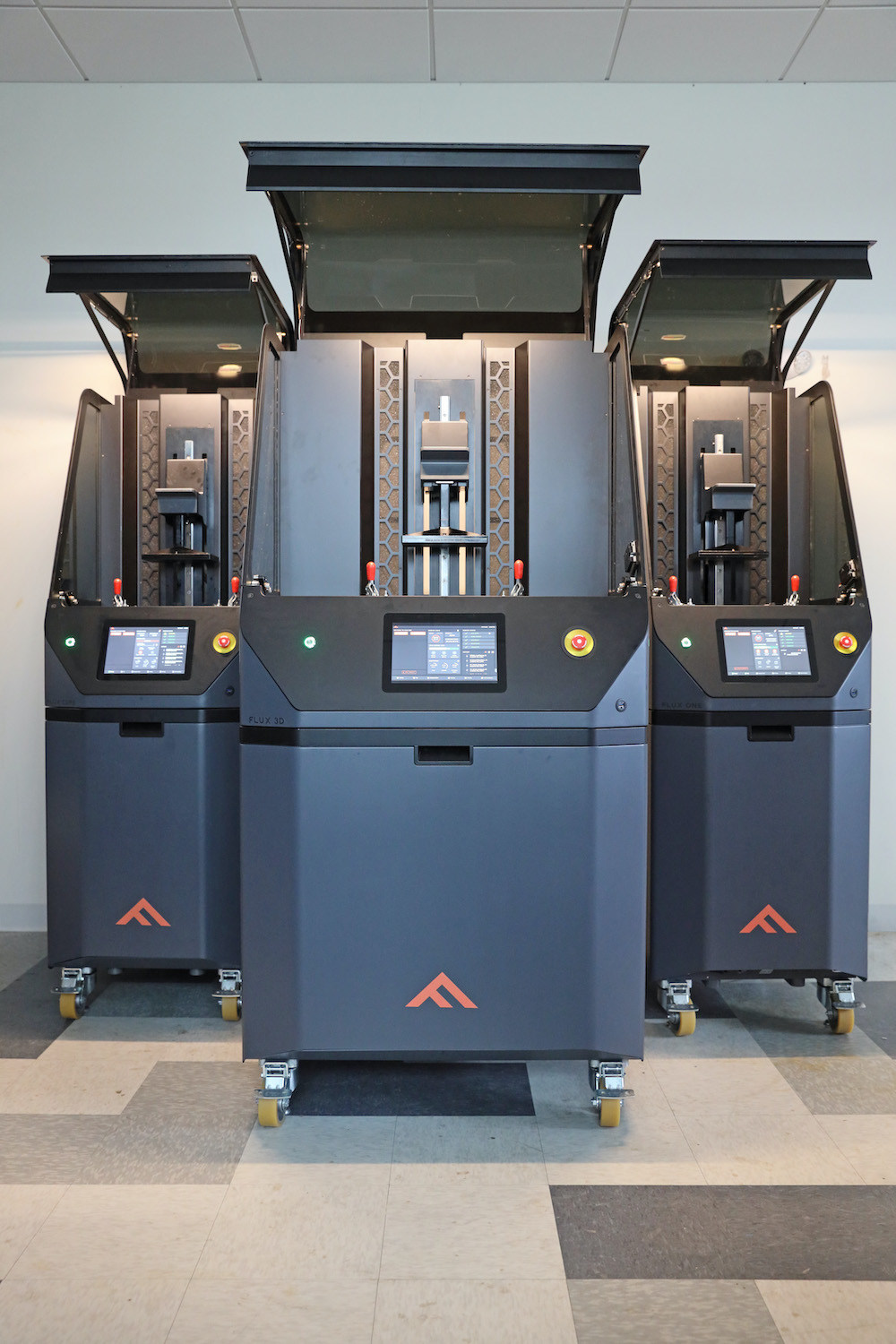
Fortify’s printers include the FLUX ONE (announced in 2020) and the new FLUX CORE and FLUX 3D printers (Image via Fortify).
The company has also announced Flux Developer: a software platform that works with all of the FLUX printers. It gives users more control over printing parameters like material flow, exposure time, and resin viscosity.
“With growing excitement around our capability to process filled photopolymers, we are seeing demand from customers who want to explore materials beyond our current offerings,” said Ben Arnold, VP of Business Development at Fortify. “Flux Developer is the toolkit they need to test and optimize new materials for their targeted applications.”
These new developments come on the heels of a busy (and successful) 2020 for the company. Fortify will use money from a $20 million equity round in March of last year to scale up the manufacture of their printers. That money doubled the company’s cash flow, and let them ship their first units of the FLUX ONE last fall. And with these new products, Fortify hopes to attract the market for end-use printed parts.
“The novel technologies built into the FLUX ONE printer can be leveraged for a variety of use cases,” said Josh Martin, CEO and Co-founder of Fortify. “While there is room for growth in the tools and fixtures market, an area that Fortify is currently providing value in with our reinforced materials, there is an order of magnitude greater market potential for end use part applications. By providing versions of our FLUX printers tailored for specific use cases, we are giving users the power to go after these markets.”
Subscribe to Our Email Newsletter
Stay up-to-date on all the latest news from the 3D printing industry and receive information and offers from third party vendors.
Print Services
Upload your 3D Models and get them printed quickly and efficiently.











You May Also Like
Ceramics 3D Printing at Ceramitec 2026
Ceramitec is a key event for the ceramics industry. Held in the lovely city of Munich, it is the leading global event for the ceramics community. With around 13,000 participants...
BMF Turns Up the Speed with microArch S150 Series
Boston Micro Fabrication (BMF) is releasing the microArch S150 Series. This series comprises two compact desktop systems. There’s a speedy microArch S150 Ultra and a more lab- or experiment-oriented microArch...
3D Printing Predictions 2026: Industrial Production & Polymer Additive Manufacturing
Polymer additive manufacturing is seeing less investment, attention, and disruption than metal additive manufacturing currently. Less crucial for defense needs, it has of late had far fewer new entrants. But,...
EPFL Is Growing Metal
Over the years, researchers in additive manufacturing have been working on different hydrogel systems for scaffolds, supports, and parts. Others have worked on different forms of growing 3D prints, while...