Ingersoll 3D Prints Massive Helicopter Blade Tool for Bell Helicopter

Ingersoll Machine Tools Inc. is continuing to demonstrate the applications for the world’s largest polymer 3D printer, the MasterPrint. This time, it 3D printed a 22-foot-long vacuum trim tool used for producing helicopter rotor blades.
The company worked together with helicopter manufacturer Bell Textron Inc. to produce the part, which used 1,150 pounds of ABS plastic with 20% chopped carbon fiber fill to produce a single part in 75 hours of continuous operation. Once the mold was printed, the MasterPrint switched to its five-axis milling head to machine the surfaces and necessary tooling features, in order to ensure full vacuum tightness, in one week.

The 22-foot-long tooling for a Bell Texitron rotor, printed but not yet machined. Image courtesy of Ingersoll.
“We are continuously testing and advancing MasterPrint in our development center,” says Chip Storie, CEO at Ingersoll. “Among Ingersoll’s short-term objectives is for MasterPrint to 3D print molds for aerospace that preserve the geometrical properties and tolerances, vacuum integrity and autoclave resilience normally obtained with traditional technology, but with the cost and time reduction only additive manufacturing can offer. The relentless progress our MasterPrint process made in 2020 has finally made this target attainable.”
According to the partners involved, this fabrication process saved months of manufacturing time, with traditional aluminum molds usually requiring between four and five months to make. In comparison, the 22-foot tool only took a matter of weeks.
“Utilizing this rapid manufacturing equipment will allow Bell to greatly accelerate our development of tooling for many applications within the Bell organization,” said James Cordell, senior manager of Process Stability at Bell.
Like the rest of the aerospace sector, Bell has been experimenting with 3D printing. In 2016, a 3D printed part flew on the Osprey helicopter developed by Bell and Boeing. It has also been researching the possibility of using metal parts made with laser powder bed fusion.
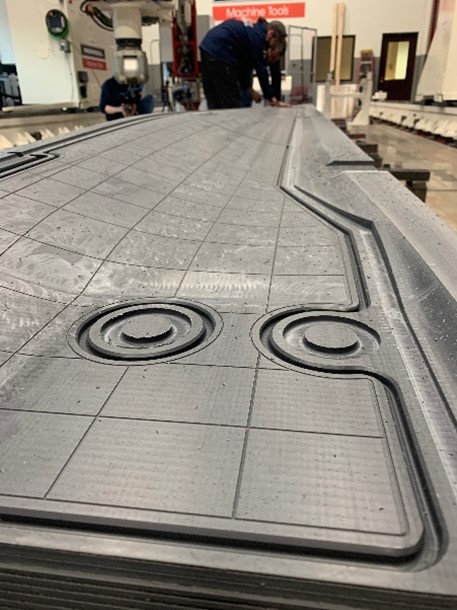
The tool after machining. Image courtesy of Ingersoll.
After demonstrating the possibilities of the technology by making the world’s largest 3D printed boat, Ingersoll’s MasterPrint has embarked on more practical matters, such as 3D printing molds for wind turbine blades. Molds and tooling seem to be a key demonstrator technology for large-scale polymer machines such as the MasterPrint and Cincinnati Incorporated’s BAAM 3D printer, both developed in collaboration with Oak Ridge National Laboratory.
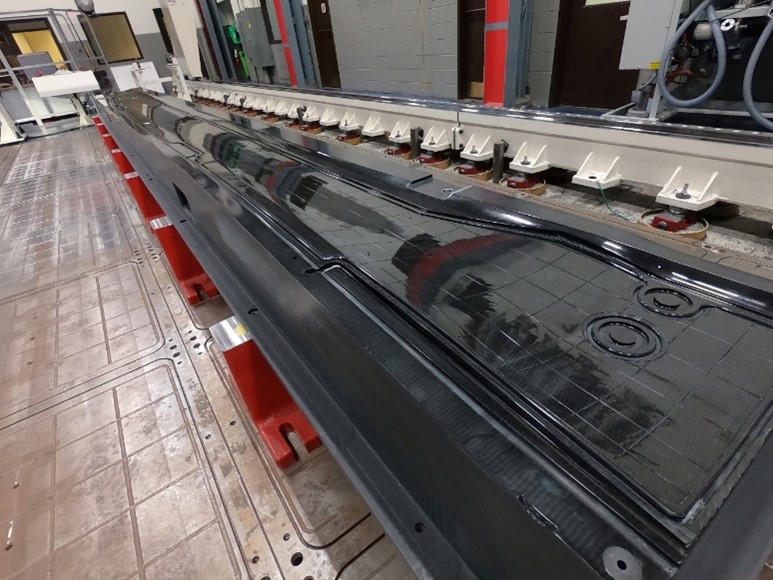
The completed tool, 3D printed, machined and vacuum sealed. Image courtesy of Inersoll.
On the one hand, these massive components showcase the potential for large-scale polymer 3D printing. At the same time, tools are for indirect manufacturing and don’t have the same standards requirements as end parts. As companies get more comfortable with the technology and develop the appropriate standards, they can move on to producing end components. However, the cost- and time-savings alone make the ability to 3D print specialized molds and tools worthwhile for such unique items as rotor blades for helicopters.
Subscribe to Our Email Newsletter
Stay up-to-date on all the latest news from the 3D printing industry and receive information and offers from third party vendors.
Print Services
Upload your 3D Models and get them printed quickly and efficiently.













You May Also Like
How Should Businesses Build New Business? Dirk Simon Weighs In — Part 1
Dirk Simon had deep experience in materials and chemistry before joining the 3D printing industry. Instrumental in BASF and Farsoon’s market introduction, Dirk has spent a lot of time thinking...
The Frankenservice Part 2: Have Your Cake and Eat it Too
This series of articles delves into a thought experiment. What if we let go of using a few machines very optimally, but instead use lots of different machines to meet...
The Additive Chicken Coop, Part IV: Lemmings
If we look at our past, we can see how making custom machines, incessantly watching ourselves, and our inability to rescope shaped our industry. We have also looked at the...
The Additive Chicken Coop, Part III: Bananas
A friend of mine, Ed Davis, once pointed out the level of strategic replication in additive. I wasn’t aware of it before and haven’t been able to unsee it since....