BASF Stainless Steel Filament Now Qualified for MakerBot METHOD 3D Printers


MakerBot, a subsidiary of Stratasys (Nasdaq: SSYS) has announced that BASF Ultrafuse 316L Stainless Steel material is qualified for use with the MakerBot LABS Experimental Extruder1 for the MakerBot METHOD line of 3D printers. This makes it one of the few brands with systems explicitly qualified to use this metal 3D printing filament.
The MakerBot METHOD is unique in that it is designed for repeatability and consistency, in part due to its heated chamber. The MakerBot LABS GEN 2 Experimental Extruder opens up this series of printers to use metal filament, such as Ultrafuse 316L. It’s possible to achieve up to 96 percent of the density of pure stainless steel.
The material is said to be particularly useful for making jigs and fixtures, as well as end use parts. Examples include workholdings that will be exposed to high heat, high strength brackets for specialty machinery, and strong, lightweight, and wear-resistant robotic grippers.
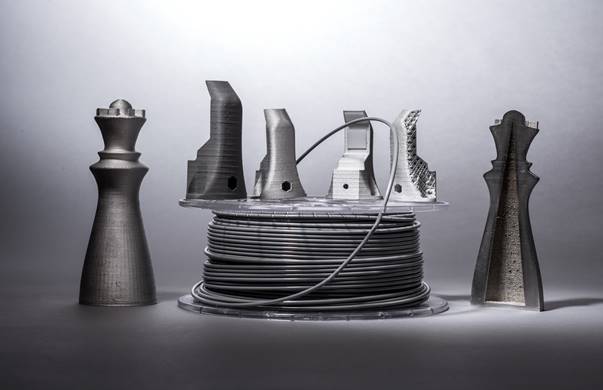 BASF’s Ultrafuse 316L – Metal filament for 3D printing stainless steel parts
Bound metal printing filaments may represent a key method for introducing metal 3D printing to a wider audience at a lower cost. With them, users of desktop 3D printers can begin fabricating metal parts. Once a component is printed in something like Ultrafuse 316L, it must then be put through a debinding process and sintered in a furnace to obtain the final metal part.
This means that those wishing to print metal parts need not purchase a Metal X from Markforged, a Studio System from Desktop Metal, or the ExOne Metal Designlab. They can instead buy a spool of metal filament and begin using their desktop machines, which typically require specialty extruder nozzles for handling abrasive filaments.
At the moment, there are only very few manufacturers of such materials on the market. On one side, The Virtual Foundry produces a wide variety of metal (and ceramic) filaments but lacks the reach and financial backing of other materials companies. In contrast, BASF is the world’s largest chemical company and, so far, has only one metal 3D printing filament.
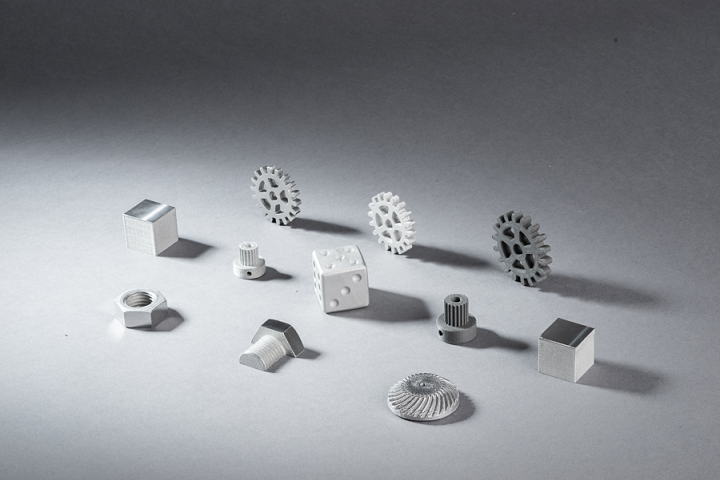 Metal parts made with BASF Ultrafuse 316LX stainless steel filament by FFF.
However, processing metal filaments is something that requires special equipment that may require some substantial capital investment. It’s worth noting that The Virtual Foundry states that debinding occurs during the sintering process and, therefore, no debinding step is required. The Virtual Foundry also offers low-cost kilns. How its materials compare to Ultrafuse is another story.
To get around the overhead investment needed for processing parts made with Ultrafuse, filament resellers like MatterHackers make it possible to connect with a service through them. Similarly, The Virtual Foundry works with Sapphire3D, who will process prints for customers, as well. Additionally, those interested in metal 3D printing filaments can have parts made by BASF subsidiary Sculpteo.
SmarTech Analysis predicts that bound metal technologies are now expected to achieve close to twice the growth rate than the overall metal AM market over the next ten years. This author is just waiting for BASF to release new materials and also a series of service providers who rely solely on printing and processing parts made with metal 3D printing filament to emerge and potentially disrupt the market.
Subscribe to Our Email Newsletter
Stay up-to-date on all the latest news from the 3D printing industry and receive information and offers from third party vendors.
Print Services
Upload your 3D Models and get them printed quickly and efficiently.













You May Also Like
US Army Awards Continuous Composites 3D Printed Missile Component Contract
Despite the very loud, indignant claims from American defense officials that the US hasn’t depleted a significant portion of its munitions stockpiles, the US has depleted a significant portion of...
New Study Shows Electronics Could Be Manufactured Directly in Space
A team of researchers from Auburn University and NASA Marshall Space Flight Center has successfully demonstrated a new additive manufacturing (AM) process that could allow astronauts to manufacture electronic components...
Phase3D’s In-Situ Monitoring Lands $2.9M in Oversubscribed Round
The use of metal additive manufacturing (AM) for production at scale appears to be steadily increasing, as evidenced by recent announcements like EOS’s sale of 30 M4 ONYX systems to...
Artemis II Returned & The Economics of Getting to Space
When the Artemis II crew returned to Earth, the headlines focused on what the mission achieved: a successful crewed flight beyond low Earth orbit (LEO), systems validated, and a program...