
Branch Technology Installs 3D Printed Façade on Local Credit Union

Chattanooga, Tennessee’s Branch Technology has been making steady progress with its unique additive construction technology, including a recent $11 million infusion to expand its fleet of 3D printers. Its latest step forward is the production of a façade for the local Tennessee Valley Federal Credit Union (TVFCU). This is the first façade made using Branch’s Cellular Fabrication (C-Fab) technology.
According to TVFCU President and CEO Todd Fortner, the idea for the façade came from his early exposure to the startup. Branch began at the city’s incubator program in 2014 and now takes up a 40,000-square foot facility with 15 industrial robotic arms capable of performing C-Fab 3D printing.
“Several years ago, I had the opportunity to visit Branch Technology when they were located in the Chattanooga Chamber of Commerce’s Business Incubator,” Fortner said. “I was amazed at what could be made on a large scale with 3D printing. I immediately began to think about how we could incorporate this new technology into a future project.”
Branch Technology’s C-Fab process is unique from just about every other additive construction firm in that it doesn’t simply 3D print concrete structures but uses composite polymers for the initial latticework of an architectural element. A recent example is a large-scale carbon fiber-reinforced ABS sculpture installed in Durham. Depending on the application, this framework is then outfitted with traditional building materials, such as spray insulation and concrete, to create the final element. Branch claims that its C-Fab process is able to use 20 times less material than other 3D printing techniques while maintaining optimum structural performance.
Branch Technology worked with the TVFCU team and its long-time builder, Construction Consultants, to create the exterior for the bank’s newest branch on the south side of Chattanooga. The design was meant to combine the natural beauty of the city’s environment with the credit union’s wave-themed branding.
“The undulating facade is patterned to identify entrances and expand around the building’s curvature, serving as wayfinding for visitors,” said John McCabe, advanced concepts team and director of communications at Branch Technology. “Varying degrees of curvature in the sinuous facade pattern nod to TVFCU’s recognizable wave logo. This project is a staple of design freedom offering a one-of-a-kind product outside the literal box of repetitive, conventional construction and facade manufacturing.”
The exterior of the building is in the final stages of construction and the installation of the façade will be complete in February 2021. When it is, it should look a little something like this:
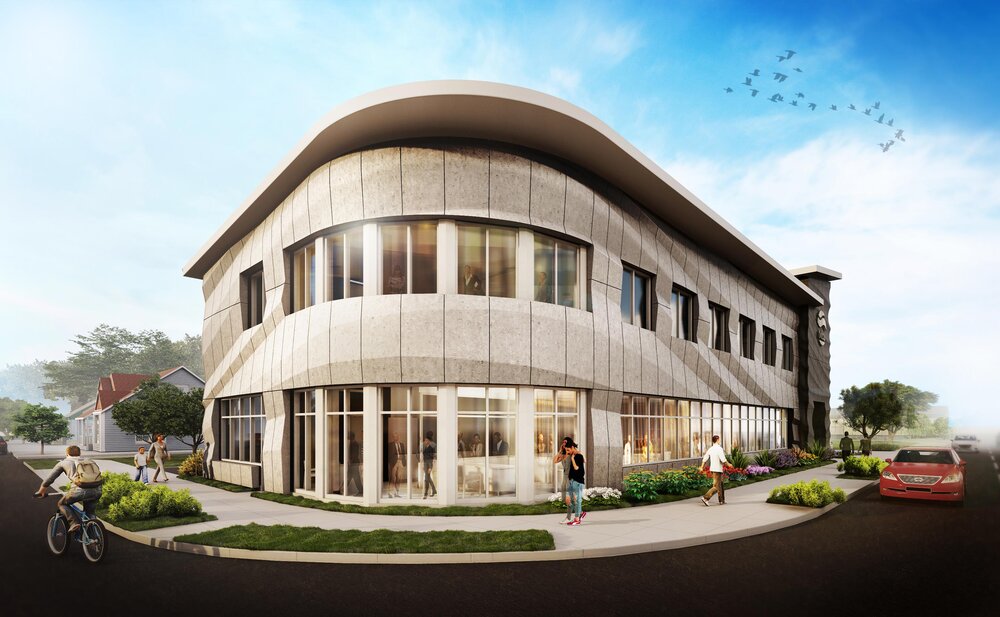
Image courtesy of Branch Technology.
Subscribe to Our Email Newsletter
Stay up-to-date on all the latest news from the 3D printing industry and receive information and offers from third party vendors.
Print Services
Upload your 3D Models and get them printed quickly and efficiently.













You May Also Like
South Korea’s Lincsolution Lands Hanwha Defense Deal as Hanwha Invests Billions in US
I recently wrote about how the South Korean additive manufacturing (AM) firm Lincsolution is building an aerospace and defense hub, part of the company’s construction of “the largest AM facility in...
Bambu Lab and SUSAN FANG 3D Print for London Fashion Week
At London Fashion Week, some of the more unusual pieces on the runway came from 3D printers. Chinese fashion designer SUSAN FANG presented her Spring/Summer 2027 Air-Illusion collection at the...
Why Cross-Border 3D Printing Is Closing the Speed Gap with Local Manufacturing
The fastest 3D printing supplier in your shortlist may no longer be the one closest to your office. That sounds unlikely to many engineers. For years, overseas 3D printing carried...
Arridex Expands 3D Printing Network to Ghana
Nigeria-based Arridex has deep experience in oil and gas additive manufacturing. Previously known as RusselSmith, the firm has in-house metal and polymer additive technology. The company is making 3D printed...























































