3D Printed Batteries: Powering Our Future?

3D printed batteries have been an area of interest for us in the 3D printing industry for a number of years now. Not often discussed, it is something that is being researched. For both consumer electronics and electric vehicles, 3D printed batteries could be very impactful. 3D printed batteries are exciting because:
- They could be flexible, which would let them be used for wearables or in other applications that were previously problematic.
- They could be readily customized for one particular application, part or use case.
- They could be designed to be conformal, following the shape of a specific device, so they easily fit into a mobile phone housing, for example.
- They could be built into a component, as well as a battery, to reduce part counts in electronics and make thinner electronics—e.g., a battery printed to have a hole for a screw and a housing for a chip.
- Batteries could be printed so that they save weight or reduce mass.
- Geometry could be optimized, to dissipate heat, for example.
- New battery designs, materials or manufacturing methods could be commercialized with 3D printing to optimize battery production for each individual vehicle or application.
- Higher energy densities could be achieved through optimizing internal topologies in the batteries themselves.
We don’t yet know if 3D printing batteries at scale is useful at all at this moment. Current methods replicate and use many nodes that are mass manufactured and this could be cheaper and more efficient than additive manufacturing. However, 3D printing an individualized geometry could make the battery itself, its construction, and its energy density more efficient, while making them smaller and lighter inside vehicles and consumer electronics. Truth be told, the 3D printed battery evolution will probably sit somewhere between each of these extremes. Interest is high for electric cars, marine, military applications, and sensors, as well as consumer electronics, however.
Research work has often centered on the increased porosity of the nodes themselves, by using 3D printing’s ability to make complex shapes. The same lattices that all the shoe designers love and can reduce weight could work in batteries as well. Rahul Panat, an associate professor of mechanical engineering at Carnegie Mellon University (CMU) notes:
“In the case of lithium-ion batteries, the electrodes with porous architectures can lead to higher charge capacities. This is because such architectures allow the lithium to penetrate through the electrode volume leading to very high electrode utilization, and thereby higher energy storage capacity. In normal batteries, 30–50% of the total electrode volume is unutilized. Our method overcomes this issue by using 3D printing where we create a microlattice electrode architecture that allows the efficient transport of lithium through the entire electrode, which also increases the battery charging rates.”
In this case, the CMU team used Aerosol Jet to make the battery nodes, finding that,
“Microlattice electrodes with porous solid truss members (Ag) are fabricated by Aerosol Jet 3D printing that leads to an unprecedented improvement in the battery performance such as 400% increase in specific capacity, 100% increase in areal capacity, and a high electrode volume utilization when compared to a thin solid Ag block electrode. “
Other projects looked at FDM to make batteries, where PLA infused batteries were made and the “highest capacity was obtained with lithium titanate and graphene nanoplatelets in the anode, and lithium manganese oxide and multiwall carbon nanotubes in the cathode. We demonstrate the use of these novel materials in a fully 3D printed coin cell, as well as 3D printed wearable electronic devices with integrated batteries.” In another instance, LiFePO4/Graphite Battery Cells were made with FDM. In yet another case, the printed battery was a lithium-ion battery. Another Lithium-Ion battery was made using direct writing.
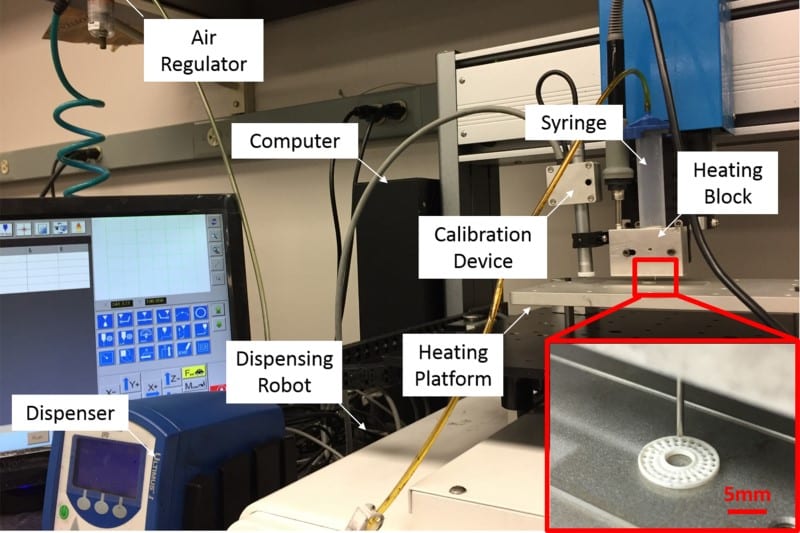
In this study, a team looks generally at free-form battery designs. In this study, we take a closer look at conformal batteries. This paper is an accessible one that is a great backgrounder for 3D printing batteries. Here we can see a handy review of flexible and other battery architecture types made through 3D printing, behind a paywall, and here is another. This review paper is also a good place to start. Here is a deeper look at structured electrodes for batteries. Printing batteries and a device in a single step is very inspirational to me.
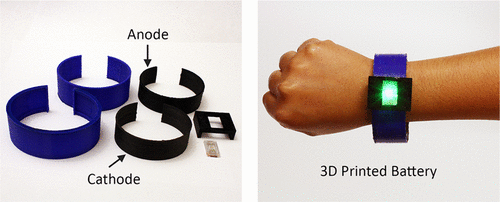
Indeed, a 2004 paper by Evan Malone and Hod Lipson that does something very similar is the reason I started working in 3D printing in the first place. The Wyss Institute at Harvard looked at tiny batteries seven years ago, as well. Sadly the team decided to focus on 3D printing onto fabrics, rather than revolutionize all electronics, through the startup Voxel8.
Other teams have looked at compressible battery structures made out of PET. Here we can see how aerogels make quasi solid state batteries that can be squeezed. KULR meanwhile is trying to make safer batteries for use in space. Blackstone technology has been working on commercializing 3D printed batteries. The company states that it,”is convinced that it can produce reliable lithium-ion batteries with higher energy density levels, in large quantities and at lower costs. The goal is to bring costs well below EUR 80.00 per kWh. This would represent the final breakthrough in storage technology.” Blackstone’s focus on solid-state batteries could very well be the new frontier in battery design.
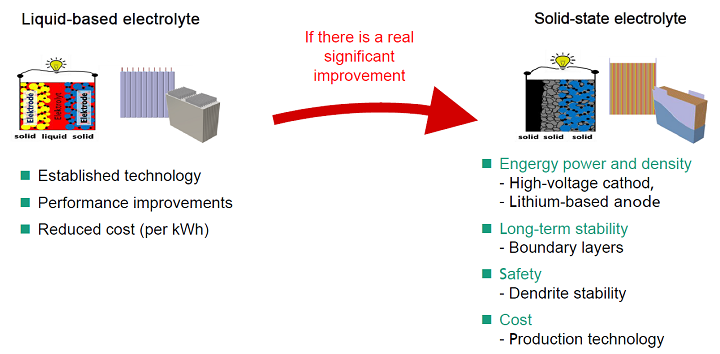
Another firm, KeraCel, wants to use binder jetting to make batteries. The company even has patents on multi-material printers and hybrid batteries. Spanish firm Polykey wants to use biopolymers to make batteries. Made out of materials such as lignin, these would be very sustainable compared to conventional ones. The company’s vision is rather radical:
“First, they don’t require toxic and scarce inorganic materials such as lithium, cobalt, nickel or manganese. Then, all-polymer batteries offer other advantages such as the use of renewable bio-based materials, flexibility, recyclability and the possibility of using additive manufacturing methods such as 3D printing for their fabrication. Our dream with iPES-3DBat was to develop materials that allow people to print their own battery at home.”
That’s something that I hadn’t considered when I began this article. All in all, we can see that there is some startup activity in the sector. Given the immense gains in electronics design, the electrification of the automobile and the electrification of many other transport modes, we would expect much more startup activity, however. Papers seem promising about binder jetting, Aerosol Jet and FDM and there is work on direct write and dispensing, but there is comparatively little going on in other 3D printing technologies. There is little going on at the micro and nanoscale (at least publicly) and this is very surprising given the potential. There have yet to be papers that point towards completely new consumer electronics or demonstrate huge strides in vehicles in a very inspiring way, however. On the whole, after reviewing the relevant press articles and scholarly publications, I feel that there is a lot missing.
There is a lot of work that I would expect to be done which is not being published or simply not being done. Is there a gap between researchers wanting to work and funding on this topic perhaps? Or are companies and institutes keeping a lot hidden for government work and stealth startups? I’m not sure, but the current Swiss cheese landscape does make me very optimistic that we could potentially bring our technology to bear on the electric devices that surround us.
Subscribe to Our Email Newsletter
Stay up-to-date on all the latest news from the 3D printing industry and receive information and offers from third party vendors.
Print Services
Upload your 3D Models and get them printed quickly and efficiently.











You May Also Like
Roboze Opens U.S. Aerospace & Defense Headquarters in El Segundo
The manufacturing sector is made up of clusters: “geographic concentrations of interconnected companies” that both cooperate and compete with each other. Of course, this is true about any sector in...
EOS Invests $3M In Its Texas Manufacturing & Logistics Facilities to Serve North American Customers
The trajectory of reshoring under President Trump has been largely a mixed bag so far. While tariffs still seem to be doing more harm than good to the U.S. domestic...
At AIAA SciTech 2026, 3D Printing Was Part of the Workflow — Part I
The AIAA SciTech Forum 2026 brought much of the aerospace community together in one place. With roughly 6,000 attendees, 115 exhibitors, 21 sponsors, and nearly 3,000 technical paper presentations, the...
€73 Million Investment Round into SWISSto12
SWISSto12 is on the move. I think that the firm owns one of the most promising and profitable applications for 3D printing, RF components, and it is showing real growth...