
Kamp C Completes Two-Story 3D Printed House in Belgium

Kamp C has been gearing up for a large-scale 3D printing effort at its site in Belgium since last year, with the delivery of a COBOD BOD2 printer measuring 10 x 10 m (32 x 32 ft). Continuing to monitor developments worldwide in 3D printed construction, along with performing its own pioneering work, the center for sustainability and construction has just announced 3D printing of a house.
While 3D printing in construction remains dubious in some cases—especially with lofty promises that may not have been exactly true—the Kamp C team is well aware of such inflated advertising and clearly states that it did print the entire two-story home in one piece. Standing 26-feet tall, the house is on par with a typical terrace home in Belgium.
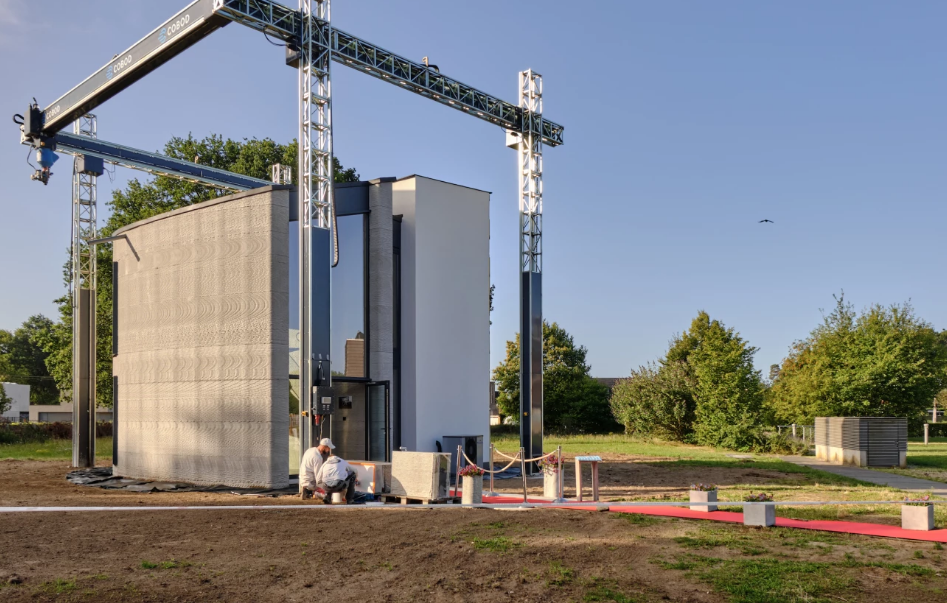
(Image: Kamp C & Jasmien Smets)
“What makes this house so unique is we printed it with a fixed 3D concrete printer,” said Emiel Ascione, project manager at Kamp C.
Comparing their success to other 3D printed construction projects consisting of only one floor and fabricated in a factory to then be assembled elsewhere, the Kamp C home was manufactured in place at Westerlo, in a project made possible due to funding from the European Regional Development Fund (ERDF) in collaboration with the European C3PO. The Kamp C team, along with their project partners, continues to raise interest in 3D printing for the construction industry.
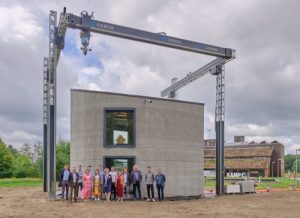
Belgium-based Kamp C has printed one of the world’s first 3D houses in one piece. (Image: © Kamp C/Jasmien Smets)
Formwork was unnecessary, allowing for an impressive 60 percent savings overall in terms of concrete, time, and budget. Very little wire-mesh reinforcement was required, with the exception of the fibers mixed into the concrete material.
Claiming that the 3D printed home is “three times sturdier” than a conventional brick home, the researchers consider this structure to be a test model. They will continue to study the integrity of the building over time to analyze its true potential for longevity.
“We printed an overhang, it has heavily curved walls, different types of walls…we also incorporated solutions to the traditional thermal bridge, eliminating cold bridges altogether,” said Ascione. “We developed a low-energy house, with all the mod cons, including floor and ceiling heating, special façade solar panels, and a heat pump, and we will also be adding a green roof.”
The team had a very flexible plan in beginning the project; in fact, the architects were not sure what purpose the building would even serve as they began printing “the shape of an average contemporary home.” As a circular home, the building could be used for a residence, office, or open exhibition space.
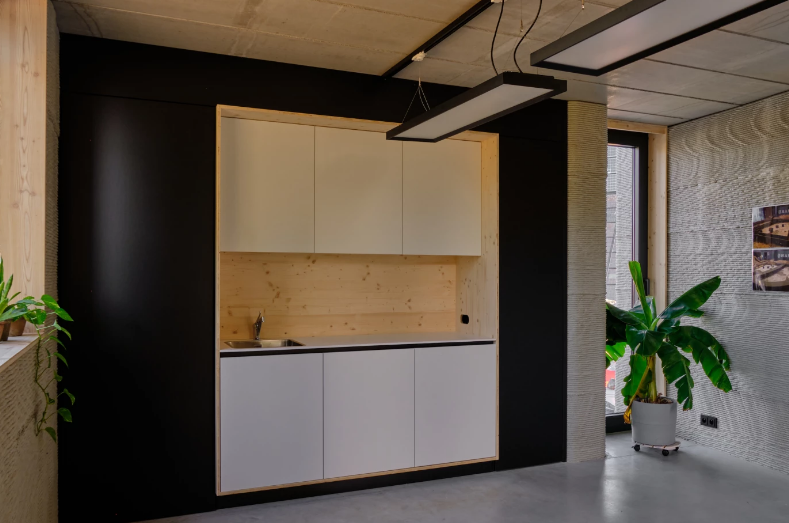
The 3D-printed house includes a simple kitchenette (Image © Kamp C/Jasmien Smets)
Numerous 3D printing projects have been completed worldwide in the construction industry. Dubai has notably been a hot spot with structures such as the world’s largest 3D printed building. Many different research projects continue regarding construction, including ongoing fabrication of habitats on other planets like Mars. While this recent model in Belgium is strategically designed to show off the potential of 3D printing, the Kamp C team expects to print similar homes in the future in under two days.
[Source / Images: Construction Canada; News Atlas]Subscribe to Our Email Newsletter
Stay up-to-date on all the latest news from the 3D printing industry and receive information and offers from third party vendors.
Print Services
Upload your 3D Models and get them printed quickly and efficiently.













You May Also Like
3D Printing News Briefs, September 26, 2026: Bioceramic Implants, 3D Concrete Printing, & More
In this weekend’s 3D Printing News Briefs, we’ll start with an integration between PanOptimization and AMCM, before moving on to healthcare news from KLS Martin and Lithoz, and then UltiMaker...
3D Printing News Briefs, September 24, 2026: Metallic Alloys, Nanobone, Alternative Meat, & More
In this week’s 3D Printing News Briefs, we’ll discuss some materials news: a reference material for standardizing photopolymer manufacturing, metallic alloys that help reduce energy loss in electric motors, a...
AMAsia Pulse: AM Investment Picks Up Across Asia-Pacific
The first half of September brought fresh investment and expansion activity across Asia-Pacific’s additive manufacturing sector. China’s Xinjinghe secured funding for an aerospace AM hub, South Korea’s Lincsolution outlined plans...
3D Printing News Briefs, September 17, 2026: 3D Printed Boat, UAS Development, & More
We’ll start with maritime manufacturing in this week’s 3D Printing News Briefs, and continue on to defense 3D printing. We’ll end with funding for Tripo AI. Read on for all...























































