
3D Printing News Briefs: March 20, 2020


Leading off our 3D Printing News Briefs today, the Wohlers Report for 2020 has been released. Moving on, Nanofabrica has achieved excellent results of direct rapid soft tooling with 3D printing. Two more interesting 3D printed projects we’re covering are ACCIONA’s 3D printed concrete bus stop, and HP’s 3D printed artwork in honor of Women’s History Month.
Wohlers Report 2020 Published
 This week, consulting firm Wohlers Associates, Inc. has announced that the 25th annual installment of its AM and 3D printing report, Wohlers Report 2020, has been published, with documentation of over 250 applications of the technology. For example, Jabil redesigned an impeller for fabrication via 3D printing, so it could be made in a single fiber-reinforced polymer composite part, while Italian company Isinnova designed and 3D printed many respirator valves in less than two days to help COVID-19 patients.
The 380-page report, which documents collaborations, government-sponsored R&D, and academic and research institute activities, includes several new and expanded features, including a review of AM in the dental industry, expert reports from 35 countries, and maturing and new AM applications for series production. 79 co-authors and contributors from around the world contributed to the report, which includes over 377 images and illustrations, 168 tables, and 42 charts and graphs.
Nanofabrica Excels at Direct Rapid Soft Tooling

(Picture courtesy of Idan Gil)
Israeli micro additive manufacturing develop Nanofabrica has been trialing its processing of direct rapid soft tooling (DRST), and seeing what it calls “enormous success” by accomplishing the 3D printing of a precise soft mold in less than one hour, for less than $20, that lasted over 20 shots. Nanofabrica completed experiments where it injected PP, PE, and ABS materials into a 3D printed mold, which lasted over 20 shots with a 400 bar at 230°C molding pressure. The mold was printed on its Terra 250 AM platform, which offers high surface finish and tiny features, while an Arburg 35 ton machine was used to inject the materials.
“We are fine tuning the manufacture of our DRST through a combination of design optimisation and improvements in materials. While we are getting a good 20 shots off this preliminary testing, we are working on improving both the material as well as the process with the aim of handling tougher injection conditions and a bigger array of injected materials. Our aim is to last 1000 shots in the coming months. This unlocks new business possibilities for mould makers and manufacturers who up until this point have been restricted to the use of long lead time and expensive traditionally manufactured mould tools for the achievement of any volume of moulding, from prototype runs all the way through to mass manufacture,” said Tovit Neizer, VP Business Development at Nanofabrica. “The Nanofabrica trials should stimulate the business case for a process chain that includes DRST, with a dramatically shorter lead time of about 2 hours from file to injected part and at costs reduced from thousands of dollars to tens.”
These experiments open the possibility of small, and medium, batch manufacturing, as Nanofabrica’s micro AM platform can print multiple small tools in a single build – allowing manufacturers to make many replacement tools for a reduced cost.
ACCIONA Inaugurates 3D Printed Concrete Bus Stop
 Global sustainable infrastructure solutions company ACCIONA has inaugurated a 3D printed concrete bus stop for the Transport Authority of the Government of Ajman, which is the smallest emirate in the UAE. While we’ve seen something similar in China, this bus stop is the first of its kind in the Middle East. The nearly 3-ton bus stop, which is made of 3 separate pieces, is 2.3 m high, 2 m wide, and 4.5 m long, and took less than ten hours to print on ACCIONA’s 6 x 3 x 2 m system, which is the largest fully functional concrete 3D printer in the world that uses powder bed technology. The 3D printed bus stop was presented at a ceremony in Ajman.
“We are glad that the Transport Authority of the Government of Ajman has chosen us to carry out this project, as it serves as a demonstration of their commitment to innovation,” said Luis Clemente, ACCIONA 3D Concrete Printing Business COO. “This project allows us to showcase another way of applying 3D concrete printing technology: making iconic, innovative and sustainable urban street fittings. It is also the first to be carried out using this Powder Bed technology in the Middle East.”
HP’s 3D Printed Artwork for Women’s History Month
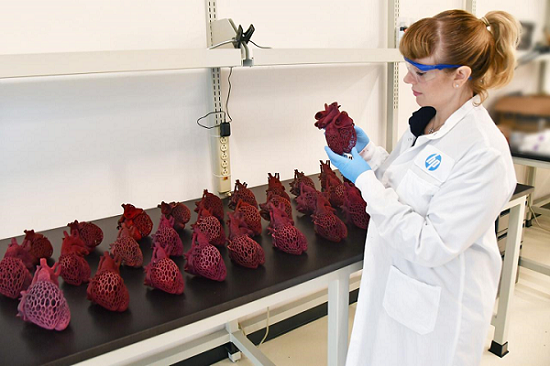 March is Women’s History Month, and to celebrate, HP is showcasing a 3D printed art collaboration with cutting-edge artist and futurist Amy Karle, who is considered to be one of the most influential women in the 3D printing industry. Her mission is to raise consciousness and contribute to social, political, and technical development, and positively impact others, by sharing her custom works of art. She recently worked with HP’s 3D Printing & Digital Manufacturing organization and HP Labs to utilize Multi Jet Fusion technology in order to create stunning, full-color 3D printed pieces for major museums.
“I love the exploration and development that 3D printing offers: a new opportunity for thinking, a new way to reshape what we create, and a completely new approach to expression in which digital, physical and biological systems are interwoven. HP 3D Printing enables me to bring this vision to life by opening up new artistic possibilities not achievable before,” Karle said.
The basis of her collection for the National Museum of Natural History is Smithsonian 3D scan data of a fossilized Triceratops skeleton, and other scans by the Smithsonian Digitization Office. For the Mori Art Museum in Tokyo, Karle created a sculpture titled “The Heart of Evolution?” that shows “what heart vasculature could look and work like with enhanced design, housed in the mechanical womb of a scientific bioreactor.”
Discuss these stories and other 3D printing topics at 3DPrintBoard.com or share your thoughts in the Facebook comments below.
Subscribe to Our Email Newsletter
Stay up-to-date on all the latest news from the 3D printing industry and receive information and offers from third party vendors.
Print Services
Upload your 3D Models and get them printed quickly and efficiently.












You May Also Like
3D Printing News Briefs, October 10, 2026: Drones, WAAM, Ceramics, & More
We have a packed 3D Printing News Briefs for you this weekend! First, America Makes celebrated the recent National Manufacturing Day with 3D printed drones, and then it’s on to...
3D Printing News Briefs, October 3, 2026: Hypersonics, Hotends, & More
We’re starting off with defense in this weekend’s 3D Printing News Briefs, as Titomic was awarded a $5 million U.S. defense contract, and VulcanForms announced a partnership with Specter Aerospace...
The Part Is Only Half the Story: Why 3D Printing Needs a Digital Thread
A 3D printed part can generate a lot of information. The challenge is keeping track of it. Manufacturers need to know which design was used, what material went into the...
Advanced Manufacturing at IMTS 2026: 3D Printing and AI and Drones, Oh My!
Last week’s International Manufacturing Technology Snow (IMTS) in Chicago welcomed over 90,000 attendees to the jungle that is McCormick Place. With over 1.17 million square feet of exhibit space, and...


























































