Horizon 2020 LASIMM Hybrid 3D Printing Project Complete

After three years of design and implementation, the Large Additive Subtractive Integrated Modular Machine (LASIMM) project, funded by the E.U.’s Horizon 2020 program, is officially complete. We’ve tracked its progress since its 2017 launch and the resulting LASIMM system is an exciting one.
The project aimed to develop a modular robotic system capable of metal 3D printing and machining directly from a CAD file. To accomplish this, the team members landed on wire and arc additive manufacturing (WAAM), which relies on low-cost plasma arc welding of wire to deposit metal onto a substrate. Two industrial robotic arms were outfitted with WAAM capabilities, while a parallel kinematic motion (PKM) robot was performed the milling procedures.
The LASIMM is capable of producing objects up to five meters long and three meters wide, including aluminum, steel and titanium parts. To test the real-world applicability of the technology, partners BAE Systems, Vestas and Fosters + Partners provided their expertise and it is believed that the LASIMM could be integrated into production environments for both manufacturing and repair purposes. Key to this integration is the fact that the system is highly configurable and, therefore could be made customized for a given customer’s needs.
Other features that could feasibly be added to the LASIMM are metrology, inspection and cold-work—that is, the ability strengthen metal parts via mechanical stress, instead of heat. Other manufacturing techniques, such as rolling, peening and in-situ alloying could also be introduced to the system. The same PKM robot that performs the milling could perform the cold work processing by rolling the part, potentially resulting in material properties stronger than those achieved by forging. This, along with the alloying, would mean that parts coming out of the process would have superior mechanical properties.
Now that the project is complete, the industrialization process will begin, which team members estimate will take about a year. When LASIMM is commercialized, it will be available as a modular and self-contained platform with a technology readiness level of six on a scale of one to nine, with nine being the highest. The commercial system will be able to fabricate parts up to six meters long with mechanical properties matching or exceeding forged alloys.
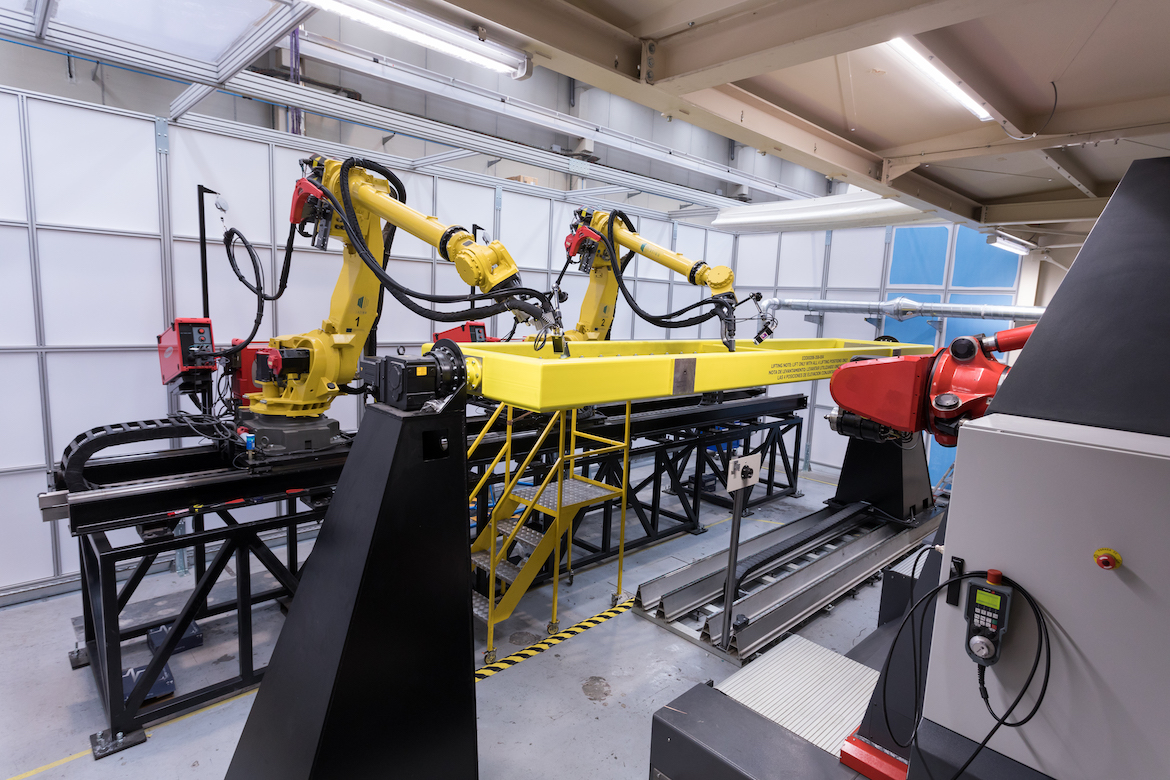
The LASIMM proyect is ready to print (Loxin Image)
Based on the partners involved, including British aerospace and weapons company BAE Systems, it’s easy to imagine this technology being used for the production of large aerospace components, as well as wind turbine blades, automobile parts and structural parts used in construction. According to the team members, the LASIMM can reduce time and cost of manufacturing parts by 20 percent compared to current additive and subtractive processes, while increasing productivity for high volume AM production by 15 percent.
The LASIMM isn’t Europe’s only massive hybrid manufacturing project. Alongside it are the OpenHybrid and Kraken hybrid metal 3D printers. The OpenHybrid project ended with the development of two systems, one which integrates directed energy deposition toolheads into an existing CNC machine and another that is a large-scale gantry system. The Kraken is a massive WAAM system that has a build volume of 20m x 8m x 6m and can also 3D print polymers at rates of 120 kg/h.
Altogether, this is a sign that not only is Europe’s already strong hybrid manufacturing space getting bigger and stronger, but hybrid 3D printing as a market is growing as predicted by SmarTech in its recent report on the subject.
Join the discussion of this and other 3D printing topics at 3DPrintBoard.com.
Subscribe to Our Email Newsletter
Stay up-to-date on all the latest news from the 3D printing industry and receive information and offers from third party vendors.
Print Services
Upload your 3D Models and get them printed quickly and efficiently.











You May Also Like
Bambu Lab A1 Used to Directly 3D Print Copper Electroplated Parts
Maker Dzingof was doing tonnes of electroplating of desktop and other 3D prints years ago with his Metalizzr project. I’ve been playing, a lot less successfully, with electroplated 3D prints...
3D Printing Financials: Materialise Reports Strong Finish to 2025, Led by Medical Growth
Materialise (Nasdaq: MTLS) closed out 2025 with a solid fourth quarter, showing stronger profitability, steady revenue growth, and continued momentum in its medical business. While some parts of the company...
Takeaways From MILAM 2026: Defense’s Growing Role in Driving 3D Printing – Part II
At the recent Military Additive Manufacturing Summit & Technology Showcase (MILAM 2026), additive manufacturing wasn’t just being discussed as a production strategy; it was being packaged for deployment. A big...
From Vision to Volume: The Next Chapter for Additive Manufacturing
Additive manufacturing has spent years navigating skepticism, hype cycles, and industrial validation. Now, the industry finds itself at a decisive turning point. The conversation has shifted away from futuristic possibilities...