Effect of Newly Developed (Meth)acrylate Resins on Impact Strength in 3D Printing



The Challenge
Dymax is creating solutions that allow photopolymer-based 3D printing resins to meet or exceed the capabilities of thermoplastic materials such as polycarbonate or ABS, targeting superior impact and temperature resistance properties. The goal is improvements in impact strength while maintaining a high Heat Deflection Temperature (HDT).
The Trade-Off
Stronger UV-curable materials with high HDTs are generally low in impact resistance, being more inflexible or brittle due to a high degree of cross-linking in their molecular composition. On the other hand, high molecular weight materials with low crosslink density typically have a low HDT or are too high in viscosity to properly 3D print. To solve this persistent problem and achieve advancement in balancing these properties, chemists need to determine the best formulation approach to attain this balance of properties within a UV-cured polymer network.
 The Materials
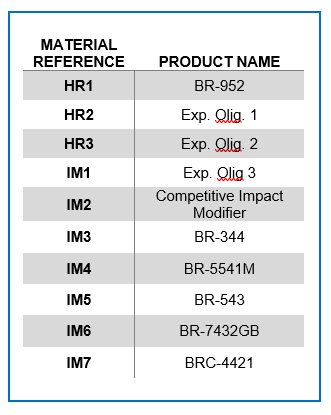
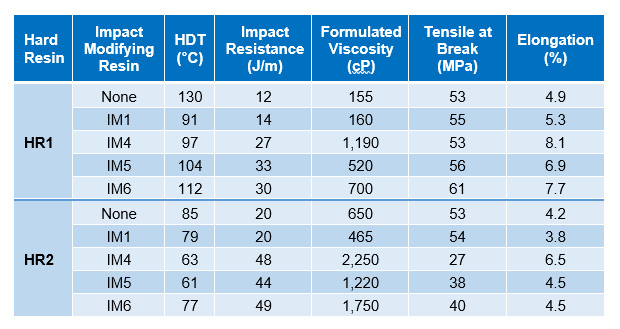
To identify the best options for 3D printing oligomer development, Dymax explored one concept for improving impact resistance by modifying hard, highly crosslinked networks with flexible impact-modifying resins. Dymax tested three experimental Hard Resins (HR) both alone and together with several Impact Modifying (IM) materials in a model formula. These materials were categorized by functionality and molecular weight, and included a range of backbone chemistries.
Printability
As Dymax researches and develops materials that balance HDT and impact resistance, we also must consider the limitations of the 3D printing process, including low formulation viscosities, limited light-source intensities, and cure dynamics of the 3D printing process. Formulators must also balance the need to achieve fast cure speed with the desire to minimize part shrinkage in order to achieve excellent print resolution and dimensional stability.
 Tensile Properties
The formulations of HR/IM combinations with the best balance of impact resistance and HDT properties were subjected to additional testing to identify potential relationships to tensile strength and elongation. Materials with lower functionalities and molecular weight showed higher tensile strengths and somewhat reduced elongation. In some cases, the HR materials are able to be toughened through the IM modification with an increase in elongation as well as a constant or increased tensile strength.
The Results
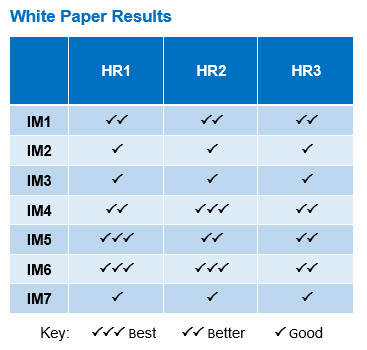
The data gathered in testing several urethane (meth)acrylate resins has allowed Dymax to expand the reach of light-curing 3D printing processes and gain powerful insight into improving both HDT and IM simultaneously, rather than simply sacrificing one for the other. As industry leaders in the chemistry, mechanical systems, and formulation expertise needed to provide total solutions to our 3D printing clients, Dymax will apply these learnings to continue to push our understanding and development even further. Download our new white paper.
Discuss this article and more on the 3DPrintBoard or comment below to tell us what you think.
Subscribe to Our Email Newsletter
Stay up-to-date on all the latest news from the 3D printing industry and receive information and offers from third party vendors.
Print Services
Upload your 3D Models and get them printed quickly and efficiently.













You May Also Like
3D Printing News Briefs, May 28, 2026: Continuous Fiber Reinforcement, Bioprinted Trachea, & More
In today’s 3D Printing News Briefs, America Makes announced the winners of its JAQS-SQ Project Call. Axtra3D is partnering with Keystone Industries to expand its dental material ecosystem, while BigRep...
3D Printing News Briefs, March 21, 2026: Resin Safety, 3D Printed Bandages, & More
We’re kicking off this weekend’s 3D Printing News Briefs with some America Makes project call news, and then moving on to resin safety myths. We’ll end with a 3D printed...
New Materials and Curing Unit at Formlabs
Formlabs is showcasing new SLA materials and a new curing solution. The new Tough 1000 Resin, with a tensile modulus of 1000, a Tough 1500, and an improved Tough 2000...
3D Printing News Briefs, October 25, 2025: Strategic Investment, Inner Ear Organoids, & More
In this weekend’s 3D Printing News Briefs, we’ll start off with some business news, as Xact Metal announced continued double digit growth in Q2 and Q3 of 2025, and the...