3D Printed Action Figures Done Right: Hauke Scheer’s Ingenious Methods

 I remember as a child having a huge collection of action figures. Whether it was my cabinets full of Teenage Mutant Ninja Turtle figures, my bedroom dresser covered with Starting Lineup Baseball figurines or my vast collection of G.I. Joes under my bed, I, like most other little boys, was quite fond of these movable toys.
As a kid, I never stopped to think about what actually went into creating such intricately detailed toys. All I cared about was battling my brother in competitive games, whether it be some sort of G.I Joe war, my Ninja Turtles conquering their arch nemesis Shredder, or figurines of my favorite Phillies players hitting fake baseballs out of fake ballparks.
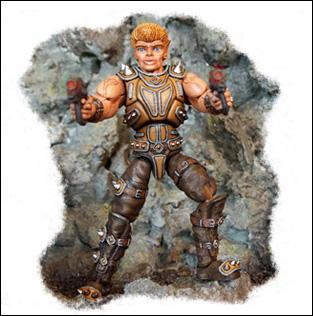
One man, named Hauke Scheer, not only understands how these action figures are created, but he has actually been quite innovative himself in their creation. He uses unique methods which include nontraditional ways of modeling and fabrication via 3D printing technology.
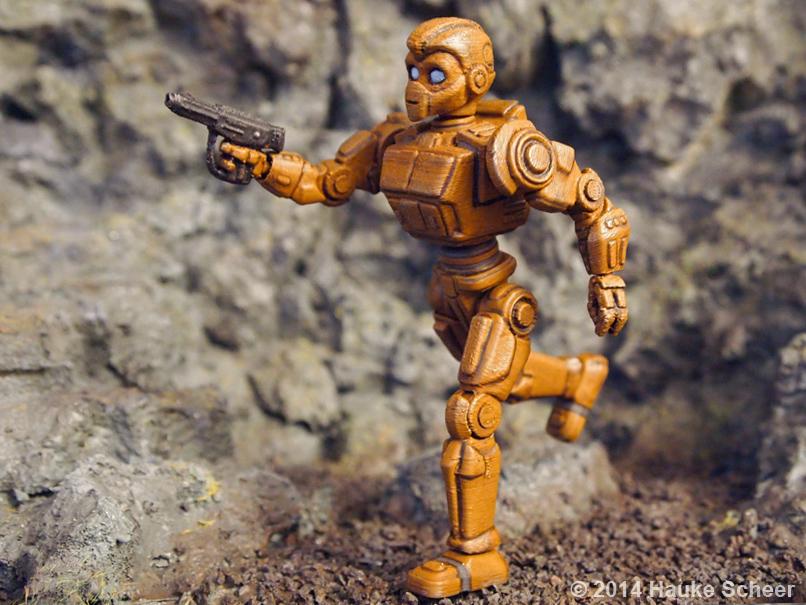
“I have been producing traditionally manufactured collectible figures for years via my company Deep Fried Figures,” Scheer tells 3DPrint.com. “In 2013 I decided to switch to 3D printing for developing the prototypes of my figures. I have been designing all my characters in 3D for years anyway so the step came natural. People soon started asking me if I could make prototypes for them so I started offering my services through my website Hauke-Scheer.de“
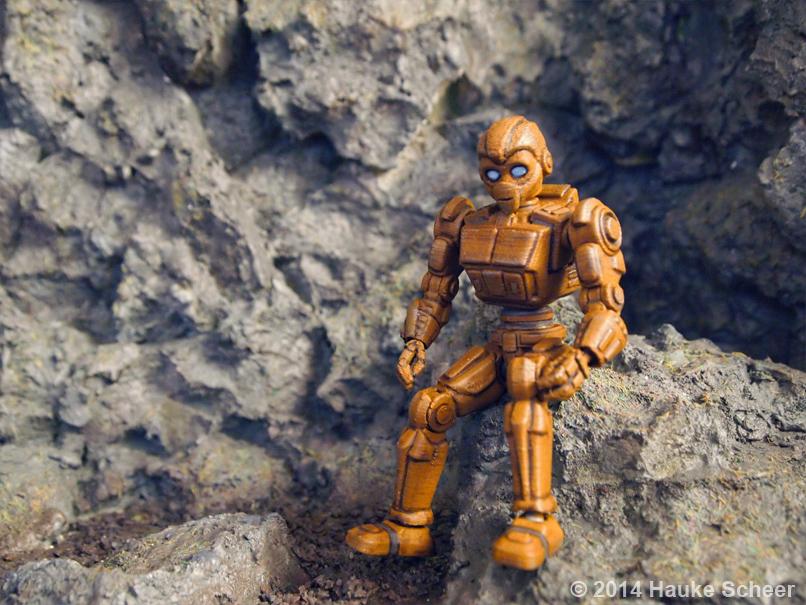 To design his figures, Scheer uses The Foundry’s Modo Software, and since his background is in modeling for animation and games, he uses an animation modeling tool for the creation of the models, rather than the more traditional CAD software.
“I design the figures pretty much like I would a mechanical character for a game or an animation,” Scheer tells us. “Modeling for animation especially has given me a good sense of figure movement and joint placement that comes in very handy when doing action figures. I do some further processing in Netfabb to optimze the models for print and also for the boolean operations to create the sockets for the joints.”
To print the figures out, Scheer uses a Stratasys Mojo 3D printer, which he says is capable of printing in “reasonable” detail, creating quite sturdy models. The figures are printed in separate parts, and then assembled without any need for glue. The ABS printed parts are then hand painted using acrylic colors. He has been very pleased with his results and says that the printer is extremely easy to use, which is something that was very important to him when deciding on which printer to utilize. “I want to concentrate on designing rather then on having to fiddle much with the printing process,” he explains.
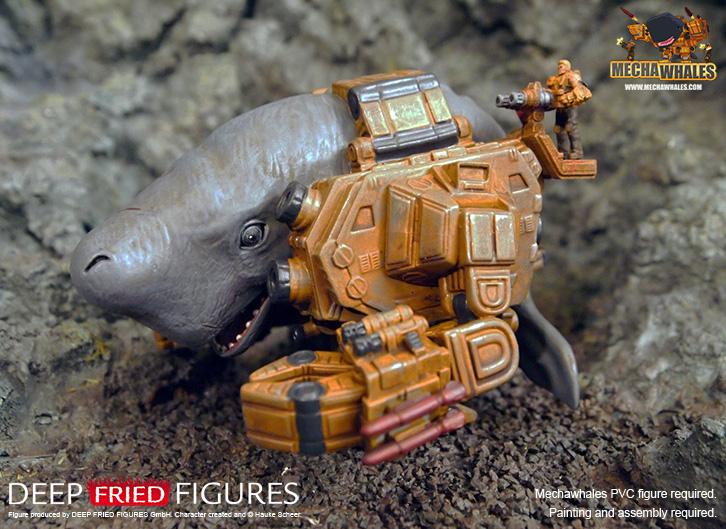
Another advantage for Scheer in using the nontraditional method of creating the figures with animation software is that it allows him to easily use the models for promotion and IP development later on. “For example the 3D models used to create my Mechawhales collectible figures could also be used to create a series of animations,” he said.
Some of Scheer’s personal 3D printed figurines can be purchased via his website. He also offers action figures with personalized 3D printed heads. On top of this, he offers 3D printed figures and custom parts for his line of Mechawhales collectible figures, via his company’s Sculpteo shop.
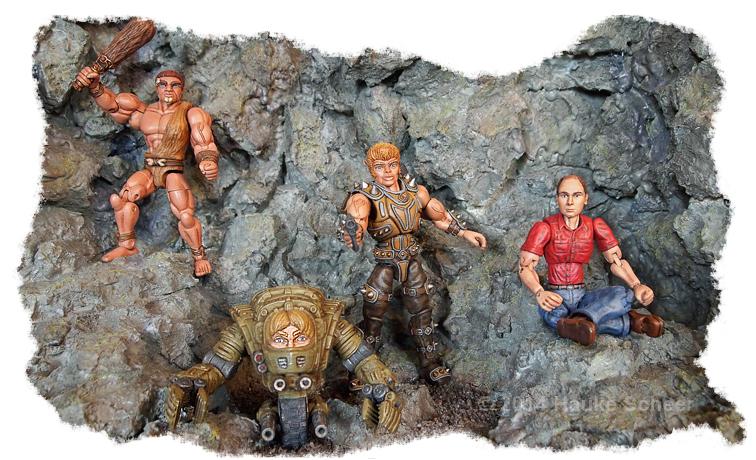
As you can see in the photos in this article, Scheer’s 3D printed action figures are of utmost quality, probably moreso than your traditional action figures that you would pick up at your local toy store. What do you think about Scheer’s figures? Would you expect it to be possible to model such detailed figures for 3D printing using animation software? Do you think this is a good method? Discuss in the 3D printed action figure forum thread on 3DPB.com.
Subscribe to Our Email Newsletter
Stay up-to-date on all the latest news from the 3D printing industry and receive information and offers from third party vendors.
Print Services
Upload your 3D Models and get them printed quickly and efficiently.













You May Also Like
AI Design and Point-of-Care Integration Headline ADDITIV Medical 2026
Medical additive manufacturing is expanding rapidly inside major healthcare institutions. In 2026 alone, hospital systems including Indiana University Health and Sheffield Teaching Hospitals launched dedicated point-of-care 3D printing facilities to...
GKN Aerospace’s UAV Demonstrator with 3D Printed Engine Avoids ITAR Regulations
The US CIA director recently made an unannounced visit to Moscow that has naturally raised much speculation, while the EU and NATO have now officially accused Russia of being behind...
The Business Case for 3D Printed Stents
A new 3D printed stent developed at New York University (NYU) does not look like the devices doctors typically use today. Instead of a simple tube, the prototype resembles a...
3D Printing Financials: 3D Systems, Prodways, and Align Build on Positive Momentum
The latest earnings from 3D Systems (NYSE: DDD), Prodways (EPA: ALPWG), and Align Technology (Nasdaq: ALGN) show that the 3D printing market continues to move forward. Some businesses are growing...