LiDar and its Applications Part 7 – Precision Forestry


Let’s talk about another interesting application of LiDar technology and the precision embedded within this. Precision forestry is a field that is focused on building or constructing a forest environment in a concise and succinct manner. Precision forestry is defined as planning or conducting forest management based on a specific forest site. Activities and operations will be conducted to improve wood quality and utilization, waste reduction, and increase the profitability of a forest area. The quality of the environment is very important and critical for all of this.

Precision forestry has a focus on information and supports economic, environmental, and sustainable decision making. This is done through leveraging technology such as LiDar. Precision forestry attempts to create highly repeatable measurements. This requires a focus on actions and different processes that can initiate, cultivate, and harvest forests in a precise manner. This also helps us to protect wildlife habitat and other resources from the surrounding environment. This can give us a lot of valuable information and conversation starters among people who are resource managers, people involved within the environmental community, manufacturers, as well as public policy makers.
We have discussed previously how we leverage LiDar to create 3D terrains, so I will not focus on that as much. I will focus on the information and data collected and how it can be utilized in this field specifically. Knowledge of information is significantly valuable for planning, organization, control, as well as length of a forestry project. With forestry comes a natural focus on how we may utilize wood properly. Wood processing is of utmost importance. In terms of wood we want to optimize dimension, grade, grain, blight disease, stiffness and taper. All of this information will influence the production of wood products as well as their profitability within the overall wood industry.
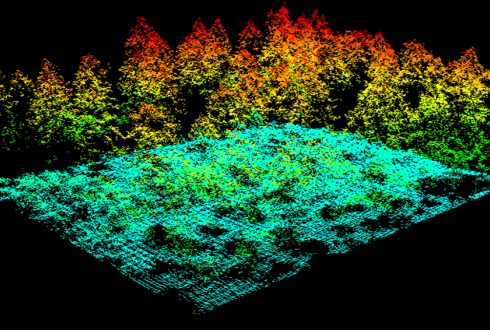
Airborne LiDar for Precision Forestry
An important topic to understand within precision forestry is optimal forest rotation age. In forestry, the optimal rotation age is the growth period needed for deriving maximum value from a stand of timber. A stand refers to a contiguous community of trees that is uniform in composition, structure, age, size, spatial arrangement, quality, or location. This allows us to distinguish a stand from adjacent groups of trees. A forest can be considered a collection of stands. To calculate optimal forest rotation age, we need to be specific to each stand and the sustainability and economic goals of anyone who wants to harvest or build a forest in a more precise manner.
Forestry Economics
Laser scanning methods such as LiDar have been effectively demonstrated in precision through applications such as forest height inventory assessment, resource inventory assessment, ecosystem studies, and stand value estimates. LiDar is able to penetrate through the density of a forest and its canopy. The laser pulses sent through a LiDar device are able to send us data and a information source on specific objects within the forest. For example, if we want to gain a better knowledge on the height of specific trees within a forest environment, we can send laser pulses from our LiDar device, and we will be able to collect object data that we can now interpret for measurement and resource allocation.
The application of technology is so abundant in different sectors. I have a newfound appreciation for different industries, but specifically technology that can be utilized in various settings. I do believe multiplicity in ability is the key to very strong technology. So let’s keep on learning and understanding new fields, and when we create technology, let’s make sure it is useful in multiple fields.
Join the discussion of this and other 3D printing topics at 3DPrintBoard.com.
Subscribe to Our Email Newsletter
Stay up-to-date on all the latest news from the 3D printing industry and receive information and offers from third party vendors.
Print Services
Upload your 3D Models and get them printed quickly and efficiently.











You May Also Like
3D Printing News Briefs, December 17, 2025: Standards, Ballistics, Dental Aligners, & More
Today’s 3D Printing News Briefs is a bit of a mixed bag, including stories about standards, ballistics 3D printing, dental aligners, and more. Read on for all the details! DNV...
Handheld 3D Printer Repairs Bone Like a Glue Gun — Tested in Rabbits, Planned for OR Use
A team of researchers from Korea and the U.S. has created a handheld 3D printing device that works like a glue gun, but instead of glue, it prints bone-like material...
Korean 3D Printing Materials Developer Graphy Goes Public
Korean vat polymerization materials developer Graphy, founded in 2017, has gone public. Graphy develops innovative resins for OEMs and offers products such as shape memory resins and directly 3D printed...
3D Printing News Briefs, July 26, 2025: Corrosion Resistance, 3D Printed Stents, & More
This weekend’s 3D Printing News Briefs are all about research! We’ll start with what’s been called the first comparison of corrosion resistance in 3D printed magnesium and zinc alloys. Then,...