nScrypt to Deliver Factory in a Tool to Australian Defense Department


The Defence Science and Technology (DST) Group of Australia’s Department of Defence has selected nScrypt’s Factory in a Tool (FiT) platform to augment its research operations. DST is a leader in safeguarding Australia by delivering expert and impartial scientific advice, supporting current operations, and providing innovative solutions for defense, national security, and future defense capabilities.
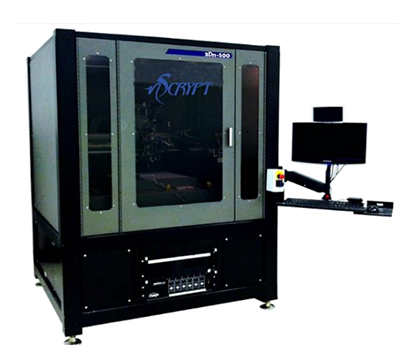
DST selected an nScrypt 3Dn-500 Penta-Head multi-material FiT platform, which will be outfitted with a SmartPumpTM microdispensing tool head, nFD™ material extrusion tool head, Pick and Place (for electronic components and subassemblies) and nMillTM tool heads (for micromilling), and UV tool head with integrated laser and Pulse Forge photonic curing for spot curing of photopolymers. The tool heads can operate in series or parallel on the FiT’s fast (up to 1 mps), high-precision (up to 10nm resolution, 500nm repeatability, 1 micron accuracy) linear motion gantry. The tool heads are monitored by multiple cameras for automated in-process inspection and computer vision routines. The system also includes a point laser height sensor for Z-tracking and mapping for conformal printing onto objects of any surface shape.
According to nScrypt’s CEO, Dr. Ken Church,
“This is one of our most advanced and versatile machines.With this tool, DST can go from CAD to a final, multi-material product with embedded electronics in a single machine, without retooling.Although the U.S. military has been a regular customer for nScrypt’s direct digital manufacturing solutions, this is nScrypt’s first sale to a foreign government agency.We are honored that Australia DST selected our tool to help support its mission.”

The FiT’s SmartPumpTM microdispensing tool head eliminates drooling with pico-liter volumetric control and boasts the widest range of materials available for any microdispensing system: more than 10,000 commercially available materials, ranging from a few centipoise (like water) to millions of centipoise (much thicker than peanut butter). The SmartPump’s™ pen tip has what is believed to be the smallest commercially available diameter, 10 microns.
The nFD™ extruder tool head can 3D print what nScrypt believes is the widest range of thermoplastics, composites, and continuous carbon fiber.
About nScrypt
Founded in 2002 and headquartered in Orlando, Florida, nScrypt designs and manufactures award-winning, next-generation, high-precision microdispensing and Direct Digital Manufacturing equipment and solutions for industrial applications, with unmatched accuracy and flexibility. Serving the printed electronics, electronics packaging, solar cell metallization, communications, printed antenna, life science, chemical/pharmaceutical, defense, space, and 3D printing industries, our equipment and solutions are widely used by the military, academic and research institutes, government agencies and national labs, and private companies. nScrypt is a 2002 spin out from Sciperio Inc., a research and development think tank specializing in cross-disciplinary solutions. The nScrypt BAT Series Bioprinter, which won the R&D 100 award in 2003, will travel to the International Space Station in 2019, in a joint program with Techshot. nScrypt Cyberfacturing Center is our direct digital contract design and manufacturing service. www.nscrypt.com
Subscribe to Our Email Newsletter
Stay up-to-date on all the latest news from the 3D printing industry and receive information and offers from third party vendors.
Print Services
Upload your 3D Models and get them printed quickly and efficiently.













You May Also Like
AI Design and Point-of-Care Integration Headline ADDITIV Medical 2026
Medical additive manufacturing is expanding rapidly inside major healthcare institutions. In 2026 alone, hospital systems including Indiana University Health and Sheffield Teaching Hospitals launched dedicated point-of-care 3D printing facilities to...
GKN Aerospace’s UAV Demonstrator with 3D Printed Engine Avoids ITAR Regulations
The US CIA director recently made an unannounced visit to Moscow that has naturally raised much speculation, while the EU and NATO have now officially accused Russia of being behind...
The Business Case for 3D Printed Stents
A new 3D printed stent developed at New York University (NYU) does not look like the devices doctors typically use today. Instead of a simple tube, the prototype resembles a...
3D Printing Financials: 3D Systems, Prodways, and Align Build on Positive Momentum
The latest earnings from 3D Systems (NYSE: DDD), Prodways (EPA: ALPWG), and Align Technology (Nasdaq: ALGN) show that the 3D printing market continues to move forward. Some businesses are growing...