VSHAPER 3D Printer Used in Fabrication of Underwater Scooter Prototype

Note: We originally wrote this article on a water scooter 3D printing case but a company involved has threatened us with legal action. It is unclear why they did this but we removed the images and some references from the article. Our apologies for this.
 A few years ago, we did a story on a 3D printed “e-floater” scooter that was solar powered and allowed users to “float” down the street. But now, Polish 3D printer manufacturer Verashape is using its VSHAPER 3D printing technology to help create an underwater scooter that can float for real. Rzeszów-based company B-4 Association is working with Verashape to manufacture a scooter prototype of the underwater device.
In business for nearly 20 years, the B-4 Association offers support for projects in the fields of development, education, and innovation, as well as offering auditing and consulting services. In addition, the company is conducting design research to hep develop a new underwater scooter. The ultimate goal is to use 3D printing to help with serial production of the scooters, but right now the cooperating companies are working on the prototype device.
One task that the B-4 Association is in charge of is developing, testing, and preparing efficient electric cells to act as the underwater scooter’s power supply. In order to produce batteries, a dedicated base is needed, which is later filled with cells that will be welded together layer by layer, held in place using special clamps. The company is using Verashape’s VSHAPER PRO+ 3D printer for the work; this system is an updated version of the company’s award-winning VSHAPER PRO.
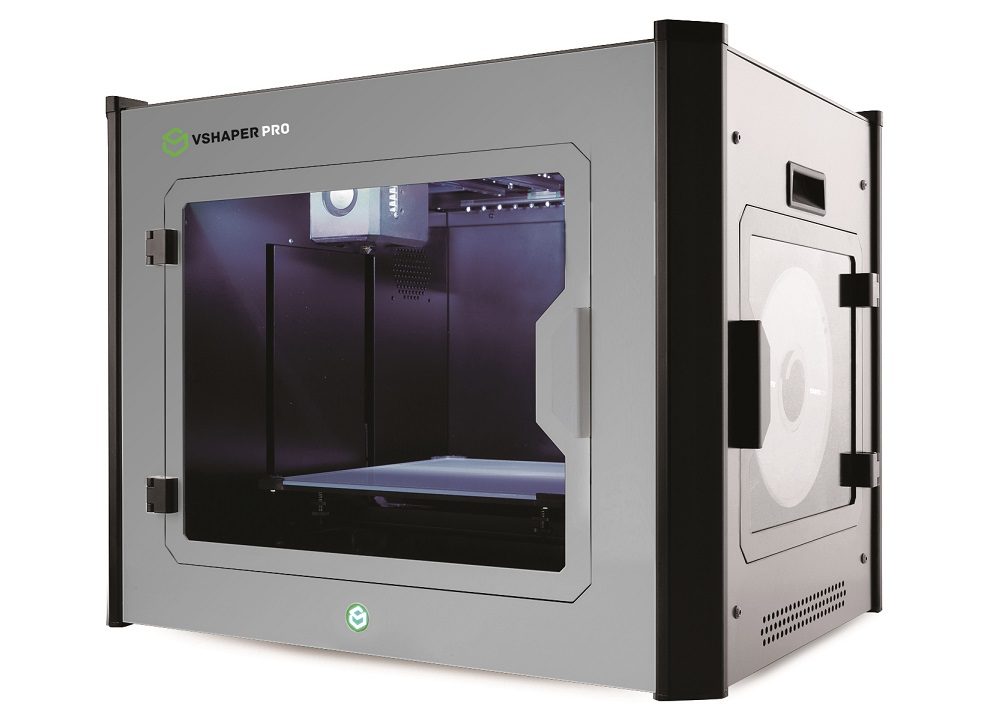
“Until now, it has taken several working days to complete the base: to develop the base in a CAD program, to prepare the production in the appropriate CAM program, to wait for the “free period” in the CNC milling machine work or to queue the task, to milling the base and, if there is even a minimal change, to restart the whole process,” explained B-4 Association representative Albin in Verashape’s case study. “Now, with VSHAPER PRO+, we can design and manufacture batteries of different capacities on the spot. In addition to the base, we also make templates on the 3D printer to keep the cells in a constant position during the welding process. The accuracy of the print allows us to produce components that are like blocks and do not require any additional processing.”
 B-4 chose to use 3D printing to make the base and template because of its rapid prototyping capability. Any design developments or shape corrections for the template and the cover can be quickly completed, which is a major benefit. In addition, because the VSHAPER PRO+ was also used to make precise models, B-4 was able to create separate elements, such as blocks, which can be assembled to build the template that’s used to keep the cells “in a fixed position” while they are being welded into place. Not only does this make it easier to take the template apart after welding, 3D printing helps save on time and resources in other ways as well, like no more time-consuming CNC machine programming for template production.
The use of 3D printing in the design process allowed and B-4 to create a solution that would have been much more difficult to fabricate with traditional forms of manufacturing.
The involved scooter has a patented immersed motor, and is both comfortable and safe for even the most demanding of dives. Plenty of famous divers have helped test the underwater scooters by exploring shipwrecks and caves in both fresh and salt water. The whole device weighs 16 kg, and it only takes about 2.5 hours to charge the scooter’s lithium-ion batteries.
Discuss this story and other 3D printing topics at 3DPrintBoard.com or share your thoughts in the Facebook comments below.
Subscribe to Our Email Newsletter
Stay up-to-date on all the latest news from the 3D printing industry and receive information and offers from third party vendors.
Print Services
Upload your 3D Models and get them printed quickly and efficiently.











You May Also Like
Portsmouth Naval Shipyard Installs 3D Printed Part on In-Service Submarine in Key Milestone for US Defense Sector
I’ve been tracking the US Navy’s additive manufacturing (AM) buildup as it relates to submarines for a while now, and even amidst the AM efforts that all the branches have embarked...
6K Additive Lands Long-Term Nickel-Alloy Powders Supply Agreement with Siemens Energy
We’ve still got a month left in Q1, but I’ve already come back to the theme of the role of additive manufacturing (AM) in the ‘sustainability-as-security’ thesis — a topic...
Cheap Printers Make Metal Powders Costly
Last year, on stage at AM Strategies, the argument was simple: additive manufacturing had to stop chasing elegance and start chasing economics. The 3D printing community had spent decades refining...
Adoption of Advanced Powder Metal Manufacturing in the Global Small Arms Space – SHOT Show 2026 Additive Manufacturing Analysis
Back in 2013, I remember being completely blown away when a company called Solid Concepts reportedly additively manufactured nearly a complete firearm as a proof of concept. Although desktop polymer...