IDS Releasing Aerosol-Based Desktop Electronics 3D Printer at NextFlex Innovation Day


 Coming up on August 8th, the NextFlex consortium will be holding an Innovation Day at its San Jose, California headquarters. The invitation-only workshop (request an invite here) celebrates the progress made on projects and results achieved in the Technology Hub, in addition to giving members a way to discover new technology, network with each other, and meet influencers in the FHE (Flexible Hybrid Electronics) manufacturing supply chain. This year, New Mexico-based company IDS will be on hand at the event to officially announce the release of its updated desktop aerosol 3D printer.
IDS, which stands for Integrated Deposition Solutions, is a small business in Albuquerque. Founded in 2013, the company is looking to become a leader in the field of 3D printed electronics – it has licensed an aerosol-based AM technology, called NanoJet, from Sandia National Laboratories and adapted it for Direct-Write Electronic (DWE) 3D printing.
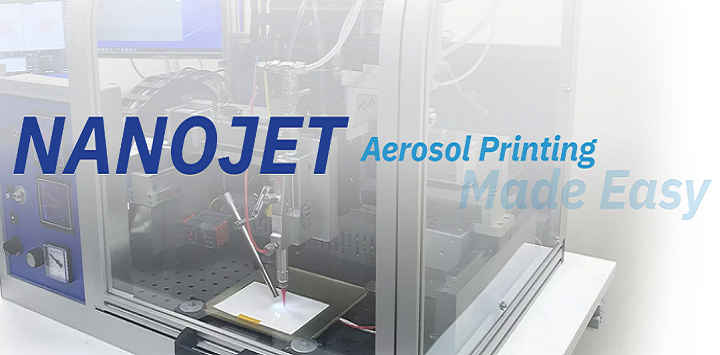
According to IDS, the company’s updated desktop 3D printer is a high-performance, low-cost system for aerosol 3D printing applications, such as printed electronics. IDS claims it’s the “first affordable aerosol-based print platform” in printed electronics that’s currently available for both research purposes and low volume production.
“The NanoJet technology is cost-effective, easy to use, reliable and capable of operating for extended periods of time without operator intervention,” the IDS website states. “The ability to print features from approximately 10 µm to 200 µm in width in conductors, dielectrics, resistors and other electronic specific materials makes the aerosol-based NanoJet technology unique.”
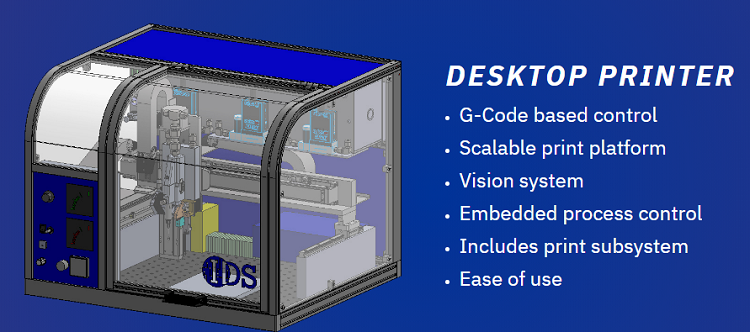
 IDS’ aerosol 3D printer has integrated its reliable NanoJet technology into a functioning desktop machine, which includes a process vision system, print process controls, simplified tool path generation, and industrial motion control driven by G-code. This motion control platform provides flexibility to end users in using tool path generators, whether it’s the one that came with the IDS printer or something similar. In addition, the multiple NanoJet print heads make it easy to switch materials between development, production, and and research processes, thanks to its aerosol focusing assemblies and easy to replace ink cartridges; each print head includes its own module.
The printer also has a 150 x 150 mm heated platform and point of use aerosol generation. Applications for IDS’ aerosol-based NanoJet 3D printing include:
- biomedical
- conformal electronics
- high-density interconnects
- wireless power transfer
Another company that’s well-known for using an aerosol-based 3D printing process is production-grade 3D printer supplier Optomec, with its patented Aerosol Jet technology for 3D printing electronics. Aerosol jetting is a very important technology because of its ability to create intricate products like antennae and sensors.
I’m not sure if IDS’ technology works the same as Optometc’s aerosol 3D printing, but I would bet the processes are very similar. IDS claims its desktop system is a plug-and-play 3D printer, with continuous operation for four hours of unattended printing, that uses Ag nanoparticle ink and single pass line thickness between 100 nm to 4 µm. The company also says that its aerosol 3D printer costs three times less than other commercially available aerosol-based systems; you can contact IDS for a quote.
What do you think? Discuss this story and other 3D printing topics at 3DPrintBoard.com or share your thoughts in the Facebook comments below.
[Images: IDS]Subscribe to Our Email Newsletter
Stay up-to-date on all the latest news from the 3D printing industry and receive information and offers from third party vendors.
Print Services
Upload your 3D Models and get them printed quickly and efficiently.













You May Also Like
3D Printing Financials: 3D Systems, Prodways, and Align Build on Positive Momentum
The latest earnings from 3D Systems (NYSE: DDD), Prodways (EPA: ALPWG), and Align Technology (Nasdaq: ALGN) show that the 3D printing market continues to move forward. Some businesses are growing...
3D Printing News Briefs, August 8, 2026: Seawall Funding, Defense Capabilities, Supports, & More
We’re starting with business in this weekend’s 3D Printing News Briefs, then moving on to defense. We’ll move on to young 3D printing entrepreneurs, and finish with some research out...
Walter Reed Gets Premarket Clearance to Make 3D Printed Point-of-Care Medical Devices
The Walter Reed National Military Medical Center’s 3-D Medical Application Center (3-D MAC) has received premarket clearance to make 3D printed medical devices. This is the first time that a...
Jeff Graves Seeks New 3D Systems CEO, The Company at a Crossroads
Jeff Graves is to step down as 3D Systems‘ CEO once a replacement has been found, the company has announced. He will then retire as CEO and as Director of...