
Michelin & GM Announce 3D Printed Prototype of Uptis, the Airless & Flatproof Tire

 The quest to solve the never-ending inconvenience, expense—and sometimes grave danger—presented by the flat tire and the dreaded blowout may finally be coming to an end, thanks to Michelin in collaboration with General Motors.
3D printing is playing a major role within this innovative development also, as they roll out a prototype of the new tire referred to as Uptis. The technology is both airless and flatproof, according to the two industry leaders in automobiles and tires, who currently have the potential to make millions of consumers very happy (and much safer) in the future.
“Uptis demonstrates that Michelin’s vision for a future of sustainable mobility is clearly an achievable dream,” said Florent Menegaux, chief executive officer for Michelin Group.
The manufacturers are currently using a fleet of Chevrolet Bolt EVs to test the new tires in Michigan, and foresee them being available to the public in 2024. And while Detroit is obviously an automotive hub, testing on Michigan roads not only allows for exposure to what some residents may consider an alarming number of potholes, but the tires will also be driven through the brutal seasons and weather of Michigan. Opaque in color, these 100 percent sustainable tires will be made to last even longer, and are a much greener alternative, with less materials used—and less waste in production.

The Michelin Uptis Prototype is tested on a Chevrolet Bolt EV May 29 at the General Motors Milford Proving Ground in Milford. (Photo: Steve Fecht for General Motors)
“General Motors is excited about the possibilities that Uptis presents, and we are thrilled to collaborate with Michelin on this breakthrough technology,” said Steve Kiefer, GM’s senior vice president of global purchasing and supply chain, in a statement. “Uptis is an ideal fit for propelling the automotive industry into the future and a great example of how our customers benefit when we collaborate and innovate with our supplier partners.”
The Unique Puncture-proof Tire System (Uptis) was announced at the Michelin Movin’On Summit in Montreal on June 4. And while the current 3D printed prototype is centered around all the benefits that could be offered for passenger vehicles, the implications for the industry of tires overall and the savings in so many different types of transportation applications are staggering; for example, with a design like this, trucking companies could save exponential amounts on the bottom line, with substantially less time invested in dealing with problems on the highways—and ongoing maintenance.
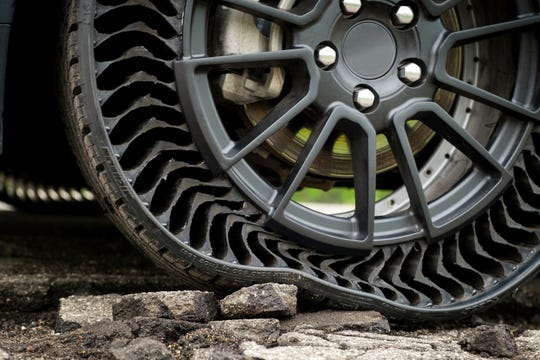
GM intends to develop this airless wheel assembly with Michelin and aims to introduce it on passenger vehicles as early as 2024. (Photo: Steve Fecht, General Motors)
3D printing has broken down incredible barriers in manufacturing, allowing for concepts that are often mind-blowing because we are so used to doing things the same way—even when they may not work all that well; for instance, with 3D printing, paving and repairing roads could become much more streamlined, and perhaps even with the help of robots mounted to drones. And although no one likes dealing with the bumpy ride of a pothole-ridden road, damage to your car may become less of a problem with new rubber technology and GM’s latest research and development in airless tires.
What do you think of this news? Let us know your thoughts! Join the discussion of this and other 3D printing topics at 3DPrintBoard.com.
[Source: The Drive; The Detroit News; Photos: General Motors]Subscribe to Our Email Newsletter
Stay up-to-date on all the latest news from the 3D printing industry and receive information and offers from third party vendors.
Print Services
Upload your 3D Models and get them printed quickly and efficiently.













You May Also Like
Stratasys vs. Bambu Lab: Why Europe and the U.S. Reached Different Results, Part II
Editor’s note: This is Part 2 of a two-part series by Xu Fanglei examining the technology and patent issues behind the Stratasys-Bambu Lab dispute. Part 1 looked at the $27.6...
Bambu Lab & 7 Accessibility Organizations Launch Design Challenge for 3D Printed Assistive Devices
In 2023, Chinese 3D printer OEM Bambu Lab launched MakerWorld, its collaborative 3D model platform. By early 2026, the platform had about 10 million monthly active users and started to...
Stratasys vs. Bambu Lab: What’s Really Behind the $27.6M Patent Verdict?
Editor’s note: This is Part 1 of a two-part series by Xu Fanglei examining the technology and patent issues behind the Stratasys-Bambu Lab dispute. Part 1 looks at the U.S....
The Part Is Only Half the Story: Why 3D Printing Needs a Digital Thread
A 3D printed part can generate a lot of information. The challenge is keeping track of it. Manufacturers need to know which design was used, what material went into the...

























































