Rapid 2019: Laminated Resin Printing Technology: Callaghan Innovation Presents MicroMaker3D


Many developments are being made on the microscopic scale in 3D printing—with numerous examples on display this week at RAPID + TCT 2019 in Detroit (May 20-23). New Zealand is hopping when it comes to 3D printing, whether in creating new metal processes or engineering dynamic new systems, and now Callaghan Innovation is representing in full force with MicroMaker3D, rapid prototyping hardware that allows for fabrication of objects smaller than a strand of hair.
Presenting their new technology today at the conference, Callaghan Innovation is introducing what they expect to be a major advancement in micro-structure 3D printing. Powered by patent-pending, laminated resin printing (LRP), MicroMaker3D has the potential to make a significant impact on the $7 billion miniaturization market with better accessibility for researchers and higher speeds in printing, impacting industries and applications to include:
- Electronics
- Wearables
- Sensors
- IoT devices
3D map of New Zealand
“We recognized the growing demand for miniaturized structures – the vital components in an increasing number of devices and manufacturing applications – and then we went about finding a way to produce these structures in a less costly way,” says Lead MicroMaker3D engineer Neil Glasson, who will deliver a presentation at RAPID.
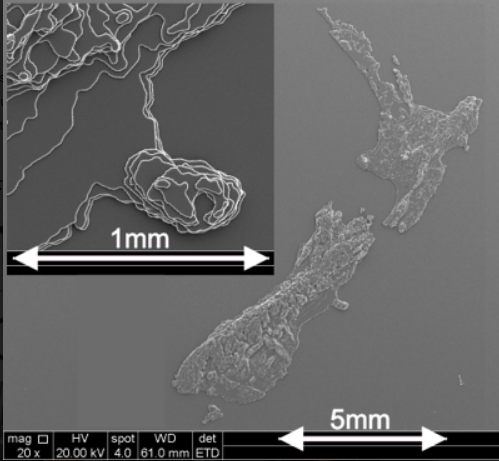
Glasson expands further, explaining that since Micromaker3D arrived on the scene, their technology has continued to accelerate and progress, resulting in even more complex prototyping as LRP allows for fabrication of submillimeter structures with complex geometries of up to 100 percent density. This new production process also offers extremely ‘low-layer thicknesses’ and imaging speeds as quick as one second per layer independent of complexity or density.
“When LRP, a new type of 3D printing, was introduced last year we knew it had the potential to be game changing,” says Glasson. “Now with specialized engineering this is becoming a reality – we are printing detailed objects smaller than a strand of human hair. For context, a human hair is about 100 microns and with MicroMaker3D we’re talking 5 microns.
“Prototyping progress has been swift, and we continue refining the level of precision on the tiny structures. The team has recently produced moving parts which is exciting.”
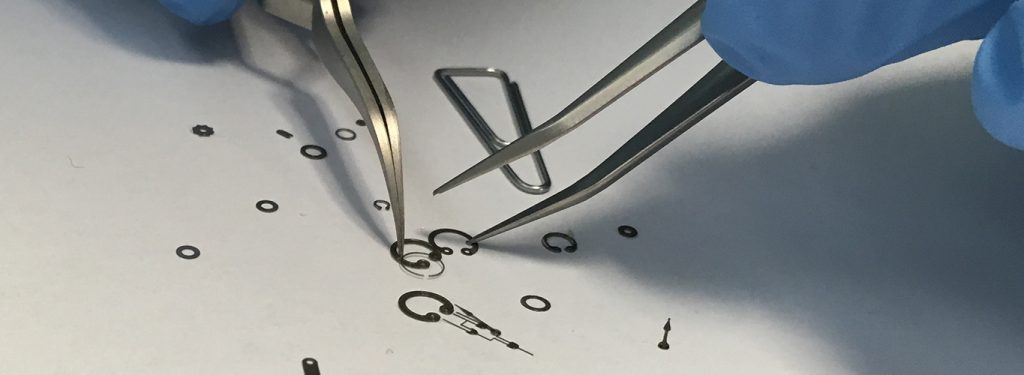
Callaghan Innovation continues to promote global development of MicroMaker3D, as it becomes closer to a commercial reality overall.
“LRP was developed to address a growing market need to rapidly produce microscale structures in an efficient, convenient and cost-effective way,” said Cath Andrews, Senior Business Development Manager. “It could open up miniaturization as a new high value application in additive manufacturing, an industry that already exceeded $US7B in 2018. So, it’s not surprising that with its development it’s attracting investor and end-user interest.”

Neil Glasson presented MicroMaker3D and discussed its progress today (Room 330 B), and he and Cath will be speaking with interested parties attending RAPID over the next few days.
3D printing seems limitless, with creative boundaries being broken continually—whether on the micro or macro size. While 3D discoveries and innovation are fascinating on the micro- and nanoscale, engineers and designers also like to go big, whether in 3D printing a skyscraper or a creating a complex art installation. What do you think of this news? Let us know your thoughts! Join the discussion of this and other 3D printing topics at 3DPrintBoard.com.
Subscribe to Our Email Newsletter
Stay up-to-date on all the latest news from the 3D printing industry and receive information and offers from third party vendors.
Print Services
Upload your 3D Models and get them printed quickly and efficiently.











You May Also Like
Killer 3D Printing Applications: Factory Automation
Across the globe, factories are using 3D printing to improve operations. Iterative improvements to production lines, automation tools, repairs, additions, custom parts for custom lines, housings for new sensors, and...
American Rheinmetall Orders $300K in 3D Printed Titanium Prototypes for U.S. Army Systems From IperionX
As I’ve noted more than once in recent months, 2025 was the year for critical minerals, and the U.S. additive manufacturing (AM) industry made the most of that. IperionX, the...
Roboze Opens U.S. Aerospace & Defense Headquarters in El Segundo
The manufacturing sector is made up of clusters: “geographic concentrations of interconnected companies” that both cooperate and compete with each other. Of course, this is true about any sector in...
EOS Invests $3M In Its Texas Manufacturing & Logistics Facilities to Serve North American Customers
The trajectory of reshoring under President Trump has been largely a mixed bag so far. While tariffs still seem to be doing more harm than good to the U.S. domestic...