Heraeus Creates Largest 3D Printed Gear Wheel Made from Amorphous Metals


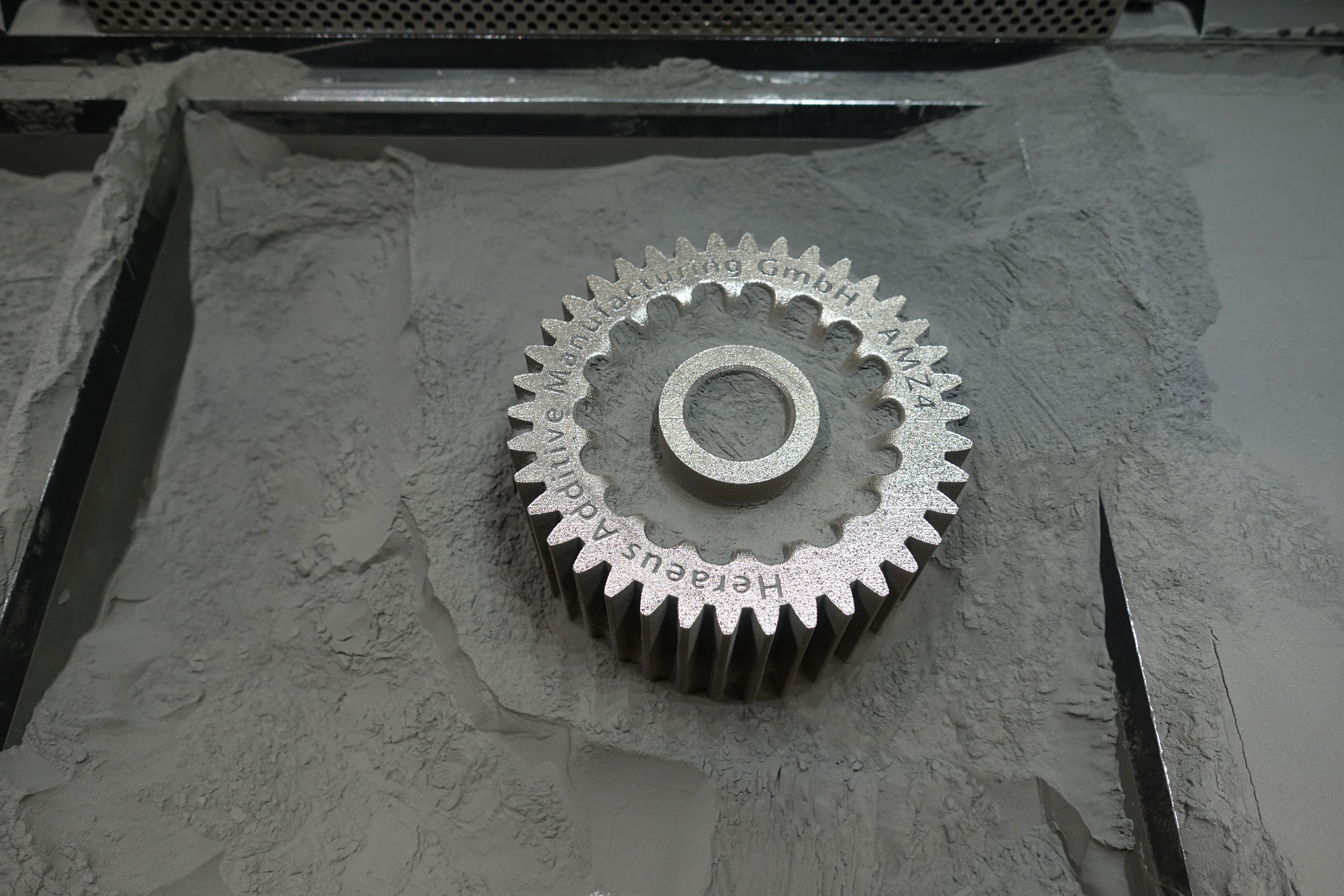
 Another historical milestone has been met in 3D printing—a technology known for outdoing itself on a continued basis—with the introduction of the largest 3D printed gear wheel ever fabricated in amorphous metals. This represents another major stride in the realm of materials science, as well as additive manufacturing. Heraeus, a technology group from Germany with a specialized niche in development of materials and parts, is behind this massive innovation, recently on display at Automate 2019 (held in Chicago from April 8-11).
Using selective laser melting (SLM) processes with a commercial printer, the team at Heraeus has opened up the door for manufacturing with amorphous metals—historically only produced as small parts due to requirements like high cooling rates (over 1000 Kelvin/second). During development of this metal gear wheel, the engineers were able to further optimize its overall topology, which meant reducing its weight by fifty percent in comparison to traditional production. This could bring major benefits to the world of automation, and more specifically, robotics. Refined AM processes for producing parts made from amorphous metals could also be helpful in other applications such as aviation, medicine, and the automotive industry.
Many users will probably be brushing up on their knowledge of metals as news spreads regarding the benefits of working with these irregular structures that ironically, permit manufacturers to build stronger and more stable parts—but with a feature that is extremely desirable: much lighter weight. Amorphous metals can also play a major role in manufacturing as they produce extremely hard parts with high yield strength and high elasticity too. They also offer:
- Excellent resistance against corrosion
- Strong wear resistance
- Polymer-like elasticity
- Soft magnetic properties
- Easy for magnetizing and demagnetizing
“With this combination of properties, amorphous metals are superior to steel, titanium and many other materials,” states the Heraeus team in their latest press release.
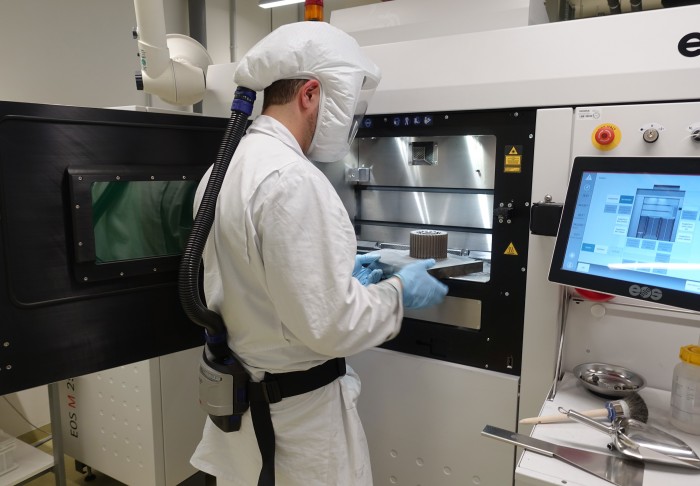
Other classic benefits of 3D printing are present in this type of manufacturing too, with the amount of material used minimized (along with waste), thus saving on the bottom line. There was also significantly more affordability in production—and the process overall was simplified:
“With conventional methods, making complex parts require numerous process and manufacturing steps. Several individual pieces have to be produced and then assembled into a unit,” stated Heraeus team. “However, 3D printers accomplish this in a single process. Following assembly in the printer, moving parts are immediately ready for use and fully functional.”
The benefits of 3D printing are substantial, and they are enticing. The biggest advantage, however, and the one that gets most users hooked (on any level) is that they can design objects that may not have been possible before at all. This is especially stunning in applications like the medical field where we see 3D printed medical models that allow for surgical reconstruction not previously available, or aerospace, where engineers are not only creating specialized materials for 3D printing rockets, but also preparing for the eventual colonization of the moon, and even Mars. As we have seen in this story too, parts that were previously extremely cumbersome, time consuming, and expensive to make can be redesigned and manufactured in 3D printing, and techniques can be improved too.
What do you think of this news? Let us know your thoughts! Join the discussion of this and other 3D printing topics at 3DPrintBoard.com.
Subscribe to Our Email Newsletter
Stay up-to-date on all the latest news from the 3D printing industry and receive information and offers from third party vendors.
Print Services
Upload your 3D Models and get them printed quickly and efficiently.












You May Also Like
UAS Additive Strategies Shows How Fast Drone Manufacturing Is Changing
The recent UAS Additive Strategies online event, hosted by 3DPrint.com and Additive Manufacturing Research (AM Research), brought together leaders from across the additive manufacturing (AM) and drone industries to discuss...
The SLS Market: Game of Trucks
This is truly an exciting moment in the SLS market. With HP‘s release of the 1200 and Formlabs‘ release of the X1, we can see the SLS market heating up....
EOS, HP, Prusa, and Stratasys Sponsor UAS Additive Strategies Webcast on June 30
3DPrint.com and AM Research will present a live webcast, UAS Additive Strategies, on June 30, from 11 AM to 2:30 PM Eastern, and you can register here. The event is...
3D Printing News Briefs, June 18, 2026: Reseller, Relocation, Metal Space Powder, & More
We’ll start with business news in today’s 3D Printing News Briefs, as XJet appointed a value-added reseller in Germany, BIO INX is expanding its presence in the Italian market, and...