Caterpillar & Argonne National Laboratory Using Additive Manufacturing to Improve Fuel Efficiency of Diesel Engines

 Additive manufacturing will play a significant role in a major project gearing up between Caterpillar and US Department of Energy’s (DOE) Argonne National Laboratory to explore better efficiency and reduced emissions in heavy-duty diesel engines. This is another extensive project meant to bring together the vast resources of large manufacturers in the US with scientists working for Department of Energy labs, making up one of seven ‘private partnerships’ created through the DOE High Performance Computing for Manufacturing (HPC4Mfg) program.
Caterpillar and Argonne will be testing industrial diesel engines to improve efficiency, using the following tools and processes:
- High performance computing (HPC)
- Additive manufacturing
- Improved fidelity design
- Simulation models
In taking advantage of these features, they will also be able to delve into the major benefits of additive manufacturing and 3D printing, to include exponentially faster turnaround in production, affordability in manufacturing, and the ability to create in the lab (or anywhere) on-demand. In working with Caterpillar, Argonne researchers also have access to comprehensive testing facilities already designated for 3D printing and AM processes, along with conventional methods that have been in use for decades.
Currently, Caterpillar is using testing and simulation resources from HPC, operating on the large scale, with Argonne’s Mira supercomputer at the Argonne Leadership Computing Facility (ALCF), a DOE Office of Science User Facility, and computing resources at Argonne’s Laboratory Computing Resource Center.
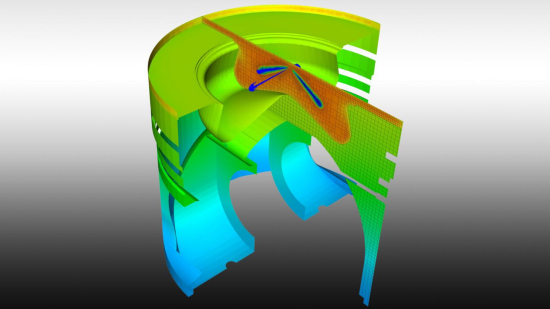
Researchers created this predictive cross-sectional view of an engine geometry showing in-cylinder and metal piston temperatures using a coupled conjugate heat transfer and computational fluid dynamics model. (Image by Convergent Science and Argonne National Laboratory.)
The two organizations will continue collaborating throughout a range of different project stages via HPC4Mfg, moving back and forth from simulation facilities at Argonne and AM testing at the Caterpillar facility. This is not the first time Caterpillar and Argonne have worked together. Previous projects have included studies regarding fuel spray, combustion modeling, and other DOE-funded work.
Currently, other programs and partnerships in progress through HPC4Mfg include work with companies like PPG Industries, Inc. and LBNL, VitroFlat Glass and LLNL to develop real-time glass furnace control, Eaton and ORNL to develop waste heat recovery (WHR) technology, General Motors LLC partnering with LLNL to reduce cycle time in composite manufacturing, Arconic working with both LLNL and ORNL to examine varying metallic phases during AM, and Vader Systems partnering with SNL to explore required physics for transition magnetoJet 3D printing. Find out more about those projects, along with Caterpillar and Argonne here.
While Caterpillar is historically responsible for producing large equipment for construction and mining, along with other machinery related to energy and transportation and resource industries, the scientists and research teams at Argonne National Laboratory are often responsible for studies that tackle the big questions regarding how technology can further the US, such as how to expand on metal 3D printing in the field for military use, or examining what actually happens during the internal processes of technology involving directed energy deposition by X-ray, leading into further discussion of research centered around piezoelectric materials.
What do you think of this news? Let us know your thoughts! Join the discussion of this and other 3D printing topics at 3DPrintBoard.com.
[Source: Green Car Congress]Subscribe to Our Email Newsletter
Stay up-to-date on all the latest news from the 3D printing industry and receive information and offers from third party vendors.
Print Services
Upload your 3D Models and get them printed quickly and efficiently.













You May Also Like
Flashforge Bets on Meshy AI as Desktop 3D Printing Battle Intensifies
Competition in desktop 3D printing is brutal. Whereas before, firms competed through value engineering, Prusa clones now have an integrated hardware, sensor, and software setup that is making all the...
Ford Uses Binder Jet 3D Printing to Make Boat Propellers for Sharrow Marine
Ford’s Advanced Industrial Technology and Platforms (ATP) group has helped Sharrow Marine make a boat propeller in two weeks rather than 130 days. Thanks to the Michigan Central program, Ford...
Skuld to Work on DARPA’s Rubble to Rockets (R2R) Program
Skuld will work on the Defense Advanced Research Projects Agency’s (DARPA) Rubble to Rockets (R2R) Program, which turns scrap metal into missile components. Skuld will help with alloy design, characterization, and...
From “Magic” to Metal: How Intrepid Automation Wants to Make 3D Printing Matter at Scale
Ben Wynne still talks about 3D printing the way people do when they’ve felt that “wow” moment up close. Back in the early 2000s, he was working at HP’s advanced...