Titomic Licenses Two CSIRO Patents for 3D Printing Titanium Piping, Signs Acquisition Agreement with FTT



CSIRO’s Keith McLean, Titomic’s Jeff Lang, and FTT’s Peter Mews sign agreement
Renowned for its metal Kinetic Fusion (TKF) technology, Australian 3D printing company Titomic recently signed an MoU with China’s largest manufacturer and global exporter of titanium powder in order to secure a high quality supply of low-cost, commercially pure titanium powders. It’s clear that the company is continuing to focus on titanium resources – it has licensed two new patents from the Commonwealth Scientific and Industrial Research Organisation (CSIRO) for the production of titanium pipe and continuous pipe. This Exclusive License Agreement with CSIRO gives Titomic global rights to the patents, which will significantly open the company’s revenue opportunities in several industries, like defense, marine and mining, and oil and gas.
 Additionally, Titomic has signed an Acquisition Agreement with Future Titanium Technologies (FTT). The company is now entitled to over eight years of exclusive 3D printing techniques and background IP relating to the production of pipes and their components.
“This is a significant expansion of Titomic’s IP and associated revenue opportunities. By adding these two new patents we are broadening our footprint in the Titanium and Titanium Alloys Additive Manufacturing space to firmly secure our future market segments,” said Titomic’s Managing Director Jeff Lang.
“Our fundamental strategy has been well timed and managed to perfectly combine the securing of cost-effective metal powder supply chain, with the expansion of our IP portfolio positioning Titomic as the global leader in viable metal Additive Manufacturing.
“To capitalise on the significant $300+ Billion global interest Titomic has received from the Oil & Gas, Mining, and Marine industries to provide more sustainable and cost-effective AM manufacturing, these new TKF technologies enable Titomic to provide viable digital manufacturing capabilities leading to significant short, mid and long-term revenue opportunities.”
 Titomic’s fast 3D printing technology, which is actually the result of a CSIRO study, can now be used by industries looking to access next generation, dual-wall materials to 3D print metal pipe without having to worry about profile or size constraints.
For instance, the oil and gas industry is uses plenty of valves, but their lifecycle can be negatively impacted by abrasive matter like rock, sand, and sediments that run through pipes during extraction. Using these newly licensed patents, Titomic can use its technology to produce metal pipes with higher corrosion and wear resistant properties; additionally, the process can also fuse dissimilar metals together to make fitting components and pipes.
“Working with companies like Titomic shows that manufacturing remains a key driver in the Australian economy,” said Stefan Gulizia, Research Group Leader at CSIRO. “We are pleased that Titomic are licensing the rights to utilise and further commercialise CSIRO research in developing new products and processes that go towards supporting productivity gains, boosting sustainability and helping capture emerging opportunities in local and global markets.”
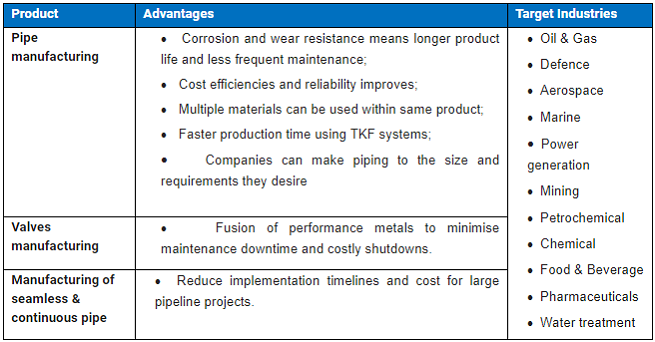
Thanks to the important performance factors like cost, quality, scale, speed, and sustainability, Titomic will now be able to commercially exploit its TKF technology. Pipe and fitting component consumers will be able to save on both time and money, as maintenance costs and down time will decrease and parts will have longer life cycles. Additionally, TKF can also be used to 3D print valves, fitting components, and pipes with new superalloys, and can even combine them with polymers, composites, ceramics, and alloys to achieve high performance properties.
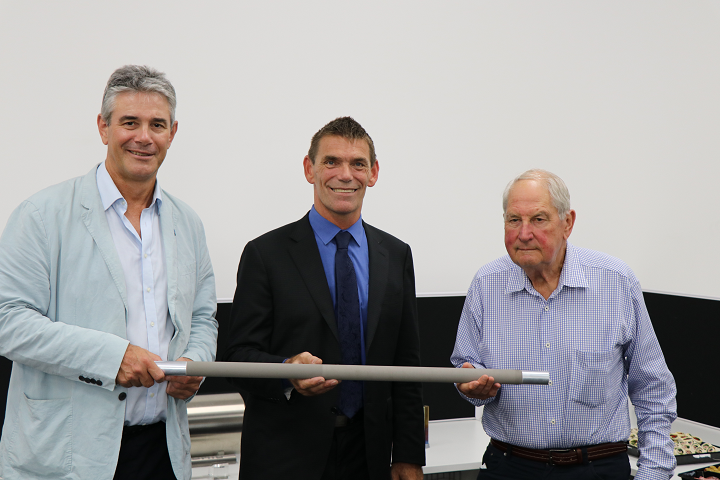
McLean, Lang, and Mews holding the sprayed pipe section.
The most important transaction terms of the new Acquisition Agreement with FTT include Titomic allotting $400,000 worth of its shares to FTT shareholders for $2.00 per share, half of which will be escrowed for a year. For every two shares, Titomic will also issue one new option to FTT shareholders, at an excerisable price set at a 130% premium to the share price with a two-year life.
In terms of its Exclusive License Agreement with CSIRO, Titomic will pay the following minimum annual royalties to CSIRO:
- $50,000 for 2018-2019
- $75,000 for 2019-2020 and 2020-2021
- $150,000 for 4th year of agreement, and each subsequent agreement year until the end of the license term

CSIROs Keith McLean, Titomic’s Jeff Lang, and FTT’s Peter Mews celebrate the collaboration.
Additionally, Titomic will pay CSIRO an upfront fee of $125,000 cash for licensing the technologies.
To hear the rest of the terms, visit Titomic’s website.
Discuss this news and other 3D printing topics at 3DPrintBoard.com or share your thoughts below.
[Images provided by Titomic]Subscribe to Our Email Newsletter
Stay up-to-date on all the latest news from the 3D printing industry and receive information and offers from third party vendors.
Print Services
Upload your 3D Models and get them printed quickly and efficiently.













You May Also Like
APAC’s 3D Printing Capital Wave Is Bigger Than Venture Funding
By the usual measure, a tally of funding rounds, APAC’s additive manufacturing market had a quiet second quarter. The capital that has actually closed across the region comes to about...
HP Stock Jumps on 3D Printing Buzz
HP (NYSE: HPQ) had its best day in over a year this week, with shares jumping more than 7% on Tuesday. Interestingly, the move was quickly tied to 3D printing,...
3D Printing News Briefs, April 8, 2026: LiDAR Scanning, Vapor Smoothing, FDM Optimization, & More
We’ll kick off today’s 3D Printing News Briefs with some 3D scanning news from Artec 3D, and then move on to new America Makes Project Calls. Then, Raise3D and AMT...
3D Printing Market Hits $16B in 2025 as Growth Picks Up Again
The global 3D printing market reached $16 billion in 2025, growing just over 10% year over year, according to new data from Additive Manufacturing Research (AM Research). After a slower...