Virginia Tech Researchers 3D Print Kapton Using Direct Ink Writing


Daniel Rau works with a 3D printer in the DREAMS Lab.
Last year, a group of Virginia Tech researchers developed a method for 3D printing Kapton, a foil-like polyimide that possesses excellent thermal and chemical stability and therefore is commonly used in insulation for aerospace applications. It also acts as an electrical insulator and is resistant to ultraviolet radiation. It doesn’t dissolve in solvents and has a degradation temperature of about 550°C.
“(Kapton) can withstand all kinds of harsh environmental insults: radiation, high temperature, chemical reagents,” said Timothy Long, a professor of chemistry and the director of Virginia Tech’s Macromolecules Innovation Institute (MII). “It’s one of these molecules that is the ultimate in terms of performance.”
Prior to last year’s study, Kapton was only available in thin two-dimensional sheets, like tape or the “gold foil” that wraps around satellites to insulate them, but the researchers then figured out how to 3D print the material using SLA. Now they have developed a second method for 3D printing Kapton: direct ink writing, or DIW. They detailed their research in a recent paper entitled “Ultraviolet-Assisted Direct Ink Write to Additively Manufacture All-Aromatic Polyimides.”
“If you think of caulking a bathtub or decorating a cake with icing, (DIW is) a very similar process,” said Daniel Rau, one of the co-authors and a Ph.D. student in the Design, Research, and Education for Additive Manufacturing Systems (DREAMS) Lab in the Department of Mechanical Engineering. “Because it’s so simple, (DIW) gives us incredible flexibility on the ink, synthesis, and the properties it has.”
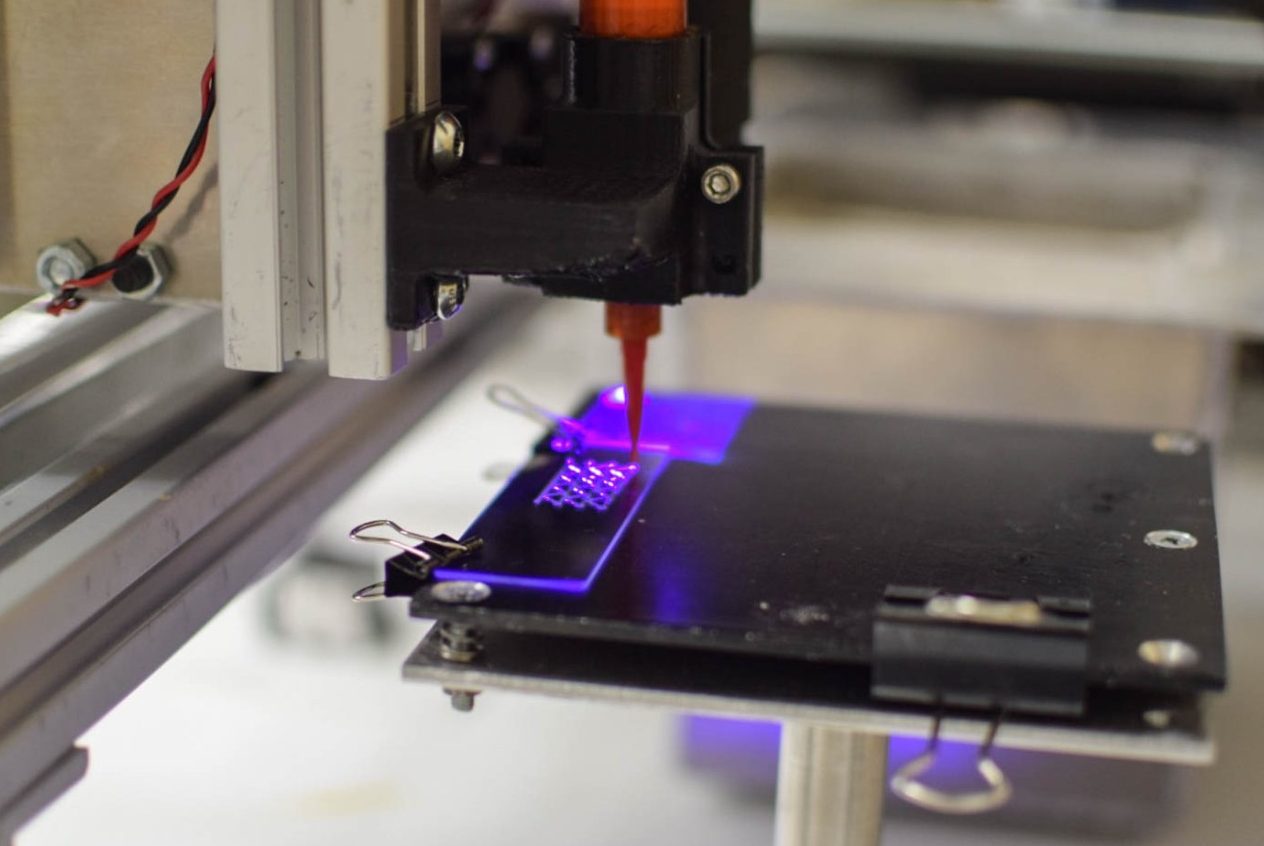 After 3D printing the material using direct ink writing, the printed parts had similar properties to commercially available Kapton film. They had similar mechanical properties up to 400°C, and their degradation temperature was 534°C. According to Rau, while SLA is better for 3D printing entire objects, direct ink writing is better for 3D printing different materials side by side.
“All of the different additive manufacturing processes are like different tools in the workshop,” Rau said. “You have hammers and that has its strengths. You have saws and that has its strengths.”
In addition to multi-material 3D printing, the researchers can also now print Kapton directly onto an existing material using direct ink writing, said Christopher Williams, director of the DREAMS Lab and associate director of MII. They can also print the material on curved surfaces.
“As soon as we were able to print Kapton, people asked us about applications,” Williams said. “The answer we often gave was printed electronics, but that’s challenging to do in stereolithography. This new technique could really enable that as we look towards simultaneous printing of conductive materials and this excellent insulator.”
In last year’s study on SLA 3D printing, Jana Herzberger, a postdoctoral student in the Long Group, created a precursor polymer to Kapton in liquid form. The liquid wouldn’t work for direct ink writing because it wouldn’t hold its shape after extrusion. Instead, Herzberger created a resin with a consistency similar to peanut butter.
“When Dr. Williams challenged us to modify the resin for the direct ink write process, we all thought it would be rather straightforward,” Herzberger said. “It turned out that the ‘easy’ route didn’t work, and we had to make some modifications to the original resin. Often times, I synthesized a resin and studied its rheological properties [rheology is the study of how a matter flows or moves in the presence of deformation], and Danny tested if it performed in the printer as we predicted. It was a new experience for me to work with engineers, and I think we learned a lot from each other and improved our communication skills quite a bit.”
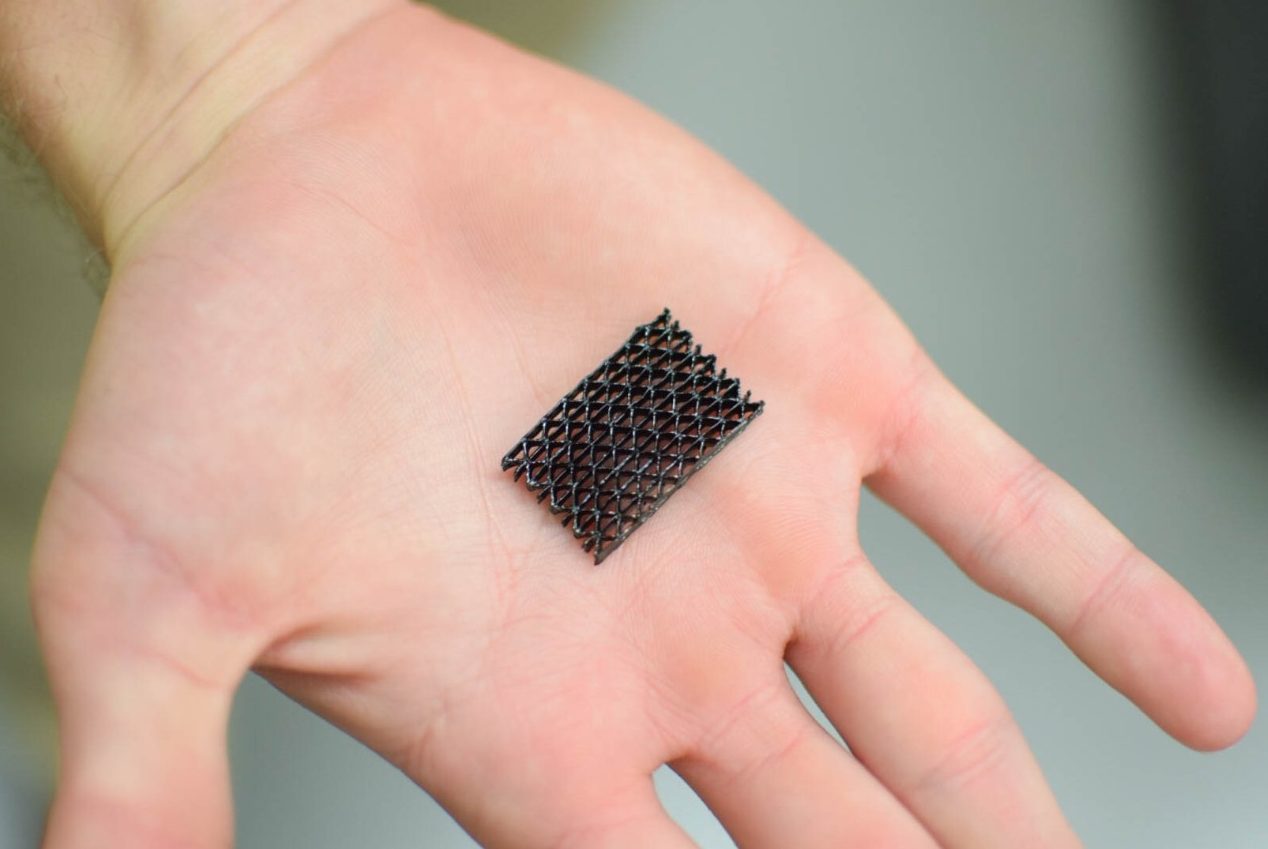
Herzberger and Rau both worked on finding the right balance of an ink that she could synthesize and he could print.
“We both had to meet in the middle and make concessions and communicate,” Rau said. “This was a great partnership — an iterative process — to make this ink printable. Neither of us had the knowledge to go from material creation to final part.”
Long’s and Williams’ groups worked closely together as well to create the new method.
“My group makes macromolecules and Chris’ group puts them into unique geometric shapes,” Long said. “It’s almost like one group working together to solve really complex questions like this.”
Discuss this and other 3D printing topics at 3DPrintBoard.com or share your thoughts below.
[Source/Images: Virginia Tech]
Subscribe to Our Email Newsletter
Stay up-to-date on all the latest news from the 3D printing industry and receive information and offers from third party vendors.
Print Services
Upload your 3D Models and get them printed quickly and efficiently.













You May Also Like
The Money Behind AM: What to Watch at AM Investment Strategies 2026
For years, simply being a 3D printing company could attract attention from investors. New machines, new materials, faster speeds, and the promise of mass production were often enough to get...
Metal AM in a Multipolar World: Resilience, Regional Production and a Changing Market
Technology develops in response to forces driving change. That was the starting point for a keynote I presented with Mikael Schuisky at AM Meetup 2026, held in Karlstad, Sweden, on...
EOS Bets on Mexico’s AM Market with Axiomatek Sales Channel Deal
Mexico is one of the biggest beneficiaries of the push to diversify manufacturing out of China. This development is perhaps inevitable given the current global trade environment, but even with...
3D Printing Market Hits $4.48B After Six Straight Quarters of Growth
The additive manufacturing market continued to grow in the second quarter of 2026, adding another quarter to what is becoming a much more consistent expansion for the industry. Worldwide revenue...