Mobile Construction Robot 3D Prints a Temporary Architectural Installation Out of Loose Stones and Twine

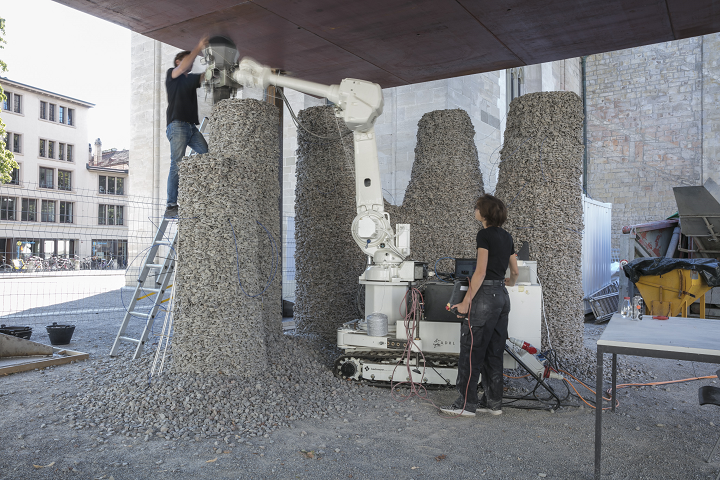
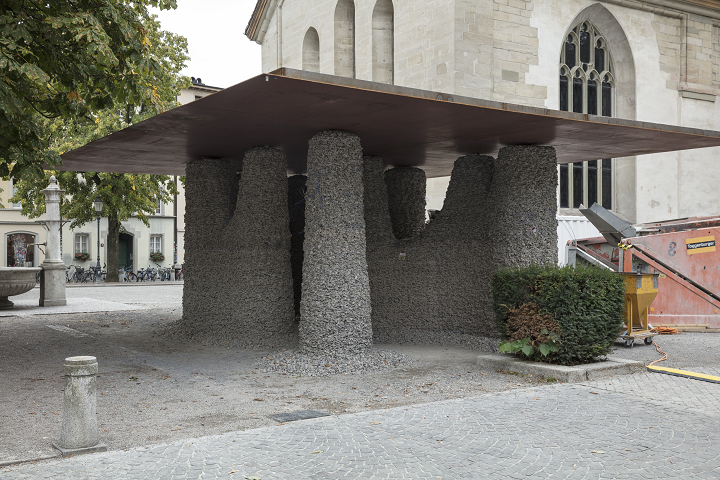
Rock Print Pavilion by Gramazio Kohler Research / ETH Zurich on the church square in front of the Gewerbemuseum Winterthur, construction phase in September 2018
While plastic is used often in 3D printing, stronger materials are required for architecture and construction applications, such as brick, concrete, and cement. But while we’ve seen stone-filled PLA filaments, rocks and stones aren’t often used as raw 3D printing materials…at least not yet.
But three years ago, the Self-Assembly Lab at MIT and Gramazio Kohler Research of ETH Zurich in Switzerland completed an architectural installation called “Rock Print” in Chicago using a method that takes advantage of the jamming principle, where material (synthetic rock in this case) is packed together so tightly that it holds its shape without a container. In this instance, twine helps hold the layers together.
Earlier today, ETH Zurich showcased its innovative, ongoing “Design and Robotic Fabrication of Jammed Architectural Structures” research project with an important unveiling. On Kirchplatz Square in front of the Gewerbemuseum Winterthur in Switzerland, a mobile construction robot had built an outdoor “Rock Print Pavilion” out of 120 km of string and over 30 metric tons of loose stones.
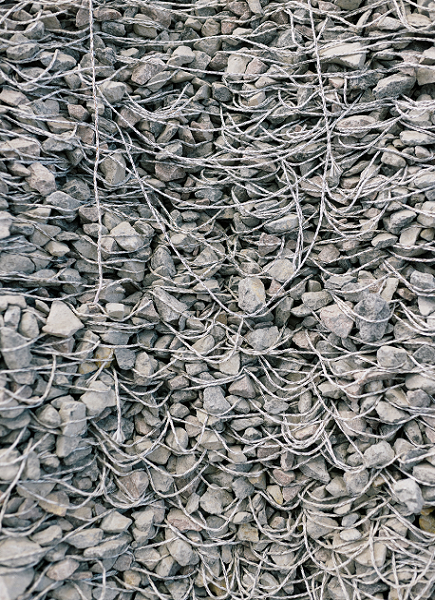 The temporary installation in the center of the city is part of the museum’s newly opened “Hello, Robot. Design between Human and Machine” exhibition, which runs through November 4, 2018. According to a release from the university, this research project investigates and further develops techniques for the “design and robotic aggregation of low-grade building material into load-bearing architectural structures.”
These structures are reusable, and, due to their high geometrical flexibility, can be reconfigured with little wasted material. The jamming principle is put to work here, but with a big difference: the team from ETH Zurich’s Gramazio Kohler Research are using it to target the macro-scale, rather than the usual nano- and meso-scale applications. When combined with automated fabrication technology, like 3D printing, and computational design and simulation, this makes the project perfect for architectural construction.
The Rock Print Pavilion project is meant to explore the many possibilities that are available through digital and robotic manufacturing. The robotic 3D printing process requires no tools, and recycling is built right in, as it’s easy to dismantle the components and reuse the loose aggregate material and twine, which is tied around the heap of tightly packed stones by the robot itself.
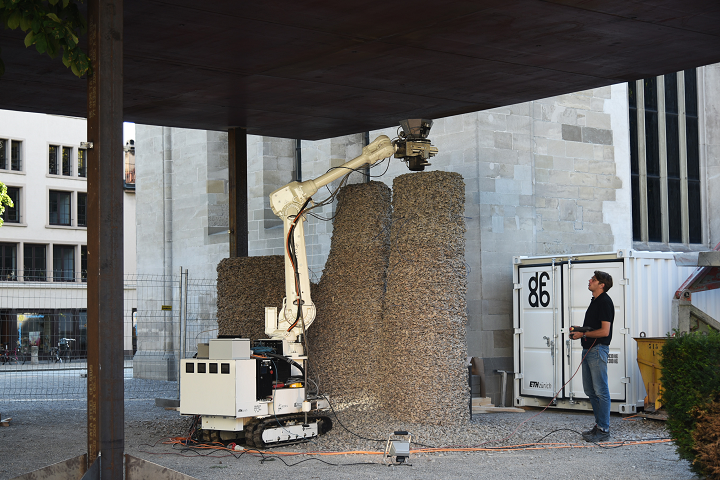
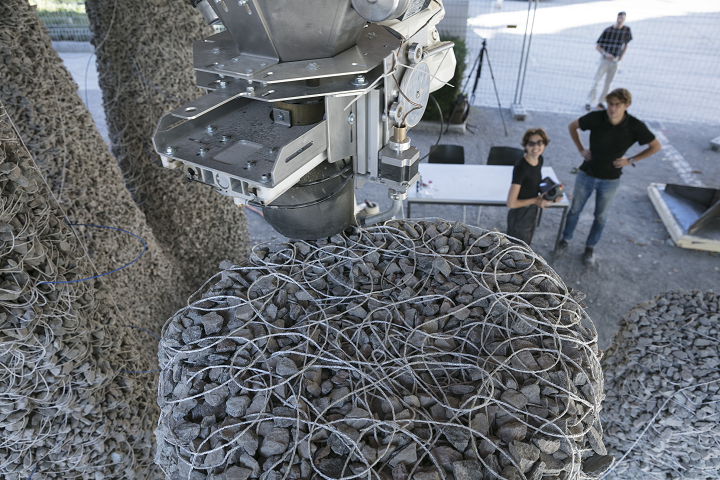
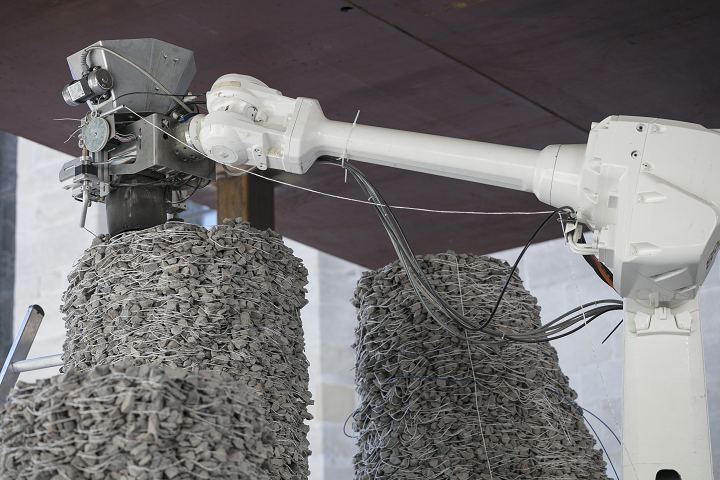
The “In situ Fabricator” 3D printing construction robot spent the last month constructing a total of 11 pillars, each one reaching 11 meters high, out of the loose stones and string. Jamming makes the stones interlock together, and once the string is arranged between each of the gravel layers by the robotic calculations, the resulting structure is durable and stable enough to support a steel roof that weighs eight metric tons…pretty impressive, to say the least.
The Rock Pavilion Project by the Gramazio Kohler Research team is definitely a good example of how new and emerging digital constructions processes can truly be transformative.
 Several of the team members will be giving public tours of the Rock Print Pavilion, in German only, over the course of the installation. These tours will be held on the following dates and times:
- Saturday, October 6, 2018, 11 am
- Saturday, October 14, 2018, 11 am
- Saturday, October 20, 2018, 11 am
- Sunday, November 4, 2018, 2 pm
Discuss this story and other 3D printing topics at 3DPrintBoard.com or share your thoughts in the Facebook comments below.
[Images provided by ETH Zurich]Subscribe to Our Email Newsletter
Stay up-to-date on all the latest news from the 3D printing industry and receive information and offers from third party vendors.
Print Services
Upload your 3D Models and get them printed quickly and efficiently.











You May Also Like
3D Printing Predictions 2026: Industrial Production in Metal Additive Manufacturing
The industrial metal additive manufacturing world is splitting, with commoditization and lower-cost parts driving the production of millions of components for consumer electronics, machinery, dental, and beyond. Meanwhile, large parts...
How 3D Printing is Making the World a Better Place, One Medical Innovation at a Time
One of the most significant sectors for 3D printing applications is the healthcare field. According to an AM Research report, the 3D printed medical device market is estimated to reach...
A Year in 3D Prints: A Visual Journey Through 2025 in AM
2025 was a year of milestones and experimentation in additive manufacturing (AM), marked not only by technical progress but also by the mergers, acquisitions, and restructurings that reshaped the industry,...
3D Printing News Briefs, December 17, 2025: Standards, Ballistics, Dental Aligners, & More
Today’s 3D Printing News Briefs is a bit of a mixed bag, including stories about standards, ballistics 3D printing, dental aligners, and more. Read on for all the details! DNV...