3D Printing Shown to be an Effective Method of Creating Wound Dressings

3D bioprinting isn’t just about the quest to print working organs, although that is the goal of many in the field. But it also has many more immediate applications, such as, for example, better wound dressings. In a thesis entitled “Design of a 3D printed nanocellulose based moisturizer for wound dressing applications,” a student named Cristian Ghibaudo discusses using 3D bioprinting to create better wound treatments. Ghibaudo points to a project called the Onskin project, for which the aim is to develop novel wound dressings based on microfibrillar cellulose, or MFC, and sustainable materials.
The concept was developed in four modules: the moisturizing module (M1), the absorbent module (M2), the barrier module (M3) and the support module (M4). The paper focuses on the moisturizing module, which has several requirements:
- The wound must be kept moist
- Wound exudate must be removed
- It must be mechanically stable under moderate compression and shear forces
- It must retain its shape to prevent maceration
- It must be 3D printable
- It must be skin friendly
- It must be sterile
- It should be able to be applied without causing any pain to the patient
- It should be available on demand
- It must allow for the daily tasks of the patient
Ghibaudo discusses the use of bioprinted nanocellulose hydrogels, with or without living cells included.
“A further improvement would be use MFC functionalized with cells, growth factors, antimicrobials and use this material as bioink for tailor-made wound dressings,” he adds. “Even printed electronics and biosensors could be integrated into the wound dressing construct, for a intelligent and personalized wound management.”
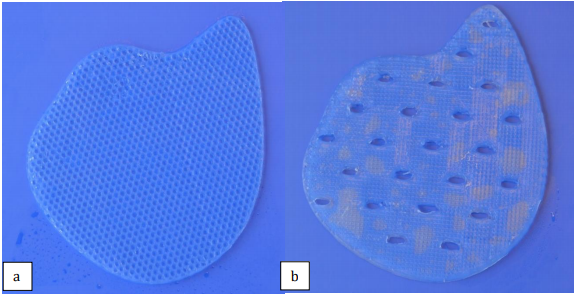
After the development and characterization of materials was completed, several wound dressing prototypes were 3D printed. Two types of prototypes were produced: flat and concave.
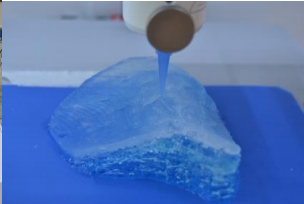
“For the printing it was used the BioX printer supplied from CELLINK, Figure 49, and it was used CELLINK start as support ink for the concave structure, Figure 50,” Ghibaudo states. ” A conical nozzle of 0.41mm was used for the concave structure while a conical nozzle of 0,25 mm was used for the flat structure, to have a better resolution. The time printing was around 7 hours for the convex structure while only 30 min for the slat structure.”
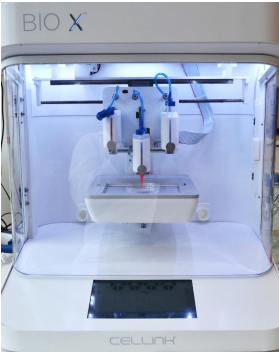
The concave prototype had several disadvantages, one being that it took seven hours to print. The 0.41mm nozzle created a low printing resolution, though a higher resolution would have required an even longer printing time. In addition, the channels in the prototype needed to be designed from the STL file; they could not be created automatically from the printing process.
The flat prototype, on the other hand, had good mechanical properties and high resolution, plus it printed in only 30 minutes. Thus, the flat prototype was selected as the best choice for the final model. Both prototypes were designed to cover an inner elbow wound, and the flat dressing showed itself to be flexible enough to cover the uneven surface.
“In the end, it is shown in this work the hydrogel MFC/alginate based characterization with rheological and mechanical test,” Ghibaudo explains. “The MFC1 and MFC8 properties were evaluated and compared with different amount of alginate in the compositions. The material chosen for this application is a combination of microfibrillated cellulose, enzymatic or carboxylmethylated, and alginate with a ratio 80:20.”
Once the best design was settled on, it was found that 3D printed wound dressings can be highly effective; both the material and the structure of the dressing met the requirements listed above.
Discuss this and other 3D printing topics at 3DPrintBoard.com or share your thoughts below.
[Images: Cristian Ghibaudo]Subscribe to Our Email Newsletter
Stay up-to-date on all the latest news from the 3D printing industry and receive information and offers from third party vendors.
Print Services
Upload your 3D Models and get them printed quickly and efficiently.











You May Also Like
Printing Money Episode 36: Recent 3DP/AM Deals and More with John Barnes (TBGA & MPW)
Welcome to Printing Money Episode 36! For this episode Danny is joined by a new guest, John Barnes (Founder and President, The Barnes Global Advisors, Founder and CEO, Metal Powder...
Friendshoring and Additive Manufacturing: Turning Australia’s Research Strength into Commercial Impact
Global supply chains are being re-written. After decades of globalisation driven primarily by cost efficiency, geopolitical tensions, trade disputes and pandemic-era disruptions have exposed the risks of concentrating manufacturing and...
Velo3D’s $32.6M Defense Contract Highlights Why U.S.-Made 3D Printing Is Suddenly Critical
When the U.S. government talks about supply chain security, it’s no longer theoretical. It’s now written directly into law and into defense contracts. That detail matters for Velo3D, which this...
Northrop Grumman & Titomic Achieve Successful Hot Fire Test with 3D Printed Thrust Chamber
Back in April, leading Australian cold spray additive manufacturing (CSAM) original equipment manufacturer (OEM) Titomic announced that the company was partnering with defense giant Northrop Grumman to test the use...