Fashion Designer Creates Both Attractive and Wearable 3D Printed Clothing



Lingxiao Luo
Often fashion on the runways looks good but is unwearable in a real-life setting, and that goes double for 3D printed fashion. Much of it is stiff and uncomfortable-looking, but some designers are incorporating the technology in a way that is both attractive and wearable. Lingxiao Luo of the Royal College of Art is one of those designers. Her work combines 3D printing with knitted fabric to create brightly colored, unique garments that feature 3D printed details and unusual seams.
Luo is pursuing a Master’s degree at the Royal College of Art, but she first learned about 3D printing as an undergraduate at the London College of Fashion. The pieces she saw combined 3D printing with mesh fabric, and she began to think about the possibility of knitted fabric combined with 3D printing. She bought her own 3D printer and set about developing her own techniques for melding the two methods of fabrication. She came up with three different techniques, in fact. The first is to use 3D printed patterns to join two different fabrics together, while the second is to print onto loosely knit nature-fiber fabric and felt the fabric afterwards “so that the contraction during the felting process can change the printed patterns and create 3D structure,” she explains. The third technique involves using a flexible filament to print onto tightly knitted elastic fabric and twist the printed patterns into a 3D structure.
“The techniques that I have investigated are unique, and the products made with my techniques have unique aesthetic and texture,” Luo says. “They’re much more playful and structural than traditional knitwear.”
She also says that her designs are “less plastic-like” and “much more wearable” than a lot of other 3D printed fashion, and they can also be easily washed and cared for, as any other clothing. She wants to appeal to consumers with both the aesthetic and user-friendliness of her designs, as well as the customization possibilities.
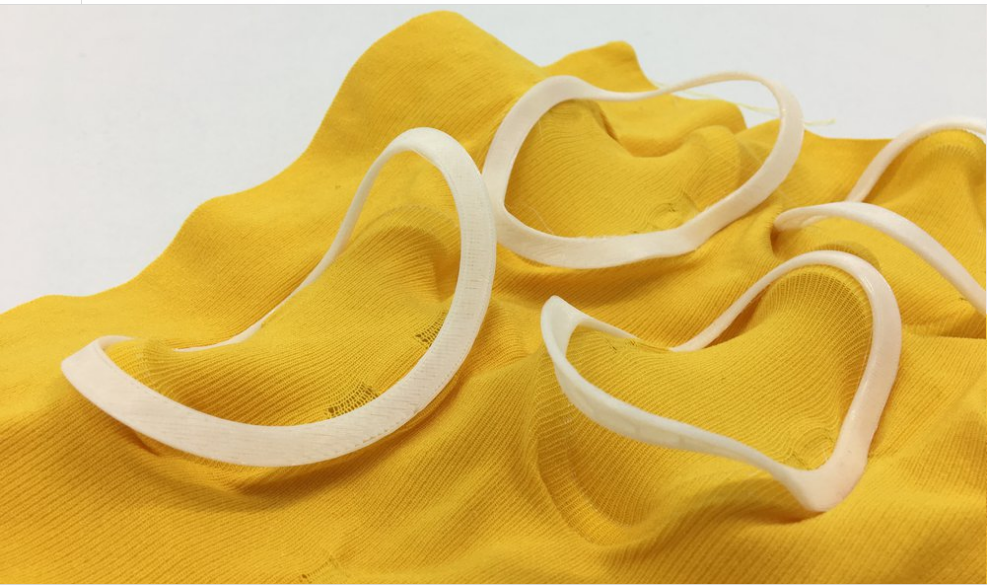
“With the engineering of knitting and printing, this innovation introduces a zero-waste fabrication to the fashion industry through the creation of customizable products,” she says.
 Luo eventually hopes to work with a 3D printer company to develop fashion-specific 3D printers that can print wearable, consumer-friendly clothing. She plans to start her own business, as well.
“Based on this technique and my final collection, I’m planning to build up a business of providing high-end products and services for the designer studios, including technical consultancy, sample making, textile, and product developing,” she says. “My market research shows that the application of 3D printing technology in the fashion industry is developing very quickly, and the design studios I have interviewed showed strong interest in using my technique and products in their collections.”
So look for Luo’s work in the near future; if you’re interested in trying 3D printed clothing, hers is definitely a good place to start, with its wearability and aesthetic appeal. Some 3D printed fashion looks great, but as a gallery piece – Luo’s is well-suited to both the runway and the closet.
Discuss this and other 3D printing topics at 3DPrintBoard.com or share your thoughts below.
[Source: Design News/Images: Royal College of Art]
Subscribe to Our Email Newsletter
Stay up-to-date on all the latest news from the 3D printing industry and receive information and offers from third party vendors.
Print Services
Upload your 3D Models and get them printed quickly and efficiently.













You May Also Like
3D Printing News Briefs, October 10, 2026: Drones, WAAM, Ceramics, & More
We have a packed 3D Printing News Briefs for you this weekend! First, America Makes celebrated the recent National Manufacturing Day with 3D printed drones, and then it’s on to...
3D Printing News Briefs, October 3, 2026: Hypersonics, Hotends, & More
We’re starting off with defense in this weekend’s 3D Printing News Briefs, as Titomic was awarded a $5 million U.S. defense contract, and VulcanForms announced a partnership with Specter Aerospace...
The Part Is Only Half the Story: Why 3D Printing Needs a Digital Thread
A 3D printed part can generate a lot of information. The challenge is keeping track of it. Manufacturers need to know which design was used, what material went into the...
Advanced Manufacturing at IMTS 2026: 3D Printing and AI and Drones, Oh My!
Last week’s International Manufacturing Technology Snow (IMTS) in Chicago welcomed over 90,000 attendees to the jungle that is McCormick Place. With over 1.17 million square feet of exhibit space, and...