Carbon Introduces New CLIP 3D Printing Materials with Epoxy Resin Family & Addition to Cyanate Ester Family

 It’s been a very busy year for Silicon Valley-based 3D printing company Carbon, but a successful one as well. After emerging from stealth with its cutting-edge CLIP 3D printing technology back in 2015, the company hit the ground running and didn’t stop, announcing in early 2016 that four partners, including Sculpteo, would begin using the high-speed CLIP technology; more partners have since been announced. Then Kodak announced that they would start helping Carbon develop new materials to advance CLIP even further. Last April, Carbon took the 3D printing world by storm with the release of its M1 commercial 3D printer, which can even (partially) print itself.
 Earlier this year, automotive parts manufacturer Delphi tested out the CLIP technology in a real world setting with a CLIP case study. Carbon has introduced a brand new material family this week, and Delphi is back for more, having already leveraged the new resin to develop high-performing electrical connectors. The newly launched resin, EPX 81, the first in the epoxy resin family, helps Delphi’s connectors exceed wire terminal retention force on “what is possible with current injection molding techniques.”
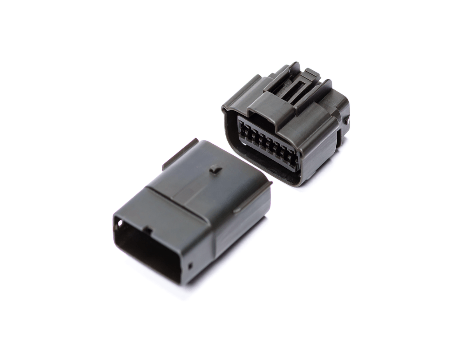
Connector made with EPX 81
The new EPX 81 resin was designed for such high-precision applications in the industrial sector, and has mechanical properties similar to 20% glass-filled PBT, which is commonly used in fabrication of electrical connectors. The high-strength engineering material features top-notch abrasion resistance and a heat deflection temperature of 140°C.
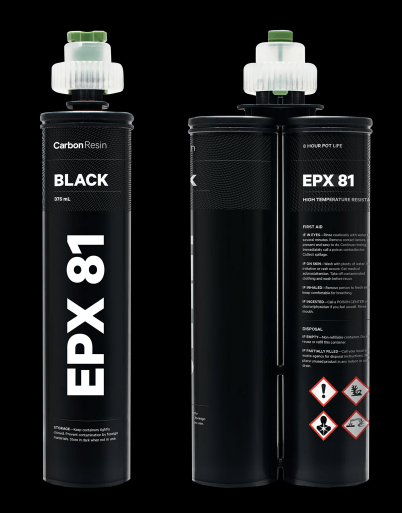 EPX 81 is a two-part engineering resin that comes in 375 mL cartridges, and needs to be mixed once it’s dispensed. When the material was put through its paces with a tensile test, its strength and stiffness were more than up to the challenge, withstanding over 85 MPa of stress before finally breaking.
In addition to EPX 81, Carbon also announced that its high temperature Cyanate Ester family was getting a new resin, CE 221. This new resin features fluid compatibility and high temperature resistance, which are only “achievable with Carbon’s patented CLIP technology.”
We have talked before with Carbon about their approach to materials and the market, as CEO and Co-Founder Dr. Joe DeSimone told us:
“Our resin diversity is what helps provide the perfect fit solution in such a wide array of verticals, including automotive, industrial design, healthcare, aerospace, and consumer electronics.”
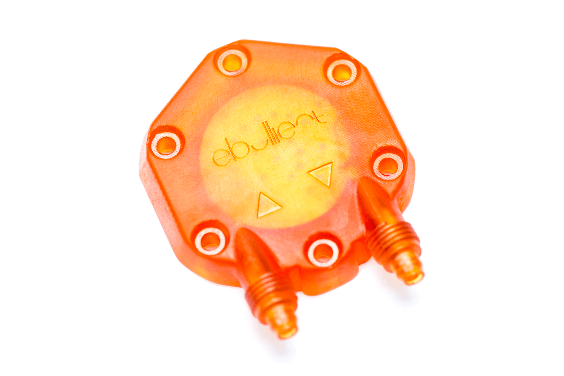
Ebullient processor cooling module made with CE 221
This Ebullient processor cooling module, made with CE 221, uses the resin to route coolant in an efficient manner, while holding up under elevated temperatures, inside servers and workstations. The strong material properties of CE 221 are said to be comparable to 14% glass-filled Nylon 6, with a 230°C heat deflection. The resin is stiff, with excellent thermal stability and chemical resistancel. Just like EPX 81, it comes in 375 mL cartridges, and as it is a two-part resin, needs to be mixed. This resin is the perfect choice for applications, such as under-the-hood components and electronics assemblies, that require long-term thermal stability. The combination of Carbon’s CLIP technology and CE 221 enables parts fabricate with this resin to have precision surface finish, as well as high-temperature resistance. Take a look at the video below to see how well it holds up under high temperatures:
As of its most recent funding round, Carbon has received $222 million in funding, and is working on speeding up production for global expansion. Discuss in the Carbon forum at 3DPB.com.
Subscribe to Our Email Newsletter
Stay up-to-date on all the latest news from the 3D printing industry and receive information and offers from third party vendors.
Print Services
Upload your 3D Models and get them printed quickly and efficiently.











You May Also Like
Orano Federal Services & UNC Charlotte Show How AM Could Cut Costs in Nuclear Energy Resurgence
Outside of the defense sector, few industries have been impacted by Russia’s ongoing occupation of Ukraine more than nuclear energy. The same appears to already be happening in response to...
HADDY’s Large-Format Robotic 3D Printing to Power Red Cat’s Drone Boat Production
In May 2025, Joris Peels, as is his custom, wrote a prescient article about Unmanned Surface Vehicles (USVs) and Unmanned Underwater Vehicles (UUVs), i.e., drone boats. Listing a multifaceted range...
EOS to Spotlight AI, Robotics, and Industrial Tooling at Hannover Messe
The US-Israel war on Iran is already catalyzing the sorts of major shifts to global supply chains that will effectively amount to permanent economic changes. In this context, the nations...
When Castings Take 18 Months: How 3D Printing Helped Fix the Soo Locks
This article is Part II of a two-part series on Lincoln Electric’s large-format metal additive manufacturing operations. In Part I, we looked at how Lincoln Electric built one of the...